
Introduction
Elizabeth Barrett Browning’s Aurora Leigh, published in 1856, stands as a landmark in Victorian literature—a sprawling verse novel that chronicles the life of its eponymous heroine, a young woman aspiring to become a poet in a society that constrains female ambition. Through epic blank verse, EBB explores themes of feminism, artistic integrity, social reform, and personal redemption, tackling issues like poverty, sexual exploitation, and the tension between love and independence, all wrapped up in an astonishing argument for the spiritually transformative effect of art. The work’s radical portrayal of a woman defying patriarchal norms to forge her own path resonates across generations, influencing countless writers who grapple with similar concerns.
We get no goodBy being ungenerous, even to a book,And calculating profits—so much helpBy so much reading. It is rather whenWe gloriously forget ourselves and plungeSoul-forward, headlong, into a book’s profound,Impassioned for its beauty and salt of truth—’Tis then we get the right good from a book.Aurora Leigh Book 1 lines 702-709
For a modern (male) reader, who is not practised in reading poetry, Aurora Leigh can be a daunting task. At 11 thousand lines Aurora Leigh is longer than the 12 books of Milton’s Paradise Lost, and the language used, although modern, frequently uses obscure words, and is densely packed with scriptural, classical and historical allusions. The text is set in contemporary Victorian England and Europe, but many of the social, political and artistic references would be known very few, non-specialists of the era, if very familiar to audiences when written. Why would I attempt this feat particularly when earlier this year I tried and failed to make sense of The Fairey Queene? Well, aside from my long-term goal of reading everything Rowling has admitted having read, shortly after The Ink Black Heart was published, J. K. Rowling told me (in so many words) to read it.
For this attempt, I was determined to be well armed. I firstly read, from cover to cover, Elizabeth Barrett Browning’s Aurora Leigh: A Reading Guide (2012) by Michele C. Martinez and published by Edinburgh University Press. My source text was the Oxford’s World Classics edition, edited in 1993 with lots of footnotes and definitions for obscure words. Lastly, I had a copy of the King James Bible handy as the scriptural footnotes give chapter and verse, but no quotations to make sense of the allusion.
To have our booksAppraised by love, associated with love,While we sit loveless! is it hard, you think?At least ’tis mournful. Fame, indeed, ’twas said,Means simply love. It was a man said that:And then, there’s love and love: the love of all(To risk in turn a woman’s paradox)Is but a small thing to the love of one.Aurora Leigh Book 5 lines 774-779
Did I need the preparation? Yes. But the poem is really very easy to get through. The readers guide helped a lot with background information. For example, the horrible plight of the seamstresses employed in English towns would have been too fantastical to be believed, if the Reader’s Guide hadn’t included the parliamentary report. The poem itself is self consciously chiastic (aside from the many chiastic stanzas):
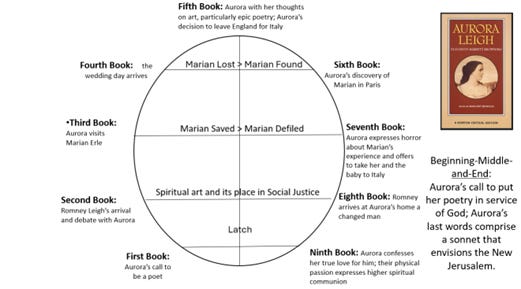
If the book can be said to have a philosophy, one that latches at the first and last books. And is the meaning in the middle of book 5, it is that art, in this case poetry, can have a transformative effect on the eternal souls of those that read it. This “non-liturgical sacred art” is one that John Granger has discussed for many years, and was the subject of his PhD thesis.
Thus is ArtSelf-magnified in magnifying a truthWhich, fully recognised, would change the worldAnd shift its morals.Aurora Leigh Book 7 lines 854-857
A passage in Aurora’s voice, repeated in books 2 and 8, lays plain the poet’s philosophy that social change and socialism cannot work without art/soul/God:
“You will not compass your poor endsOf barley-feeding and material ease,Without the poet’s individualismTo work your universal. It takes a soul,To move a body—it takes a high-souled man,To move the masses, even to a cleaner sty:It takes the ideal, to blow an inch insideThe dust of the actual: and your Fouriers failed,Because not poets enough to understandThat life develops from within.”Aurora Leigh Book 7 lines 427-436
Rowling’s Acknowledgement of Aurora Leigh’s Impact
J.K. Rowling has drawn from a rich tapestry of literary influences throughout her career, from Jane Austen’s wit to Charles Dickens’s social commentary. Rowling’s explicit acknowledgements, extensive use of epigraphs, and thematic parallels demonstrate how EBB’s epic shaped her narrative techniques and exploration of gender dynamics, abuse, and creativity.
Rowling has openly credited Aurora Leigh as a key literary touchstone in her creative process for the Strike series. In a live Q&A with the Barmy Book Army in October 2022, when asked if EBB’s poem served as the structural backdrop for The Ink Black Heart—similar to how Edmund Spenser’s The Faerie Queene underpinned Troubled Blood or Henrik Ibsen’s Rosmersholm informed Lethal White, Rowling enthusiastically affirmed the connection.
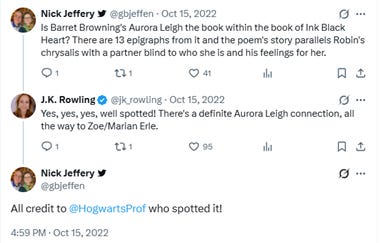
This confirmation underscores Aurora Leigh‘s role not merely as a source of quotes for the epigraphs but as a foundational template for the novel’s architecture.
Further evidence appears in her social media interactions. In a 2023 Twitter exchange, she described how her habit of selecting chapter epigraphs often leads her to immerse herself in beloved texts, admitting, “I get drawn in and 45 minutes later realise I’ve re-read half of Aurora Leigh and haven’t written a word of my own!”
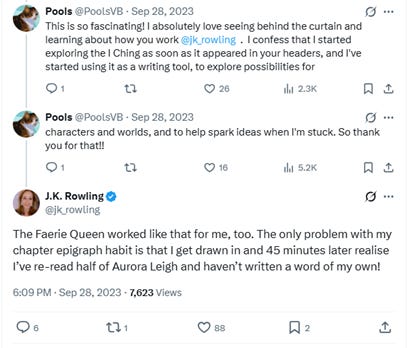
These public endorsements reveal an admiration, positioning Aurora Leigh as a catalyst for Rowling’s exploration of complex female experiences in her fiction.
The Prominent Use of Epigraphs in The Ink Black Heart
One of the most tangible manifestations of Aurora Leigh’s influence is Rowling’s incorporation of its verses as epigraphs in The Ink Black Heart. Out of the novel’s 107 chapters, fourteen feature excerpts from Barrett Browning’s poem—representing 13% of all poetic epigraphs and more than from any other single source.
This deliberate choice not only pays homage to the Victorian work but also weaves its essence into the fabric of Rowling’s narrative, using the quotes to foreshadow events, illuminate character motivations, and underscore thematic resonances.
For instance, the epigraph for Chapter 12—”I who should have known, Forereckoned mischief!” (book 4, lines 466-467)—mirrors protagonist Robin Ellacott’s guilt over failing to anticipate a tragedy, echoing Aurora’s self-reproach in the poem.
Similarly, Chapter 33’s lines about feeling “out of place” in an “Eden of delight” (book 4, lines 943-944) parallel the character Katya Upcott’s well-intentioned but harmful actions, drawing from Marian Erle’s realisation of her exclusion from a romantic ideal.
Other epigraphs, such as Chapter 47’s depiction of “blotched souls” spreading their “bad breath,” (book 4, lines 1060-1061) critique manipulative figures in the novel, aligning with Barrett Browning’s condemnation of societal hypocrites.
These selections are not arbitrary; they serve as interpretive keys, inviting readers to draw connections between the 19th-century verse and Rowling’s modern tale of online toxicity, anonymity, and justice.
Character Parallels and Inspirations
Beyond epigraphs, Aurora Leigh directly informs character development in The Ink Black Heart, with Rowling mapping Victorian archetypes onto her contemporary detectives and suspects. Robin Ellacott, the series’ co-lead and a determined private investigator, embodies elements of Aurora Leigh herself—a woman navigating personal growth amid professional ambitions.
Like Aurora, who rejects conventional marriage to pursue her art, Robin grapples with independence, often in tension with her partner Cormoran Strike, who remains “blind” to her feelings and value, much as Romney Leigh initially undervalues Aurora.
A more explicit parallel is Zoe Haigh, a vulnerable young woman in the novel, modelled after Marian Erle. Marian, a working-class girl exploited and abused, finds redemption through sisterhood and resilience; similarly, Zoe endures predatory relationships and societal stigma, her story highlighting themes of sexual violence and marginalisation.
This borrowing enriches Rowling’s portrayal of abuse survivors, infusing her thriller with EBB’s compassionate critique of class and gender inequities.
Thematic Resonances and Broader Literary Influence
Thematically, Aurora Leigh‘s focus on feminism, artistic creation, and social justice permeates The Ink Black Heart, reflecting Rowling’s evolving concerns. EBB’s epic challenges the silencing of women, advocating for alliances among them—a motif Rowling amplifies through Robin’s affecting “sisterhood” with figures like Zoe, amid a backdrop of online harassment and misogyny.
The poem’s Edenic imagery, symbolising lost innocence and corrupted ideals, mirrors the novel’s depiction of creative spaces like North Grove as paradises tainted by sin and exploitation. Romney Leigh’s socialist collective (termed a phalanstery from Fourier’s theories of collectivism) is destroyed when it is burned down, just North Grove is attempted to be burned. In Bronte’s Jane Eyre, Rochester is blinded in the fire that consumes his ancestral home, and in Romney Leigh is blinded in the fire that consumes his.
Aurora Leigh may have shaped Rowling’s approach to blending genre fiction with social commentary, enhancing her reputation as a versatile storyteller.
Conclusion
Elizabeth Barrett Browning’s Aurora Leigh exerts a profound influence on J.K. Rowling, most vividly manifested in The Ink Black Heart through epigraphs, character parallels, and thematic depth. Rowling’s acknowledgements reveal a deep personal engagement with the text, one that informs her writing process and enriches her narratives with Victorian insights into modern dilemmas. By integrating Barrett Browning’s feminist vision, Rowling not only honours a literary predecessor but also amplifies enduring questions about gender, creativity, and the soul.
Wow, this is wonderful! You've laid down the gauntlet for those of us attempting to be serious readers open to personal transformation that is profoundly good. Thank you and well done!
Bless you for writing this outside the literary walls of Victorian Studies!