
Nick Jeffery once again acted on my resolve to read C. S. Lewis’ Till We Have Faces before I did. His preliminary findings, too — a swing-for-the-fences look at the 1956 re-telling of the Cupid and Psyche myth to see if it is or is not the story template of the Rowling-Galbraith Cormoran Strike series! — shame me in their boldness and the speed with which he posted them to share my own.
I chose not to look for the correspondences between Lewis’ book and the individual Strike mysteries because Nick was already all over that and had shared his preliminary notes with me. I made notes in the margins of my paperback copy of Faces instead, marginalia markers about echoes I heard between CSL’s and JKR’s creative use of the Cupid and Psyche myth. I came up with seven points (of course).
Before jumping into that, though, I’m obliged to answer the question, “Why would readers of the Strike-Ellacott books want to read Till We Have Faces, with The Great Divorce probably the least known and appreciated part of Lewis’ fiction?” There are three reasons.
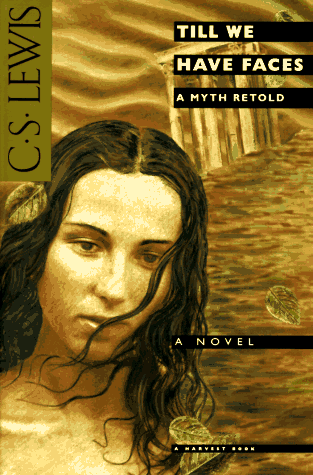
First, anything by C. S. Lewis rewards a close reading by any thoughtful person and lover of challenging modern writing (and, though Lewis is often dismissed as some kind of Christian dinosaur, he is thoroughly modern writer). Faces was his last fiction piece, he and Tolkien thought it was his best, and it is a catharsis inducing masterpiece, frankly, that makes a more than generous return on any time invested in it.
Second, despite Rowling’s several digs at Lewis near the end of Potter Mania’s peak around the publication of Deathly Hallows, it would be hard to exaggerate the hat-tips and references to CSL’s Narniad in the Hogwarts Saga. Rowling’s efforts to diminish if not dismiss that influence have to be read in tandem with her earlier effusion of admiration for Lewis and his work. Her Christmas Pig, I think, can be read as her attempt — her wonderfully successful attempt, by the way, at least with respect to accessibility and humor — to out-do Lewis’ The Great Divorce. Reading Lewisis a good idea for the Serious Striker, then, because its a decent bet based on the postmodern writer’s track record that the bibliographical inspiration or Lake aspect of her work might be found there.
Third, forget the Lake, Rowling’s Shed is filled with tools that Lewis used.
Literary alchemy? Read his Space Trilogy.
Ring composition? Every Chronicles of Narnia novel and Space Trilogy piece is chiastic.
Psychomachia or Soul-Allegory? Pilgrim’s Regress, Great Divorce, Till We Have Faces.
Genre Blend with Heavy Doses of Literary Allusion? Again, the Narniad and Space Trilogy.
Christian symbolism? If Lewis is known for anything, loved by his fans and despised by his detractors, it is because of his “smuggling the Gospel” into his stories, not-so-subtly and supremely subtly (see Planet Narnia for exposition of the latter).
And to the point today, use of Classical myth as a story launching pad and template. Serious Strikers know that the Strike-Ellacott series is up to its eyeballs in mythic backdrops; think of Leda and the Swan, Castor and Pollux, Tisiphone and Artemis, and, the only one confirmed by the author via tweet, Cupid and Psyche. Lewis’ Till We Have Faces is a re-telling of this exact myth.
It’s not a direct match by any means. Lewis’ adaptation is fairly straight-forward (well, relative to Rowling-Galbraith’s). He re-tells the Cupid and Psyche myth from the perspective of one of Psyche’s supposedly jealous sisters. It’s still set in a mythic time and in a pagan or pre-Christian Greece (or thereabouts). Rowling uses the myth, in contrast, as a near invisible back-drop or atmosphere that informs her story, a subtle deployment that wasn’t noticed by readers until its reveal in Troubled Blood and Ink Black Heart (a revelation that wasn’t accepted by fandom until Rowling’s tweet post Hallmarked Man).
Given the links connecting CSL and JKR, however, that Lewis wrote a Cupid and Psyche based novel when Rowling-Galbraith is writing one makes reading the one book a natural step for anyone wanting to understand better the series in progress.
Having made the case that reading Till We Have Faces is a reasonable venture for a Rowling Reader, what did I find on my first re-reading of the book in more than twenty years? I check the marginalia I scrawled in haste and find seven points of correspondence that confirm that reading Faces will help understand the artistry and meaning of Rowling-Galbraith’s latest.
Let’s start with the obvious and undeniable and work our way through the suggestive echoes to get to the more subtle and rich correspondences.
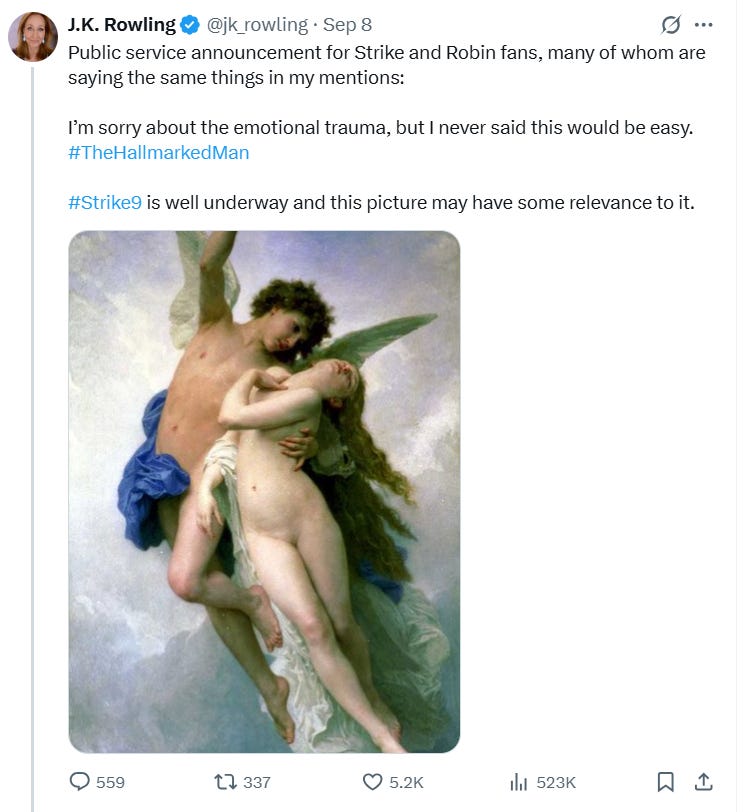
Cupid and Psyche retelling!
Lewis at the end of Faces adds a three page ‘Note’ in which, after condensing Apuleius’ version of the myth in four paragraphs, he writes:
The central alteration in my own version consists in making Psyche’s palace invisible to normal, mortal eyes — if “making” is not the wrong word for something which forced itself upon me, almost at my first reading of the story as the way it must have been. This change of course brings with it a more ambivalent motive and a different character for my heroine and finally modifies the whole quality of the tale…. Apuleius was of course a man of genius: but in relation to my work he is a “source,” not an “influence” nor a “model.”
Rowling, I think as likely as not, thinks of Lewis’ work, at least with respect to The Chronicles of Narnia and her Hogwarts Saga. I have searched unsuccessfully for the interview in which Rowling describes Lewis as a “genius;” it is clear in her post 2005 comments that she does not want others to think of him as her exemplar or defining influence.
Having noted that, even without the tweeted picture of Psyche Ascendant, the importance of the Cupid and Psyche myth in Rowling-Galbraith’s Cormoran Strike series is not that difficult to spot for those aware of the author’s penchant for writing her works over mythological templates. Charlotte Campbell is modelled on Venus or Aphrodite, Strike as Ares, Haephestus, and Cupid, Robin the Psychologist-in-Formation plays the long-suffering Psyche, and in Troubled Blood we have the critical light-and-knife scene from the myth reinvented or re-envisioned in the Agency office late night Robin-Strike meeting post American Bar battle with Carl ‘Hermes’ Oakden.
Artemis and Aphrodite
I’ve written at some length about the importance of Jonathan Wace figuratively pinning an ‘Artemis’ nametag onto Robin’s jersey in The Running Grave. As evil as the man is, it is clear that Rowling is speaking through his lips and into the ears of her readers that ‘get’ her love of Classical mythology. It was, with the aside Robin makes in the same book about her bout of chlamydia post rape, the critical pointer to the oncoming plot point of Robin being sterile without IVF or surrogacy. Robin’s insecurity vis a vis Charlotte Campbell, her boss’ long time lover and out of this world venereal beauty, not to mention Strike’s attraction to both, is easily read as an Artemis-Aphrodite conflict, internal and external.
In Till We Have Faces’ ‘turn’ or pivotal chapter — chapter 13 in a twenty-five chapter book has twelve chapters before and after it making it the story-pivot — Orual the heroine discusses with her mentor ‘The Fox’ what she is to do about her half-sister Psyche who has survived exposure on the Gray Mountain and living in a grove on its far side. Their discussion and Orual’s decision about how to rescue the seemingly deluded Psyche informs the rest of Lewis’ retelling of the myth, why the invisibility of the Palace or Orual’s denial of seeing it is so important to his reimagined story.
The Fox says to Orual in his surety that Psyche is out of her mind, a victim of PTSD if you will, and in need of rescue describes his love for the girl this way:
There’s one part love in your heart {orual}, and five parts anger, and seven parts pride. The gods know I love Psyche, too, And you know it; you know I love her as well as you do. It’s a bitter grief that our child — our very Artemis and Aphrodite all in one — should live a beggar’s life and lie in a beggar’s arms. (148)
Too much is easily made of this, I understand. For close readers of Rowling’s work, however, it is a jarring thing, I submit, to encounter at the heart of another novel the principal goddesses of the Strike series embedded mythology, the two whose opposition largely define the interior and exterior story conflict of Strike and Ellacott, even if only as just an aside.
In Pursuit of ‘The Real’
Readers of Hogwarts Professor posts and those who listen to our podcast conversations are familiar with the Golden Thread running through everything Rowling writes, the importance of grasping ‘The Real.’
She writes about it explicitly in finale of the scene she “waited seventeen years to write,” the key to unlocking Harry Potter, namely, Dumbledore’s last words to Harry at the other-worldly King’s Cross in Deathly Hallows.
She turns that scene on its head in Troubled Blood in Strike’s conversation with Robin about astrology during which he shares his nominalist and materialist, so-called “fact based” view of reality, i.e., “None of it is real, is it?” (p 242).
In Christmas Pig, the Blue Bunny sees through Jack’s disguise as a lost toy and declares, “Your a boy,” he whispered. “You’re real.” That discovery and his sacrificial decision to be Jack and CP’s “decoy” leads immediately to his being found by Jeannie in the garden.
As I wrote about this in ‘Christmas Pig 5: The Blue Bunny,’ there are few scenes more important than this for ‘getting’ at the heart of Rowling’s meaning and artistry:
The Bunny’s simple declaration, “You’re real,” i.e., “from Up There,” the greater reality of the Land of the Living in which Things have their awakening in the love of their owners, clarifies these other usages. Dumbledore shares his wisdom with Harry that the maternal love which saved him, first at Godric’s Hollow and then in the Forest, is the metaphysical sub-stance beneath, behind, and within all other reality. Strike gives Robin a dose of his skeptical ignorance and nominalist first principle that nothing is real but surface appearance subject to measurement and physical sensation, mental grasp of all things being consequent to that.
Christmas Pig‘s “real” moment acts as a key to these others, one evident in the Bunny’s response to the revelation of Jack’s greater ontological status. He does a Dobby, offering to die for Jack as Jack has done in his descent into the Land of the Lost for DP, a surrender of self to near certain death in being given to the Loser he considers an “honor.” He acts spontaneously and selflessly as a “decoy,” a saving replacement in other words, for the “living boy” as Dobby did for the “Boy Who Lived.” The pathetic distraction that saved the DP rescue mission in Mislaid despite himself, crying out in desperation for his own existence, has metamorphized consequent to his experience with Broken Angel and in Jack’s example, into a heroic decoy that allows Jack and CP to enter the City of the Missed.
The Blue Bunny makes out better than the House-elf, too, and this is the key event of the book and the best evidence since the death of Lily Potter, Harry’s defeat of Quirrell, and the demise of the Dark Lord that mother’s love is Rowling’s default symbolism for Christian love in her writing. The Bunny’s choice to act as decoy, his decision to die to his ego-self, generates the life saving appearance of maternal love and its equivalent in the transference attachment a child feels for a beloved toy. The Johannine quality of the light that shines down on him from the Finding Hole and his Elijah-esque elevation nails down the Logos-love correspondence.
If you want a more recent example of ‘The Real’ theme in Rowling’s work, check out Hallmarked Man’s finale in its Part Ten and Epilogue. It is only when Tyler Powell becomes “real” to Strike as he enters Ian Griffith’s home to find Sapphire that he becomes the young man in that shared identity/identification and avenges his crucifixion in the Silver Vault. Similarly, Robin’s agony at Strike’s profession of love on the Agency spiral staircase is because she cannot believe it is “real,” or, worse, that she cannot yet trust in its reality.
In the same pivotal chapter of Till We Have Faces that we hear The Fox note that Psyche is simultaneously Artemis and Aphrodite, Lewis has Orual ask her mentor as Harry asked Dumbledore about how to recognize what is Real:
“You think, then, [Psyche]’s mad for certain?”
He darted a quick glance at me. “Why, daughter, what then have you been thinking?”
“You’ll call it folly, I suppose. But you weren’t with her, Grandfather. She talked so calmly. There was nothing disordered in her speech. She could laugh merrily. Her glance wasn’t wild. If I’d had my eyes shut, I would have believed her palace as real as this.”
“But, your eyes being open, you saw no such thing.”
“You don’t think — not possibly — not as a mere hundredth chance — there might be things that are real though we can’t see them?… Are there no things — I mean things — but what we see?” (141, emphasis in original)
Note that Orual does not answer The Fox’s question. While in the grove, Orual does see something if only fleetingly, hence her question. She asked Bardia, a man of devotional faith and wariness about the gods, immediately after meeting with Psyche:
“Then you think there really was a palace in the valley though I couldn’t see it?”
“I don’t well know what’s really, when it comes to houses of gods.” (135, emphasis in original)
Lewis’ treatment of the myth includes a theme close to Rowling’s heart, the nature of the Real and our capacity to know it.
The Hidden Nature of Divinity
As Nick and I discussed in our recent conversation about a Jungian understanding of Literary Alchemy, it seems likely that Rowling is aware of both the low-ceilinged psychological understanding of the human soul or ‘mind,’ the predominant view of the postmodern West, and the traditional view that includes super-conscious reality, a spiritual dimension for which every human being is designed to enter and experience. She said in her 2008 interview with Adeel Amini that the dialogue between Harry and Dumbledore at the mythic King’s Cross was written to foster a “debate” within and among her readers about its reality. The point to be debated: Is there an after-life or was this ‘just in Harry’s head’?
Rowling’s other comments in the Amini interview as well as textual evidence in the Potter and Strike series make it fairly clear that Rowling believes in the survival of the soul after death, a point she made explicitly in her Cruz interview, also 2008. The Christian symbolism and content of the Hogwarts Saga which has said was always “obvious” to her suggests, too, that she is at least nominally a Christian.
Her most recent comments about her beliefs in God’s existence, however, point to a person for whom the “debate” is still very much a live issue. “I’ve struggled with religious faith since my mid-teens. I appear to have a God-shaped vacuum inside of me but I never seem quite able to make up my mind what to do about it.” That and her description of The Lake as “mysterious source of inspiration, ability to tap into something in the universal psyche that animates the best stories,” shows her interior psychologist debater is alive and well.
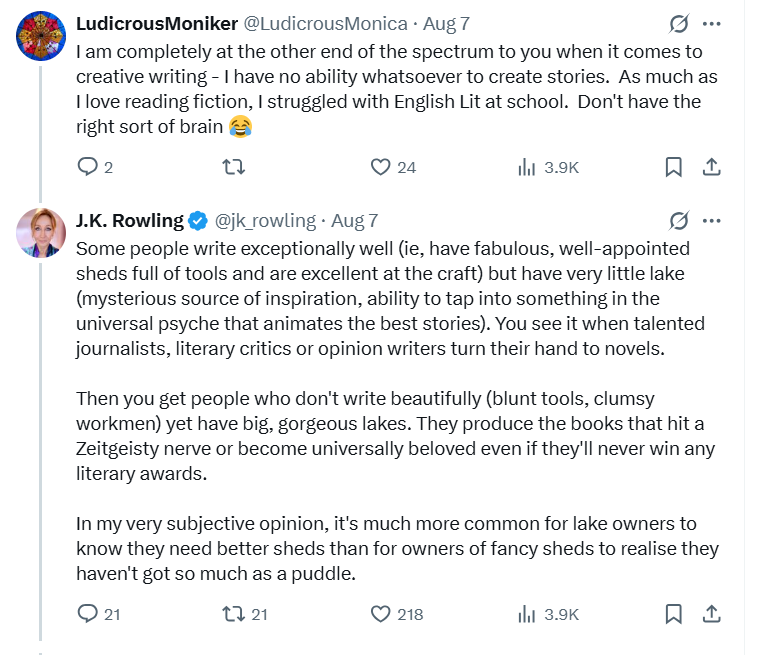
Rowling wants her readers to share in her theological discomfort, to feel the conflict between a life spent in denial of the “God-shaped vacuum” within us and one that pursues the means to commune with that self-transcending Reality. Whence the traditional Shed tools that constitute her signature craftsmanship as a writer: the alchemy, the soul-allegory, the ring composition, the Christian symbolism and “archetypal” characters. You don’t use the tools of theocentric literature unless your ends are to write transformative story or at least to highlight the tension between understanding the human being as an ‘individual’ and as a ‘person.’
Rowling’s debate is mirrored in C. S. Lewis’ work and especially in the novel he thought was the capstone of all his efforts in fiction, Till We Have Faces. Michael Ward writes about this in the conclusion of his magisterial work Planet Narnia on how best to understand the seven Chronicles, that is, a work in which the invisibility of “God’s unperceived ubiquity and propinquity” becomes, if not visible, then something obvious and which we experience imaginatively.
[Lewis] was wanting to portray symbolically [in the Narniad] the human predicament that he had portrayed conceptually in Miracles. There he had written:
“The fact which is in one respect the most obvious and primary fact, and through which alone you have access to all the other facts may be precisely the one that is most easily forgotten – forgotten not because it is so remote or abstruse but because it is so near and so obvious. And that is exactly how the Supernatural has been forgotten.”
Miracles uses a variety of images to symbolise this natural human forgetfulness, including transparent windows, native grammar, and breathing. When we see a window-pane, rather than seeing through it, it is probably because it is dirty; when we consciously have to make verbs agree with nouns it is because we are speaking a foreign language; and when we become aware of the noise of our breathing it is because of illness or over-exertion. Clean windows, mother tongues, and healthy lungs do not draw attention to themselves: they work best when they are noticed least. As a result we can quite easily overlook them and act as if they were of not importance. Lewis quotes Aristotle to the same effect: ‘For as bat’s eyes are to daylight so is our intellectual eye to those truths which are, in their own nature, the most obvious of all.’
And it is not just in Miracles, but throughout his writings, that Lewis points out this natural human tendency to be oblivious to the obvious.
In Mere Christianity he writes: ‘Since that [divine] power, if it exists, would not be one of the observed facts but a reality which makes them, no mere observation of the facts can find it.’
In The Problem of Pain he writes: ‘You may reply, as a Christian, that God (and Satan) do, in fact, affect my consciousness in this direct way without signs of “externality.” Yes: and the result is that most people remain ignorant of the existence of both.’
In Letters to Malcolm he writes: ‘We may ignore, but we can nowhere evade, the presence of God. The world is crowded with Him. He walks everywhere incognito.’
In ‘The Weight of Glory’ he declares that, ‘In [the Christian] Christ vere latitat - the glorifier and the glorified, Glory Himself – is truly hidden.’
And in what he regarded as his best work, Till We Have Faces, he has Orual complain, ‘nothing that’s beautiful hides its face. Nothing that’s honest hides its name.’
Of course, she is utterly wrong. Kallistos Ware suggests that the leitmotif of Till We Have Faces ‘is the hiddenness of the Divine,’ and this judgement may be equally well applied to Lewis’s general theological vision: he is continually preoccupied with God’s unperceived ubiquity and propinquity.
Correlatively, the major feature of his spirituality is the exercising of Enjoyment consciousness in order to experience that hidden divinity. Coming to know God, for Lewis, is not like ‘learning a subject’ but like ‘breathing a new atmosphere,’ and it is of the highest significance that the word ‘atmosphere’, which is his preferred term for the kappa element in romance, should also serve for his description of the nature of the Christian life. As a story’s inner meaning is cryptic, so, Lewis believes, is one’s spiritual state. (226-228)
The agony of Orual in Faces, her complaint against the gods, is that they do not give enough clues to solve the mystery or “riddle” as she calls it of their existence and our right relationship with the numinous and noetic. In the summary of her first draft case against the Olympians she wrote:
How could any mortal have known of that palace at all? That much of the truth they had dropped into someone’s mind, in a dream, or an oracle, or however they do such things. That much; and wiped clean out the very meaning, the pith, the central knot of the whole tale.
Do I not do well to write a book against them, telling them what they have kept hidden? Never, sitting on my judgement seat, had I caught a false witness in a more cunning half-truth. For if the true story had been like their story, no riddle would have been set me; there would have been no guessing and no guessing wrong.
More than that, it’s a story belonging to a different world, a world in which the gods show themselves clearly and don’t torment men with glimpses, nor unveil to one what they hide from another, nor ask you to believe what contradicts your eyes and ears and nose and tongues and fingers.
In such a world (is thee such? it’s not ours for certain) I would have walked aright. The gods themselves would have have been able to find no fault in me. (243-244)
The remaining four chapters of Faces are the gods’ response to Orual.
If Rowling did not pick up this theme — the debate defining human behavior and understanding, the human “riddle” — from CSL’s work in general or from Faces specifically, it certainly is one she shares with the Oxford don.
The Story Structure
As noted, Lewis splits Till We Have Faces into two Parts of unequal length. The first Part is twenty-one chapters long and is the first person narration of Orual, the half-sister of Psyche, who shapes her story as a complaint against the gods. She is moved to this effort after encountering a temple in the woods dedicated to Psyche as a goddess, in which shrine the story has been twisted so Orual’s part in it is that of a jealous sister. The second part is only four chapters long, but Orual’s experience in them reshapes our understanding of everything we thought we knew from the first twenty-one.
The great mystery of Hallmarked Man is how to understand it. The consensus in Strike fandom according to one writer is that it is undeniably the worst of the series, a book so bad that re-reading it only improves appreciation of it marginally. Our contention at Hogwarts Professor, in contrast, beginning soon after our first reading (see here and here) and continuing with ‘Why Hallmarked Man is the Best Cormoran Strike Novel and Will Be Considered the Key to Unlocking the Series Mysteries,’ is just the opposite. What separates how Nick and I understand Strike 8 from the perspective of other Serious Strikers online?
In a word, ‘Structure.’
I don’t mean that other readers of Rowling’s fiction don’t grasp the importance of structure in her work. If anything, at least one of them has focused almost her energies into grasping the series structure before we have all its parts. None of them have done the work in exploring the rings-within-rings of Hallmarked Man that we have done here as a group project, but that’s not the principal difference in understanding between the readers of the Strike novels about structure.
The great divide is about how to understand the last three books of the series. The great majority of readers believe it is best grasped as the eighth book in the series and in the same way we understood the first seven, i.e., as a stand-alone mystery with a cast of characters specific to that mystery we won’t meet again. Read this way, of course, the great crowd of characters in Hallmarked Man is a dog’s mess and borderline incomprehensible even on second and third readings.
Nick and I think it’s a mistake to read the series as a whole and Hallmarked Man specifically this way. The series, as I first suggested after my ring-within-rings reading of Running Grave, is best understood as a seven book series a la Harry Potter — which it echoes in playful fashion book-by-book and in structure — followed by a trilogy in which Rowling reveals all that we missed or just misunderstood in the septology.
Something akin to the two Parts of Till We Have Faces? Exactly like that.
Hallmarked Man if read as the set up for great reveals about the deaths of Leda Strike and Charlotte Campbell, about Strike’s self-understanding and his Nancarrow family, and Robin’s vocation and spiritual life is a brilliant book. If not, well, it’s a book that doesn’t make any sense. It’s as if you read Harry Potter and the Half-Blood Prince and choose to overlook how it works as set-up to Deathly Hallows.
I could be wrong about this, of course. But I’m going to bet on Rowling as brilliant author rather than on her writing a “bad book,” the “worst of the series,” as she nears the finish line. Till We Have Faces suggests that’s where the smart money is wagered.
The Meaning of ‘Faces’
I think the debate embedded in the Strike series, as mentioned, is between understanding the Robin Ellacott and Cormoran Strike relationship (a) psychologically, which is to say, as an allegory of the masculine and feminine aspects of a person joining in a process of “individuation” per the Jungian ideas of anima and animus, or (b) spiritually, the anagogical depiction of the human soul and Spirit as man and woman, both seeking apotheosis in their conjunction (cf., Shakespeare’s comedies, Romeo and Juliet, Antony and Cleopatra, Cymbeline, and Spenser’s Una and Red Crosse Knight in Faerie Queene). Unlike the “debate” at King’s Cross, Rowling has written the Strike series so both perspectives are seriously represented.
I doubt the psychological perspective will lack for advocates as it is the default position of thinking people today, alas, even among Christians. I have chosen to champion the traditional or Perennialist view, as you’d expect, though I have been obliged to make the Jungian argument when readers of that perspective fall down on the job (e.g. ‘Troubled Blood: A Jungian Reading’).
If this were a C. S. Lewis substack page, I’d be tempted to discuss here his thoughts on modern psychology, especially about the differences he seemed to perceive between the perspectives and conclusions of Freud and Jung. His relative sympathy for Jung’s ideas I think are in play in Till We Have Faces. Certainly Orual manifests her animus as Queen of Glume and only “becomes” Psyche when her veil is removed and she reads her complaint before the gods and all witnesses.
Having noted that, though, it is safe to assume that Lewis, who worked for more than three decades on writing Till We Have Faces, chose its title carefully (his publishers refused his preferred title, Bareface, because it sounded like a Western). And ‘Faces’ is a loaded word theologically as Lewis certainly knew.
The Greek word for ‘face’ is their word for ‘person:’ πρόσωπον, prosópon, which means literally “what is opposite to the eyes [of the other],” or “facing another person.” Today the word ‘person’ is English is considered synonymous with ‘individual.’ In Classical and Biblical Greek, however (πρόσωπον occurs seventy seven times in the New Testament), you are only a ‘person’ insomuch as you have relationships with other person. Aristotle wrote in the Politics that a man who lives outside the city walls, the community, is either a god or a monster, not a human being; the Greek word for the person who understood themselves as an ‘individual,’ someone of indivisible reality independent of all others, confirming Aristotle’s view was the rule not the exception, was ἰδιώτης idiōtēs, from which we get the word ‘idiot’ and, arguably, ‘hideous.’
The idea of ‘person’ understood as an antonym rather than synonym for ‘individual’ is critical in Christian theology and specifically soteriology, how one achieves salvation, both because of the Trine God being three persons (here Hypostases) and because no one is saved as an individual, only in community and as a person. [This isn’t the place for that conversation but if you want to explore it a good beginning poinr is this rather challenging piece by a Greek Orthodox Metropolitan of blessed memory, Person and Personality in Orthodox Teaching: Concerning the Concept of a “Personal Lord and Savior.”]
Lewis’ view, as you’d expect aligns with the traditional Christian understanding of ‘Face’ and ‘Person,’ though Rill We Have Faces certainly can be read through a Jungian lens. That fails in the end because it is because Orual thinks as an individual that she is unable to see the logos position, the third way between Bardia’s devotional faith and the Fox’s religious skepticism, which explains why she was able to catch a glimpse of Psyche’s palace.
And Cormoran and Robin? The reason that Spenser and Shakespeare depicted soul and Spirit as two persons, male and female, was because the allegorical union of soul and Spirit is not a process of “individuation,” a psycho-spirituality without transpersonal faculties or realities. It takes at least two to represent soul and Other, the “facing” of person-hood. I choose to think that Rowling, unlike Angela Carter in her Jungian alchemical novel, gets that.
Eros-Anteros
Last February, Nick Jeffery and I sat down to create via conversation a Valentine’s Day Special: The Cupid and Psyche Myth within the Cormoran Strike Series, the subtitle of which post was ‘[Reading the Myth] as Both a Series Template and Traditional Delivery System for the Fundamental Choice in Human Existence, Eros vs Anteros.’
The Eros/Anteros distinction has been part of the Hogwarts Professor conversation since 2021’s ‘Mythological Key to Cormoran Strike: The Myth of Eros, Psyche, and Venus.’ In that remarkable piece, if I say so myself, I explained that the Two Cupids were a touchstone in scholarship about Edmund Spenser’s Faerie Queene, to include C. S. Lewis’ Spenser’s Images of Life. The ‘False Cupid’ is the Eros of “amorous desire” or carnal passion. The True Cupid or Anteros is the God of Agape or selfless, sacrificial love.
Here is the most relevant part of that discussion:
None of the Spenserian epigraphs chosen for Troubled Blood refer to Venus or Cupid which is a shame. As C. S. Lewis remarks in Spenser’s Images of Life, “the mythology of Cupid and Venus is one of the central interests of the poem” (19); Lewis devotes the better part of his book on Faerie Queen, in fact, to discussion of its treatment of Cupid and “the false Cupid.” Thomas Hyde in his ‘Cupid’ entry for The Spenser Encyclopedia concurs: “The god of love, or more precisely, of amorous desire, appears in Spenser’s poetry more often and in greater variety than any other god or goddess” (201). Hyde thinks the two Cupids evident in Faerie Queen are aspects of the one god in his carnal and spiritual aspects, a “coherent mythology” as well as a “poetic theology of love.” “In fact, Spenser persistently relates human erotic impulses to the heavenly love that created and sustains the universe” (ibid.).
But two Cupids there are, in Faerie Queen and in Cormoran Strike. We’re struck by this in the story because it begins in Cuckoo’s Calling with Robin’s recall of Matthew’s proposal the night before beneath the statue of Cupid on top of the Shaftesbury Memorial Fountain in Piccadilly Circus. Robin thinks on her way to Strike’s office in Chapter 1 of her time “under the statue of Eros” and that “she loved Eros.”
Robin “loves Eros” because she thinks the statue above the fountain is Cupid, the god of love. As Joanne Gray has pointed out, however, it is not; the figure looking out over Piccadilly Square is not Eros but Anteros, the god of reciprocal and reciprocated love. Robin is thinking about her romantic love with her childhood sweetheart in the first paragraphs of the first chapter of the first book and is on her way to meet the man with whom she now seems will have a truly complementary and integral, reciprocal love, Cormoran Strike. Moments later, the Peg-legged PI makes his appearance as Cupid in the drama of Eros and Psyche.
Unlike Psyche climbing the mountain to her death, marriage to the inhuman monster foretold by the Oracle, Robin has a suitor in hand. Very much like Psyche, though, she is about to enter the mad world of Venus. Robin just misses being run over by Charlotte Campbell, our Aphrodite, as she exits the Denmark Street street entrance; they meet face to face, “missing contact by a centimeter,” and Robin is astonished by the woman’s beauty and “exhilarated” appearance (13).
Strike here takes the role of Cupid in the myth head-on. Eros was charged by Venus, you recall, to throw Psyche from the peak of the mountain; instead, he rescues her from the precipice, falls in love with her, and takes her to a secret, magical place apart from the world, hiding himself from her vision. Strike, in pursuit of Charlotte, knocks Robin off the top of the “lethal staircase” and she was “catapulted backwards, handbag flying, arms windmilling” (14) to her almost certain death.
But he does not kill her. He saves her. “He seized a fistful of cloth and flesh” and
a second shriek of pain echoed around the stone walls and then, with a wrench and a tussle, he had succeeded in dragging the girl back on to firm ground. Her shrieks were still echoing off the walls, and he realized that he himself had bellowed, “Jesus Christ!” (15).
The God of Love, Spenser’s “heavenly love that created and sustains the universe,” is named by the story stand-in for the mythological Cupid, spiritual god of love. And the myth-love-story of Robin and Cormoran has its start.
As in the myth, their first contact is physical, even sexual (he grabs her, you’ll recall, by “a substantial part of her left breast,” the part just above her heart). The office is their secret sanctuary. Strike, in emotional and financial free fall because of Charlotte’s madness, immediately hides himself from Robin in his inner office and, until Troubled Blood at least, conceals his history and feelings from her so she cannot know who he is. [End ‘Mythological Key’ excerpt]
As Nick and I explored in our Valentine’s Day Special earlier this year, the Eros/Anteros distinction permeates every aspect of the Strike-Ellacott relationship; not seeing how their love for one another differs from their carnal relationships with other men and women as lust differs from the sacrificial love of Christ for every person, is, to risk hyperbole, really to miss the power and genius of Rowling’s psychomachian allegory. Of course we all experience it even if we don’t consciously see it, being as Ward puts it “oblivious to the obvious,” but its The Real aspect of the series. Hence Strike’s first words to Robin are “Jesus Christ!’
And of course the distinction between Eros and Anteros is in Till We Have Faces. Owen Barfield, Lewis’ most challenging friend, once wrote that everything Lewis thought was in anything he wrote; in his re-imagining of the Cupid and Psyche myth, you’d be right to assume that the Eros of the story would be the True rather than the False Cupid. It’s not in-your-face the way Aslan-as-Christ can be in the Chronicles of Narnia, but the appearance of Eros to Orual in chapter 15 as “the God of the Mountain” in voice and appearance is the Incarnate Word of God, the Light of the World (170-175).
Conclusion
There’s a lot more that can be said about why reading Till We Have Faces may be the single best book to read to understand the profundities and allegorical genius of both C. S. Lewis and Joanne Rowling Murray; I’m filing my name notes for my conversation with Nick on this subject. Having said that, though, I realize I’ve already said a lot. “a lot more” will have to wait on your reading or re-reading Faces and letting me know what you think of these seven points.
Look for my conversation with Nick in your inbox tomorrow! Thank you as always for reading these exegetical essays and for sharing your thoughts in the comment boxes below.
I'll be able to pick up Till We Have Faces tomorrow but in the meantime I've been really enjoying this read! Your point about Wace being evil and yet also able to see Artemis in Robin reminds me of Balaam, a Gentile prophet representing a false god, but the one true God of Israel still uses Balaam to thwart a foreign king’s desire to curse Israel. (Numbers 22) Balaam’s donkey reminds me of your point about reality because she sees the angel of the Lord (who Balaam can't see) on the path to get to that king, and the donkey talks!! “What have I done to you that you have struck me 3 times?” Balaam complains that the donkey made a mockery of him (kind of like Fox making a mockery of Orual’s “one part love… 5 parts anger and 7 parts pride”). But the donkey counters “Am I not your donkey on which you've ridden all your life? Have I ever been accustomed to do so to you?” Gotta wonder just how “real” that is… At any rate Balaam doesn't curse Israel, even though sorely tempted to do so. This also reminds me of the question the Professor asks Peter and Susan when they approach him concerned about Lucy's story about meeting Tumnus in Narnia when she hid in the wardrobe during a game of hide and seek: “How do you know your sister's story is not true?” And when they mention Edmund's comment about pretending, the Professor asks “does your experience lead you to regard your brother or your sister as the more reliable… more truthful?” The Professor laments that the children aren't taught logic (logos!) in school. It's one of my (many) favorite bits in the Narniad.
I also really appreciate your point about the hiddeness of God, that Rowling wants readers to share in her theological discomfort. The way you pointed out that “person” and “individual” are antonyms, not synonyms, is a whole new concept for me, but it makes so much sense! As to the structure, oh my goodness, the hidden structure, felt, but not immediately seen… Your comment that the second part of TWHF being relatively short and that Orual’s experience in them reshapes the reader's understanding of everything “we thought we knew” from the first part read like it was in neon lights. THM most oft repeated phrase, anyone??? That's as far as I got because my ability to do anything but laugh signaled a break was due, lol!
Wow a lot to chew over… this one is going to take a couple of reads to absorb everything I think!
It would be hard to really understand Lewis work without reading Exo33-34 and 2 Cor 3 I think.
I do like your point about the structure. Rowling loves the twist and the shift in our view of Orual’s love that happens in the second part is very Rowling. I’m also seeing correspondences with the idea of possessive love - with Robin’s relationships to Matthew and Murphy (who seek to control in order to protect) contrasted to Strike (who admits he can’t control but still has to work out how to protect).