

(Credit: BBC)
Katya Slonenko is a Serious Striker who posts at the r/CormoranStrike reddit page. I wrote about her ‘Shanker John Ricci’ theory here last week in a post called Dementia, Jewelry, and a Nine Inch Cock: The Mystery of Shanker’s ‘Old Man,’ His Given Name, and Why He’s Never Killed Jeff Whittaker. If you think that Rowling-Galbraith has been writing the Strike novels in playful parallel with her Harry Potter novels, you’ll find in the evidence Katya presents there — that Shanker is Nico ‘Mucky’ Ricci’s illegitimate son — a simultaneous proof that Strike’s Dark Side mate is a Severus Snape stand-in.
Katya has written up other great ideas about the series on the Cormoran Strike reddit page. Some of my favorites after a few days catching up with her writing since 2021 are Leda Had Another Child Before Strike, Longcasters and Legards, Leda’s Eggs and Robin’s Eggs, Cultural Allusions in Rokeby’s Flat, and Frozen Peas are a Frozen Eggs Metaphor. These relatively brief posts are all bold, text-based, explosive devices that either turn your thinking in a different direction than the author has been pushing us or reveals new depths to the series’ artistry and meaning. It’s good writing and thinking — and it’s fun, all reddit style.
The one Katya theory I felt I had to share with you, though, before Nick Jeffery and I talk next month with Ms Slonenko about her work is what she has written about tattoos in the Strike series. She’s written about them twice, first in late 2020 and again in 2023, both times to explore the meaning of Leda ‘Peggy Nancarrow’ Strike’s ‘Mistress of the Salmon Salt’ inking. Her theory about how Rowling uses tattoos that her Strellacott characters have been assigned doesn’t include any of the tatts in Hallmarked Man but the hypothesis holds up, as we’ll see.
I confess to being embarrassed, for reasons that will become obvious, that I didn’t take a closer look at the character tattoos in the Strike series, especially after reading Katya’s first post and writing about it in 2021. Katya, who asks to be referred to in these posts by her given name, has the advantage on all of us in one regard with respect to the meaning and importance of ink art; in addition to being a Serious Striker Order of Merit, First Class, multiple winner, Katya makes her living as a tattoo artist in Amsterdam.
Before going into some detail about what she noted concerning tattoos in the Strike series, I’m obliged to note that the older posts do not necessarily represent her current thinking on the subject. As she wrote to me last week:
About the “Mistress,” I last updated the theory in 2023, and since then, I have to confess, I drifted away from it. I chose to believe that Leda was on the Greater Good side of events. So there’s that. I am still certain that the tattoo will come up again, and will be excited to hear your opinion and the opinions of your readers; I’m just not prepared to defend this theory beyond what I’ve already written - I changed my mind! :D
We’ll be exploring her current tattoo ideas on our podcast conversation with her. of course.
This post comes in three parts:
The textual appearances of the ‘Mistress of the Salmon Salt’ tattoo in Career of Evil with my notes;
Katya’s review of the tattoos in the Cormoran Strike series and what each tells us about the character who has it; and
Katya’s ideas about Leda Strike’s ‘Mistress of the Salmon Salt’ tattoo specifically and about its placement.
All three will come with my commentary with special emphasis on how tattoo interpretation fits into Rowling’s exteriorization principle and her texts-inside-texts Shed Golden Thread, but, really, all the heavy lifting was done in Katya’s reddit posts at r/Cormoran Strike.
(Credit: BBC)
Leda Strike’s “Obsession Really” with Blue Oyster Cult and Other Career of Evil ‘Mistress of the Salmon Salt’ Notes
The reader first learns about Strike’s familiarity with the Blue Oyster Cult song in the meeting with Metropolitan police officers Wardle and Ekwensi after Robin received a leg at the Agency’s front door in Career of Evil:
Wardle took the polythene-covered note and scanned it, frowning.
“It’s gibberish,” he said, then read aloud: “‘A harvest of limbs, of arms and of legs, of necks—’”
“‘—that turn like swans,’” interrupted Strike, who was leaning against the cooker and too far away to read the note, “‘as if inclined to gasp or pray.’”
The other three stared at him.
“They’re lyrics,” said Strike. Robin did not like the expression on his face. She could tell that the words meant something to him, something bad. With what looked like an effort, he elucidated: “From the last verse of ‘Mistress of the Salmon Salt.’ By Blue Öyster Cult.”
Detective Sergeant Ekwensi raised finely penciled eyebrows. (Career of Evil, ch 3)
Strike shares with Robin in their pub debrief later how he came to a memorized knowledge of the song and to his familiarity with the band, namely, through his mother Leda’s “obsession” with Blue Öyster Cult:
“Aren’t you even going to tell me,” Robin asked, after several more minutes’ silence, “what your connection with that song is?”
He chewed for a while, drank more beer, ordered another pint of Doom Bar then said, “My mother had the title tattooed on her.”
He did not fancy telling Robin exactly where the tattoo had been. He preferred not to think about that. However, he was mellowing with food and drink: Robin had never showed prurient interest in his past and he supposed she was justified in a request for information today.
“It was her favorite song. Blue Öyster Cult were her favorite band. Well, ‘favorite’ is an understatement. Obsession, really.”
“Her favorite wasn’t the Deadbeats?” asked Robin, without thinking. Strike’s father was the lead singer of the Deadbeats. They had never discussed him, either.
“No,” said Strike, managing a half-smile. “Old Jonny came a poor second with Leda. She wanted Eric Bloom, lead singer of Blue Öyster Cult, but she never got him. One of the very few who got away.”
Robin was not sure what to say. She had wondered before what it felt like to have your mother’s epic sexual history online for anybody to see. Strike’s fresh pint arrived and he took a swig before continuing.
“I was nearly christened Eric Bloom Strike,” he said and Robin choked on her water. He laughed as she coughed into a napkin. “Let’s face it, Cormoran’s not much bloody better. Cormoran Blue—”
“Blue?”
“Blue Öyster Cult, aren’t you listening?”
“God,” said Robin. “You keep that quiet.”
“Wouldn’t you?”
“What does it mean, ‘Mistress of the Salmon Salt’?”
“Search me. Their lyrics are insane. Science fiction. Crazy stuff.”
A voice in his head: She wanted to die. She was the quicklime girl.
He drank more beer.
“I don’t think I’ve ever heard any Blue Öyster Cult,” said Robin.
“Yeah, you have,” Strike contradicted her. “‘Don’t Fear the Reaper.’”
“Don’t—what?”
“It was a monster hit for them. ‘Don’t Fear the Reaper.’”
“Oh, I—I see.” (Career of Evil, ch 4)
Strike doesn’t share “exactly where the tattoo had been” on Leda’s body. He balks at looking it up online himself later, but Robin’s curiosity gets the better of her:
After sitting in thought for several more minutes, and with a sense that she was somehow betraying her boss, Robin typed Leda Strike into the search box and then, feeling guiltier than ever, naked.
The picture was black and white. The young Leda posed with her arms over her head, a long cloud of dark hair falling down over her breasts. Even in the thumbnail version, Robin could make out an arch of curly script set above the dark triangle of pubic hair. Squinting slightly, as though rendering the image a little fuzzy somehow mitigated her actions, Robin brought up the full-sized picture. She did not want to have to zoom in and nor did she need to. The words Mistress of were clearly legible.
The bathroom fan whirred into life next door. With a guilty start, Robin shut down the page she had been viewing. Matthew had lately developed a habit of borrowing her laptop and a few weeks previously she had caught him reading her emails to Strike. With this in mind, she reopened the web page, cleared her browsing history, brought up her settings and, after a moment’s consideration, changed her password to DontFearTheReaper. That would scupper him. (Career of Evil, ch 6)
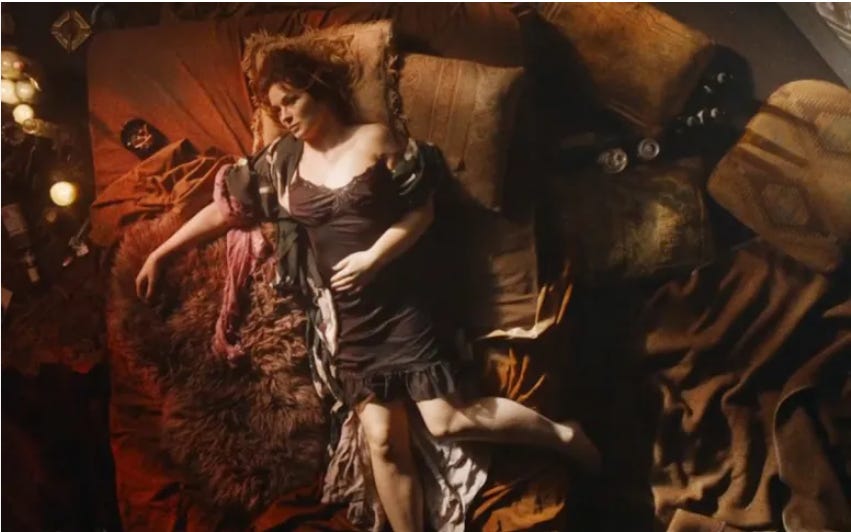
The producers of the BBC teevee adaptation of the novels elected to go PG on their picture of this tattoo (above). Strike several chapters later reflects on the “voice in his head” he had heard talking about a “Quicklime Girl” in his pub talk with Robin. It turns out to have been the voice of his step-father, Jeff Whittaker, whom Strike remembers testifying in court about his mother’s death:
[Whittaker’s] voice had cracked melodramatically and he broke into dry sobs. Counsel for the defense hastened to ask whether he needed to take a moment.
It was then that Whittaker had shaken his head bravely and offered his gnomic pronouncement on Leda’s death:
“She wanted to die. She was the quicklime girl.”
Nobody else had understood the reference at the time, perhaps only Strike who had heard the song so many times through his childhood and adolescence. Whittaker was quoting from “Mistress of the Salmon Salt.”
He had walked free. The medical evidence supported the view that Leda had not been a habitual heroin user, but her reputation was against her. She had done plenty of other drugs. She was an infamous party girl. To the men in curled wigs whose job it was to classify violent deaths, it seemed wholly in character that she would die on a dirty mattress in pursuit of pleasure her mundane life could not give her. (Career of Evil, ch 10)
We get one more mention of Leda’s telling tattoo in Strike’s brief search of Donny Laing’s apartment before their climactic confrontation in Career:
The bulb was out in the only bedroom. Strike turned on the small torch he had brought with him and advanced slowly towards the only piece of furniture, a cheap pine wardrobe. The door creaked as he opened it.
The interior was plastered with articles from the newspapers about the Shacklewell Ripper. Taped above all of them was a picture that had been printed on a piece of A4 paper, possibly from the internet. Strike’s young mother, naked, arms over her head, her long cloud of dark hair not quite covering her breasts proudly displayed, an arch of curly script clearly visible over the dark triangle of pubic hair: Mistress of the Salmon Salt.
He looked down at the floor of the wardrobe where a pile of hard-core pornography sat beside a black bin bag. Putting the torch under his arm, Strike opened the latter with his latex-gloved hands. Inside was a small selection of women’s underclothing, some of it stiff with old brown blood. At the very bottom of the bag his fingers closed on a fine chain and a hoop earring. A heart-shaped harp charm glinted in the light of his torch. There was a trace of dry blood on the hoop. (Career of Evil, ch 61)
Rowling-Galbraith in Career of Evil repeatedly makes the lyric tattooed just above Leda Strike’s pudenda the object of her characters’ and her readers’ reflection. This intentional and pointed repetition reflects intentional artistry which in turn makes it a point for interpretation; what does it mean? To get this specific tattoo’s meaning, though, we need to grasp what tattoos in general mean in Cormoran Strike. Enter Katya Slonenko.
What Tattoos Mean in Cormoran Strike
From Katya’s 2023 ‘Mistress of the Salmon Salt Revisited:’
I hear you asking - why can’t Leda’s be just a tattoo, without any deeper meaning to it? That’s because all the other tattoos in the Strike books have meaning and provide a clue to their wearers’ characters.
Here are some examples:
Kelsey Pratt’s One Direction tattoo is an obvious link to her being a One Direction fan. (How Leda’s tattoo is different? She chose the name of the particular song, not the more generic name of the band, to be tattooed on her)
Laing’s rose pierced with a dagger bluntly means violence to women. Rose is a woman in the language of symbols, while the dagger is… well, a dagger.
Polworth’s St Piran’s cross means he’s a Cornish patriot. I’ll be surprised if it also doesn’t mark him as The Hanged Man (a symbolic bearer of a cross)
Portia Bayliss’s trident refers to her Caribbean roots
Edie had a small black heart on the knuckles because she was the creator of ‘The Ink Black Heart’ cartoon.
Zoe’s tattoos are of ‘The Ink Black Heart’ characters she identifies with.
Pez Pierce has The Beatles quote around his neck - Strawberry Fields was (is?) a place in Liverpool.
Union Jack, a skull, and a Nordic “Chaos” rune give a good impression of what the Turisaz character will be about (all tattooed on visible spots like head or neck - he wears them proudly!);
Same with Algiz and Uruz, sans the Union Jack and the skull.
Noli Seymour’s tattoo stands for “Golden Prophet”. It denotes her connection to the Universal Humanitarian Church and her status there as the current Golden Prophet.
An ace of spades was inked onto his left cheek, and a tattooed tiger covered his throat. - Jordan Reaney’s tattoos are pretty telling, too.
Not a character, but still - JK herself has a tattoo, “Solve et Coagula”, which means - “I’m a writer of an alchemical detective series!” :D
So you see, all these tattoos are chosen to reflect their owners’ personal histories. That’s generally a feature of Rowling’s writing: if she describes a character, every little detail works for the portrait she wants to paint. There are no details put there “just because” - everything is important. How the characters dress and speak, what they eat and drink, what music they listen to, and what tattoos they have tell us something about the character.
What does Leda’s tattoo contribute to her portrait?
Nothing!
In Career of Evil, when we learn of its existence, the tattoo adds literally nothing to Leda’s portrait. Why is it mentioned in the story to which it makes zero contribution, except for serving as a plot device enabling the killer’s obsession?
Because it will be important later.
I mentioned above that I was embarrassed that I hadn’t seen the importance of tattoos in the Strike series before reading Katya’s posts on Leda’s ‘Mistress of the Salmon Salt’ posts. I went all palm-to-forehead because tattoos are a combination of two of Rowling’s essential principles as an intentional artist.

(Credit: BBC)
The first of the two principles wrapped up in Rowling’s Strellacott Series ink-work is exteriorization.
I first encountered the word ‘exteriorizing’ or ‘externalization’ used with respect to Rowling’s work in Beatrice Groves’ seminal Literary Allusion in Harry Potter (112), who cites Klaus’ 2012 ‘A Fairy-tale Crew? J.K. Rowling’s Characters Under Scrutiny’ in Hallet’s J.K. Rowling: Harry Potter (New Casebooks) (26-27) for the idea, who in turn credits Kullman’s 2008 Englische Kinder-und Jugendliteratur: Eine Einfuhring (164) as her source. [See Groves’ 2019 essay on Fantastic Beasts for more on this.]
This is not, in short, John’s little hobby horse but a ‘given’ of Potter Punditry and Rowling Studies.
As I wrote up in my examination of Rowling’s The Christmas Pig as an extra-liturgical sacred art per the traditionalist reading, Perennialists understand sacred art as the work of an artisan who uses traditional forms in his work to imitate nature’s “methods of operations” rather than created nature itself. This artifact is the exteriorizing of the artisan’s inner essence or logos in conformity to the inspired or revealed forms of the Logos, the Creative Principle within that creates everything existent, visible and invisible.
‘Exteriorization’ of interior psychological conditions in this manner is what Rowling does best, frankly. It is the principle of allegory, frankly, alieni-loquium, ‘one thing standing for another,’ that informs Rowling’s literary alchemy, psychomachia, and mythological templates, i.e., making visible in story the invisible qualities and transformation of the soul. The reader of her workers is engaged in that transformative experience via imaginative identification with the character in chrysalis and consequent catharsis.
Take Harry Potter. Rowling populates her Hogwarts stories with magical items and creatures that “exteriorize” psychological phenomenon.
The exteriorizing of interior psychic states is most obvious in the various magical objects and creatures designed for just this purpose in Rowling’s ‘Wizarding World.’
The Mirror of Erised reflects the person’s “heart’s desire” rather than their image.
The boggart when confronted turns into the worse fears of anyone it meets.
Howlers are letters which explode with the anger of the person writing.
The Sorting Hat identifies the primary quality of every new student’s soul and proclaims it to the student body as the name of a Hogwarts House.
Dumbledore’s Pensieve creates three dimensional experience of a memory and the MACUSA Death Pool similarly projects the doomed convict’s happy memories into the lethal black waters.
The Room of Requirement changes into whatever space the person in need must have, be it a bathroom, an ever expanding secret headquarters for a resistance movement, or a dump for unwanted objects.
Each “externalisation of psychological phenomenon” creates “comprehensible, physical forms” of “complex emotions” and soul capacities (Groves 2017, 112, citing Klaus 26-7, citing Kullman 164).
Rowling is highlighting psychological interior elements, in other words, her characters’ fears, desires, repressed emotions, for her readers to look for in character behavior and language in addition to what can be seen in her exteriorizing devices. In Harry Potter, the Fantastic Beasts films, in Christmas Pig, and in the Strike-Ellacott mysteries, Rowling is writing allegorical drama of the soul’s journey to perfection or damnation, a match with the Martin Ling’s model for interpreting Shakespeare as sacred literary art (see the ‘Traditional Theory of Literature’ posts for Paid Subscribers for much more on this).
Tattoo interpretation as Katya Slonenko explains it is another example of Rowling-Galbraith exteriorization artistry. Being tattooed, because of its visibility and permanence, is by definition ‘message sending’ of the person tattooed understanding of themselves to others, even if the message is only “I am the kind of person who thinks body art is really neat.” In Rowling-World, however, the message in those characters with only one tattoo is their exteriorization or projection of what that person is about, a visible key to their psychological self-understanding.
As Katya points out, Rowling’s tattoo, ‘Solve et Coagula’ on the wrist of her writing hand, conforms to this exteriorizing principle. What is the key to understanding Rowling according to Rowling per her only visible tattoo? I read it to say:
“I write stories and live my life in order to advance the alchemical transformation in myself and readers as much as possible from the unconscious, historical, and psychological individuals we all are largely due to accident-of-birth and lived experience into ego-transcendent, intentionally spiritual, and loving persons transcending circumstances. Solve et Coagula means ‘I dissolve my unconscious existence and self understanding to recongeal myself as a more deliberate and consciously integrated image of the God Who is Love’.”
More mundanely, it might just mean, “I was crushed by life events and recovered via counseling, reflection, and deliberate choices.” It could even be a subtle reference to choices that changed her life from which she is recovering still.
What, though, does she think her tattoo means?
No idea! I’m confident that will be revealed only in the authorized biography rumor says is in the works or in the autobiography to be published after her death. [See my post about why Rowling went public with this tattoo just before she blew up Potter fandom’s idolization of her by supporting Maya Forstater for more on her hermetic self-understanding and exteriorization in ink.]
The second of the two principles that tattoos represent in the Strike series is Rowling’s penchant of providing texts-within-texts for readers to interpret alongside the story characters reading the interior narrative.
As I’ve written elsewhere, Rowling is a writer who writes about the experience of reading.
Every book and screenplay we have had from her to date has had, first, embedded texts which characters struggle to come to terms with and, more important, both good guys and bad guys create narratives they want others to believe in order to manipulate or trap them.
In Harry Potter, the two types of texts vary book to book, Chocolate Frog Card to Beedle the Bard, with the Prophecy linking Voldemort and the Boy Who Lived the ur-text behind the overall story. Dumbledore and the Dark Lord are the master manipulators through story-telling; think of how Tom Riddle, Jr., uses the Diary in Chamber to convince Harry that Hagrid is the Heir of Slytherin and dreams in Phoenix to get him to the Department of Mysteries — and Dumbledore’s use of select memories in the Pensieve in Prince to frame Harry’s understanding as the Headmaster wants it for Hallows. See Guest Post: David Martin reveals the Role of Books in the Hogwarts Saga for a full review.
In Strike, it is implicitly the false narrative created by the murderer to prevent detection of his or her crime. Explicitly, though, the books are crammed with other books and writing, fiction and real world non-fiction, e.g., Strike 2’s Bombyx Mori, Talbot’s True Book’s puzzle-pictures and Astrology 14 in Troubled Blood, ‘The Ink Black Heart’ cartoon in Ink Black Heart, and the Legend of Hiram Abiff and various Masonic texts in The Hallmarked Man.
Rowling’s dramas are protagonists and antagonists simultaneously dealing and dueling with stories just as we are struggling alongside them to figure out what the external creator of these internal authors and readers is doing.
I think it hard to overstate how important this is to grasping Rowling’s artistry and meaning; the goal of her story-telling is to foster greater reader ‘penetration,’ not only, not even especially while reading but in how we see and think after what we’ve experienced as serious readers. We are meant to learn from our decoding and deciphering the dueling narratives and to realize again and again that like the characters we were deceived and need to be more attentive and less gullible in future. She achieves this transformed vision in her readers through a variety of fascinating traditional tools, from literary alchemy to ring composition, but always by providing us with a mirror within the story we are reading both of characters trying to understand a text and white and black hats writing a story to deceive them.
And tattoos?
Rowling puts tattoos on her imaginary characters’ flesh as written texts, words or pictogram images, for her characters and her readers to interpret, to penetrate, in order to understand the person beneath the ink.
So, what does ‘Mistress of the Salmon Salt’ mean, in itself and in its placement just above Leda Strike’s pudenda?
The ‘Mistress of the Salmon Salt’ Tattoo
In late 2020, Katya thought that Leda Strike was saying, “If you can read this, you’re in danger of being murdered.” For her full exegesis, see ‘Why did Leda have a “Mistress of the salmon salt” tattoo? Because she was the quicklime girl. And what’s that?’
In Career of Evil, we learn that Leda Strike had “Mistress of the Salmon Salt” tattooed on her lower belly. Of course, Blue Oyster Cult was her favourite band, but why choose this particular song? What did it mean to her? What sort of a unique connection does it have with her life and death?
She provides a definition for ‘quicklime’ and its historical use:
What is quicklime, in case you wonder? (I did). Quicklime is another name for calcium oxide, a compound made by the thermal decomposition of limestone. And limestone is that thing white cliffs of Cornwall is made of. Could that connect Leda to her Cornish roots? Not likely, if you ask me. Leda hated her roots. She ran away from home young, changing her Cornish name and never going back to stay.
Could the tattoo be a metaphor for her transformation then? From limestone to quicklime through some sort of thermal decomposition? That sounds more plausible. I catch a whiff of Rowling-esque alchemy here. :D Was “Mistress of the Salmon Salt” Leda’s “Solve et Coagula”? Maybe.
That, of course, if we presume that Leda got the tattoo because “she was the quicklime girl”. Whittaker probably thought so, but did Leda herself? After all, she didn’t get “Quicklime girl” written (which would be shorter and less painful! :D). Was that simply because “mistress” sounds better and more empowering than “girl”?
Or, could it mean something deeper and more sinister? That is what we learn from Wikipedia about the use of the quicklime:
Disposal of corpses: Historically, it was believed that quicklime was efficacious in accelerating the decomposition of corpses. This was quite mistaken, and the application of quicklime can even promote preservation; although it can help eradicate the stench of decomposition, which may have led people to suppose it was the actual flesh which had been consumed.
Katya then shares links to the lyrics of the ‘Salmon Salt’ song and how Blue Oyster Cult fans understand the song:
And even more disturbing [than the ‘disposal of corpses’ use of quicklime,] there is a general opinion among the Blue Oyster Cult fans what the “Mistress of the Salmon Salt” lyrics is all about:
Its lyrics describe a woman, implied to be a prostitute, who murders soldiers on shore leave.
WHHHAT?!
Yep. Lots of comments in different corners of the Internet share this view:
This song is not the peaceful pastoral idyll about gardening and the cycles of life that the lyrics and upbeat folky tune suggest at first listening. It concerns a female serial killer who disposes of men in quicklime after having sex with them. The Quicklime Girl is something of a monster to be feared. (here)
Blue Oyster Cult was Leda Strike’s favorite band, and Mistress of the Salmon Salt was her favorite song. She liked the song so much she listened to it time and again and even got the title tattooed on her. What was in the song that resonated with Leda?... There is a general agreement around the internet (1, 2, 3) that Mistress of the Salmon Salt is a song about a serial killer.
You can read the lyrics here or listen to the song here. It’s very metaphorical, but all in all, the lyrics go about a woman who lures her victims with sex and kills them “on the shore”. Leda, the true fan of Blue Oyster Cult, must’ve known that - and J K Rowling, a cunning author who puts a lot of research into her source material, certainly does! Then why, god, WHY, did they (the author and the character) choose the title of that particular song as Leda’s tattoo?..
… What does it say about Leda? What made her relate to the Mistress of the Salmon Salt? This song must have felt truly about her (even if not actually dedicated to her).
Could it be that the life of Leda Strike presents even more mysteries than her death? Is it possible that Strike’s future cathartic revelation would not only include the answer to the question “who killed Leda?” but more to the - “who she really was?”
As I wrote in 2021 after learning about Katya’s post, the message of ‘Mistress of the Salmon Salts’ seems to be ‘Beware!’
The accepted interpretation of the Blue Oyster Cult lyrics according to the sources Katya shares is that the Quick Lime Girl was a prostitute-murderer who preyed on Coast Guard sailors on shore leave, i.e., those who paid for sex with her became corpses buried under quicklime in the Salmon Salts of Long Island.
It’s hard to read that as anything other than a warning, no? As Janice Beattie shares at the end of Troubled Blood, “Actions have consequences.”
More to the point, the ‘Beware!’ message is placed where it is for a specific audience.
The distinguishing characteristic of the tattoo is its placement. Pretty unusual, no, to put a tattoo where she did? It has a pretty limited audience, namely, those who see her in the nude, and, forgive me, those who might have their eyes at that level, not just looking at but with their eyes in her pudenda.
The obvious interpretation of the tattoo is that Leda was sending a coded message (’Don’t say I didn’t warn you!’) to her lovers that sex with her, if only for pleasure or exploitation, came at a high price for, even the life of the offender.
“Screw this woman and you’ll be screwed royally, fucker” seems a likely interpretation. “Don’t Fuck With Me” would be the bumper sticker abbreviation.
So What?
The tattoo and the repetition by Whittaker of the lyric repeatedly at his trial, not to mention Donny Laing’s sharing it with Robin and Cormoran in the message he sent with the severed leg (he knows it was her tattoo only via images online) mean that Rowling-Galbraith wants us to think and think again about this lyric.
We have it’s obvious meaning and for whom it was meant. What are we supposed to make of that?
My first guess was that Whittaker only figured out the tattoo’s meaning after Leda’s suicide put him in the Dock for murder at the Old Bailey. He believed that she committed suicide in the way she did because she knew the police and her family and friends would think he did it and lock him up for years, maybe decades. “She was the Quicklime Girl” to Whittaker meant, “Damn! Screwing with her and her kids has meant my death...”
This is significant evidence that Whittaker did not kill Leda himself but that he believed she did top herself to pre-empt and punish him for threatening to kill her or their son.
It is not evidence that Leda actually did kill herself. The murder could have been staged by anyone wanting Leda dead or wanting to frame Whittaker or both. We have good reason via Katya’s close reading of Shanker’s past to think that he and the Riccis are somehow involved. But Whittaker’s quoting of the pudenda lyric line in the Dock suggests strongly that in her death he believed Leda had turned the tables on him the way the Quicklime Girl did those Coast Guard sailors.
In Mistress of the Salmon Salt revisited (2023), Katya reviewed why we’re almost sure to get an answer to the mystery of this inked text before the series closes:
If you’re about to argue that Leda’s story is done and will never be returned to, consider this:
In a mystery series about a detective striving for justice, a huge unsolved mystery is announced right in the first book. The injustice of that mystery haunts the main hero in every book. Personally, I’d find it very disappointing if it was left untied.
Nearly all other books feature a storyline from the past that nobody expected to be solved, but that was solved. (Charlie Bristow’s murder, pushing Elspeth Kerr to kill herself, the horse mystery in LW, Margo Bamborough, Daiyu). Deep in the past is not a problem.
Nearly all the other cases proved to have a personal connection to Strike’s life: Charlie was his classmate; he took Leonora’s case because he was sorry for the girl with a missing father; the killer in CoE was obsessed with Strike himself; Margo disappeared in 1974 - the year Strike was born; he investigated his ex’s ex-husband; then the cult that grew on top of the community he spent his worst time in… There must be a case even more personal to Strike’s than these - and what it can be if not Leda’s murder, which’s already been hanging there since book 1?..
No suicide in this series is a simple suicide. Nobody has attempted to kill themselves without coercion or bullying (Elspeth Kerr, Rhiannon Winn, Edie, Gigi Cazanove, Alex Graves, Cherie), or, more often than not, suicides turn out to be murders. (Charlie Bristow, Lula Laundry, Rochelle Onifade, Dowthwait’s girlfriend, Jasper Chiswell). It makes me highly doubt that Leda killed herself - and Charlotte, too….
Unlike now, it was much less common for a woman in the 80s or 90s to get a tattoo with her favorite band’s lyrics. Consider societal pressure (no self-respecting woman had visible tattoos, even among rock stars, back then) and a much narrower choice of hygienic tattoo shops to walk into. So, Leda must’ve put a significant effort into getting this (one and only as far as we know) tattoo - and Rowling certainly did in choosing a suitable lyric for her!
Katya then reviewed the “main points” of the extended reddit conversation about the meaning of Leda’s ‘Mistress of the Salmon Salt’ tattoo consequent to her first post:
The post I made three years ago sparked a fascinating discussion, and we covered a lot of possibilities there. I suggest you read it yourself, but here are the main points:
Who did Leda kill? We don’t know. :D (Dave Polworth’s father was on the table once, but their timelines didn’t match).
How did she kill them? The song suggests she was offering them sex before killing.
What did she do with corpses? We actually have a good idea about that! “She was the quicklime girl“. Quicklime is used to decompose corpses chemically and is available in abundance in Cornwall.
Why would Leda be killing anyone? Means before motive, but we slid right into discussing motives of course! :D Revenge to abusers, general “badness”, and possible mental illness were mentioned.
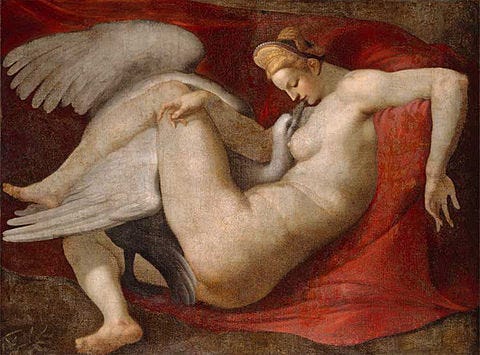
Greek myth exploration: the name “Leda“ suggests that Leda Strike was a survivor of sexual abuse; otherwise, why naming her Leda, do you know any real person with that name? Me neither.
Zeus raped mythological Leda in the guise of a swan. A theme of disguise and its importance for the Strike series. Rapists disguising himself as something else (a gorilla mask comes to mind).
Mythological Leda is the mother of four people responsible for the start of the Trojan War: Castor and Pollux, Helena and Clytemnestra. Leda Strike was a mother of Strike, Lucy, Switch, and Shanker - which one of those is Helena, you decide, but I personally vote for Strike. 😀
Finally, who killed Leda and why? We have no idea, but it must be someone already introduced. Uncle Ted, Lucy, Shanker, Rokeby, Gillespie? The possibilities and reasoning are covered in the comments there.
Do you want to discuss any of these subjects? Do you have any theories or ideas, or maybe just want to express your disbelief and anger? :D Anyways, it would bring me joy if we could continue discussing Leda as a killer again!
As noted above, Katya no longer thinks Leda was a serial killer.
Of all these points, there are three I want to explore here briefly before opening the floor to your comments.
Leda was confessing to her lovers in the tattoo as much as warning them that she as ‘Quicklime Girl’ was a murderer, even a serial killer, i.e., that her lovers were somehow cursed, doomed to die for entering these gates;
Everything that Rowling has written about Leda Strike, nee Peggy Nancarrow, has been positive. Well, Aunt Joan didn’t like her much and daughter Lucy certainly wasn’t a fan, but everyone else seems to have thought of her as troubled, yes, but funny, intelligent, beautiful, and loving. Not a great mother perhaps by conventional measures, but a woman who cared for her children as well as her mental condition and inherent instability allowed.
Which is why the tattoo of a lyric about a Jacqueline the Ripper, a prostitute who murders her Johns, over her pubic hair is so jarring. Her seemingly benign nature and the ‘Mistress’ message conjoined raises the possibility that she felt guilty or responsible for the misfortune that happened to men who had sex with her.
Which suggests further -
that ‘Leda’ chose that name because she was the victim of sexual abuse by a person of godlike authority in her life, rape that resulted in pregnancy, maybe more than once, which abuse and pregnancy, the tattoo reports, ended in murder that no one knows about;
The Golden Thread of incest that runs through Rowling’s work and which was highlighted in The Hallmarked Man’s Decima-Rupert-Lion plotline has raised the possibility that either Leda was the fruit of incest between her mother and her much older brother Ted or that she was sexually abused by her father Trevik (or both). If Trevik’s abuse included rape that resulted in pregnancy, the murders implicit to the tattoo’s message and consequent to that crime could be Ted’s killing Trevik, Leda’s terminating the pregnancy, or, again, both.
Which House of Horrors would explain a lot.
Leda’s choice of names,
her identification with the ‘Mistress of the Salmon Salt’ lyrics,
her mental instability and internal conflicts about sex and marriage,
her love of her living children (and refusal to murder them in utero),
her succubine lifestyle qua ‘groupie,’ and
her decision to flee Cornwall as soon as she was of age.
I suspect readers find this speculation sobering, disgusting, or a reflection more of my issues than real story possibilities. Fair enough! There’s a big ick factor in incest, combining as it most often does rape with child abuse, I get it.
But Rowling goes there as often as not — and Sophocles and Freud think she’s talking about fundamental issues beneath human tragedies when she weaves incest into her dramas. It’s not just me.
Finally, the idea of ‘rape in disguise’ linking Leda with her swan to Robin with her gorilla-masked rapist.
Ed Shardlow wrote on the Hogwarts Professor Moderator Backchannels last week that there had to be something in the coincidence of ‘Mistress of the Salmon Salts’ and ‘Maid of the Silver Sea’ beyond their initials (though MOTSS has a fascinating history which may be a Rowling inside joke for her LGB friends and fans). Is Rowling trying to link the characters connected with those titles?
Leda Strike is the obvious candidate for ‘Mistress of the Salmon Salt.’ She labeled herself with that tag literally and indelibly.
Which Strike character best qualifies for Maid of the Silver Sea’s Nance Harmon? If you haven’t read the story, Beatrice Groves gave this thumb-nail sketch of the character before the publication of Hallmarked Man:
Sark’s silver proves elusive [in the Oxenham story], but in the novel it is replaced by a woman – Nance – who is worth her weight in gold: ‘he would give all the silver in the mines of Sark to win her appreciation and regard’ (Chap 7); ‘Gard, as he watched her, felt like a discoverer of hidden treasure, overwhelmed and intoxicated with the wonder of unexpected riches. He had come to this wild little land of Sark after silver, and he said to himself that he had found a pearl beyond price’ (Chap 11). Nance is the true treasure of Sark – the prize of Gard’s life: ‘and, if he had incurred unreasonable dislike, he had also lighted on the virgin lode of Nance’s love and trust, and that, he said to himself with a glow of gratitude, outweighed all else’ (Chap 20). The phrase ‘virgin lode’ connects Nance (the ‘maid’ of the title) with silver mining via a metaphor of metal as ‘virgin.’ This is a word used for metal ‘of great purity, esp. occurring naturally in an uncombined state’ (The Oxford English Dictionary). But ‘virgin lode’ is not a general mining term – rather it is a specific reference to Gard’s Cornish roots. It recalls the Cornish mines of West Wheal Virgin and Wheal Virgin, and the seam (or ‘virgin lode’) which was the most important and lucrative find of those mines: ‘the most important lode was Virgin Lode which was stopped or over 1.3 miles (2.1 km).’ Gard unconsciously connects Nance with his Cornish roots, just as Strike’s first thoughts on falling for Robin connect her with Trevaylor Woods and his Cornish childhood.

(Credit: BBC/Sam Taylor)
Robin Ellacott is our best bet for the Strike series’ ‘Maid of the Silver Sea.’
Is Rowling suggesting in having these MOTSS tags on both Leda and Robin that ‘all men marry their mothers’ per folk wisdom and Freudian psychology, that Strike senses a common element in the life of his mum and his business partner?
If so, then the odds on Leda Strike having been raped by a man in disguise (perhaps a man who was not what he seemed to be to others, her father Trevik?) as Robin was by the gorilla-man, go way up. The two women would have in common their more or less successful struggle to recover from that violation and regain a life not defined in large part by that assault.
Hat doffed once again to Katya Slonenko and the Serious Strikers at r/Cormoran Strike for spying the importance of Leda Strike’s ‘Mistress of the Salmon Salts’ tattoo and their exegetical efforts to explain it! I look forward to reading what the Hogwarts Professor All Pros make of Katya’s idea and my glosses on her work — have at it in the comment boxes below.
I am not on Reddit so I really appreciate Katya's analysis being shared here. I thoroughly enjoyed this meaty article with her insights. How much this enriches my experience of the series!
I'm not a regular reader of the Strike Reddit mostly due to many of the contributors failing to use what's actually available to us in the eight books to support what is, for the most part, a great deal of conjecture.
Case in point, Laing's original tattoo is just a yellow rose.
"Strike remembered his opponent’s small black eyes and his bristle cut, which was the dark red of fox fur. A tattoo of a yellow rose spanned the length of his left forearm." Ch 15 CoE
His tattoo refers to the emblem of Melrose rugby club, for whom he played as a Jnr until they, "kicked him out. No discipline." Ch 16 CoE
After which the pitch was "carved up".
When Strike see's Laing's photo on the 'fund raising' page, the tattoo has had an addition.
"He was wearing a yellow T-shirt and on his right forearm was the rose tattoo, which had undergone a modification: a dagger now ran through it, and drops of blood fell out of the flower towards the wrist." Ch 28
The knife through the rose representing the death of his past, the hometown and family that rejected him, drove him away.
The rugby tattoo link is an important clue and one of the ways JKR links each Leg Sending Suspect / killer. CoE starts with a rugby match - one which contributes to Robin & Matthew's relationship breakdown - and each of Strike's Leg Sending Suspects plays or has played rugby.