
This is the fifth in a series of posts for Hogwarts Professor Paid Subscribers that introduces the Perennialist interpretation of fiction via a book by Ray Livingston titled The Traditional Theory of Literature (University of Minnesota Press, 1962). I have sent out three and one half chapters thus far in single posts — Prologue, Man, Society, and Art, The Creative Process, and The Work of Art, Part One — and, beginning with Chapter IV, the last three chapters may be sent out as two posts due to their length.
In this second half of Livingston’s chapter on what constitutes a traditional literary work of art, he explains via Coomaraswamy that (1) the artisan should deploy the tricks of the trade, his “literary devices” or “ornaments,” that create anagogical narrative and self-transcending experience; (2) that the work should be beautiful as it must be if it accurately reflects his intention to write archetypal story, and (3) that the artist and his work will have an individual style necessarily but only so that his audience might have access to imaginative experience not restricted to the age in which he and his audience live.
As he puts it in the chapter conclusion:
[A Traditional work of literature] should be ornamented or furnished with those literary devices that enhance its efficacy as a means to knowledge.
It should be beautiful, as it will be if it has been well and truly made. Beauty as the attractive power of perfection relates to the cognitive power. A work approaches perfection to the degree that it expresses or imitates adequately the conception of it in the artist’s intellect.
Last, a Traditional work of literature will have a style. This style, which is a personal thing only accidentally, is conceived as a means to accommodating knowledge to the condition of those for whom the work was made, but without distortion or radical misrepresentation of that knowledge.
As always, this chapter from The Traditional Theory of Literature is reading that both requires significant effort and generously rewards all the time given to understanding it.
I found this chapter especially meaningful because of the questions that Serious Strikers who are familiar with Rowling’s traditional tools — her use of chiastic structures and parallelism, literary alchemy, soul allegories (psychomachia), Christian symbolism, and mythic templates — should be asking themselves. Namely, how do we best understand her use of these “literary devices”? Are they just her quirky signatures or personal style, things only of interest to pointy headed academics? Or are they keys that work together to create a transformative work, one both beautiful and, in that, useful to bring us into transpersonal contact with what is Real?
Are they, in fact, the substantial reason readers everywhere respond to her work the way they do?
Livingston in this chapter does Rowling Readers a great favor. His explanations of the place of ornament, beauty, and style in traditional literature all but force us to take a larger view of Rowling’s traditional artistry and the meaning implicit to such artistry. She really is after the Real — and charting her novels, even Parts of her novels, laying out the alchemical colors, sequences, and symbols, and noting the parallelism and Christian content have to also touch on the effect these “literary devices” have, their peculiar beauty. Without that explanation, the charting and exegesis is to real literary criticism what taxonomy is to biology, which is to say, a useful foundation for the important work.
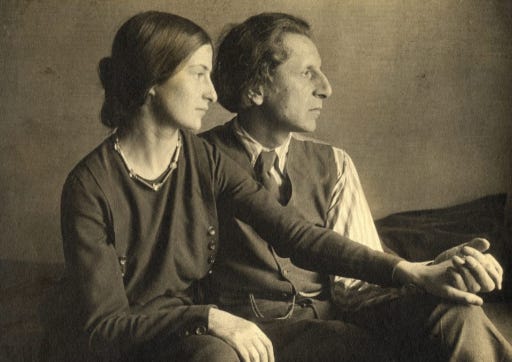
[Stella Bloch and Ananda Coomaraswamy]
A big thanks to our Paid Subscribers for keeping the lights on here at Hogwarts Professor, to include the lights in our new ad hoc film studio! We’re filming a course in the coming weeks to test the system and our techno-gadgets, all of which will be free to paid subscribers (the longer courses will be deeply discounted).
Enjoy the chapter — and let me know what you think in the comment boxes below!
