
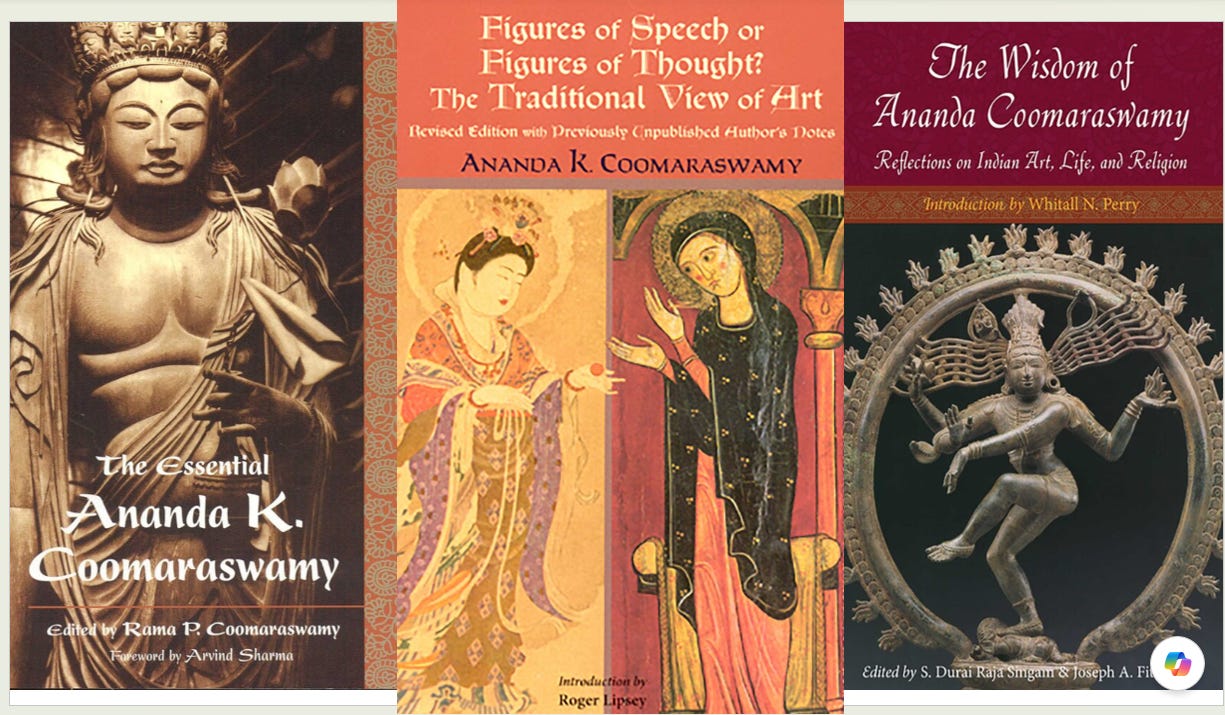
This is the eighth in a series of posts for Hogwarts Professor Paid Subscribers that introduces the Perennialist interpretation of fiction via a book by Ray Livingston titled The Traditional Theory of Literature (University of Minnesota Press, 1962). I have sent out seven chapters thus far in single posts — Prologue, Man, Society, and Art, The Creative Process, The Work of Art, Part One, The Work of Art, Part Two, The Function of Works of Art, and Judgement and Criticism — and with this post, the Conclusion and Appendix to Traditional Theory, the series comes to a finish.
The Appendix is a brief life of Ananada Kentish Coomaraswamy and speaks for itself.
The Conclusion, the greater part of this post, has three parts. The first is Livingston’s five-point explanation of how reading — or writing — literature today through Coomaraswamy’s traditionalist perspective is much better than prevalent modes of interpretation and composition. In brief, it is better because it aligns both with the created order of things and with man’s spiritual constitution (logos) and end (telos).
This leads to his ‘for instance’ of how Coomaraswamy’s approach to narrative art resolves mysteries of literature that contemporary theories can do little more than acknowledge as mysterious. His choice as an example is the power of tragic katharsis.
I have re-read several times Livingston’s explanation of why story, on stage or page, affects us as audience member or reader as it does and each time I have marveled at the way it congeals for me both my experiences as a reader of Rowling’s work and what I have tried to communicate in my efforts to explain her traditional artistry to modern and postmodern readers. I will be referring to it, quoting from it, I suspect in all future talks and posts. I can only hope that you enjoy it even half as much as I have.
Livingston concludes the chapter and his book with a not very hopeful but exceedingly sober picture of literary criticism today. Given that his brilliant presentation in one volume of Coomaraswamy’s more than 400 books and articles insofar as that writing touched on literature as sacred art has been not just overlooked but forgotten, his almost dour view seems as prophetic as it is depressing.
The good news? It really hasn’t been forgotten; here we are reading and being challenged by his work.
I think Livingston and Coomaraswamy would both have laughed hardily at the unlikelihood of a 21st Century writer such as Joanne Murray and her against-the-rip-tide revival of the traditional Shed tools of creating transformational literary sacred art — Christian symbolism, mythological story-templates, literary alchemy, psychomachia or soul allegory, chiastic structure, and cathartic shock —being the cause of this revival. But, again, here we are.
Rowling’s deliberate choice of these traditional tools, her consistent use of them over almost thirty years of writing, and their effect together and individually being precisely that of sacred art makes reading and interpreting her work without the traditional or spiritually-minded perspective of the Perennialists something akin to critical malpractice. Reading via the perspectives of Critique and other critical methodologies would be like using a screwdriver to pound in a nail.
My next post will make frequent reference to Livingston’s Chapter Six, the post on literary criticism just previous to this one, and his conclusion in my attempt to frame the two right-readings of Rowling’s Harry Potter series as we re-enter Potter Mania this Christmas. Those two readings — as sacred art and as spiritual danger — seem to be in necessary conflict; I will explore how an Orthodox priest’s recent reading of Tale of Two Cities illustrates almost perfectly why those two critical perspectives simply talk past one another. Coomaraswamy via Plato explains why both are necessary if one is much preferable to the other.
Nick and I will be talking about this, about work being done in Strike fandom by Tamara, Katya, and Fiona (I hope with interviews with each!), and about the upcoming Snape and Strike Summer School series we are editing now. Thank you to all our subscribers, especially to those who contribute to the cause. It promises to be a very exciting time here the next few months as we prepare for the animated Christmas Pig and the HBO+Bronte Studios television adaptation of the Hogwarts Saga.
I have highlighted the dense passages below and included links to the definitions of those words Substack’s editors do not recognize as words. My apologies if either or both are distracting or annoying to you. Enjoy this profound read!
