
This is the second part of at least a three part series of articles with supplementary video discussion in which I take a long look at Rowling-Galbraith’s choices for character names in the eighth Strike-Ellacott novel, The Hallmarked Man. For the first posts in this series, in which I explain why this is a worthwhile effort, one critical to Rowling’s intentional artistry and complementary to her other Shed tools, see ‘The Allegorical Cryptonyms of The Hallmarked Man, Part One’ and my conversation with Nick Jeffery about it ‘What do Tyler Powell, Rupert Fleetwood, Jolanda Lindvall, and Lady Jensen Have in Common?’

Almost half of today’s ten posts are about characters named ‘Lion’ or variants on the leonine theme. I think the number of lions prowling through Hallmarked Man, not to mention the dogs from Hell and the bears benign and grizzly, deserve their own post, especially to contrast it with the predominant swan symbolism of the first seven books. Or are they conjoined in Jonny Rokeby, whose middle name is the lionesque ‘Leonard’ and who plays the part of a Jovian swan in the Leda mating that produced Cormoran Strike (we think?). [Be sure to check out Ed Shardlow’s full catalogue of the lions afoot in the pages of Hallmarked Man!]
More on that below and on another day! Let’s start our second Hallmarked Man list of Best Guesses with the funniest ‘Lion’ name, the porn star epithet for the SSA afflicted gardener from Sark.
Daniel DeLeon (‘Dangerous Dick De Lion’)
There is no listing for ‘DeLeon’ in Rowling’s Go-To reference work for names, Reaney & Wilson’s Oxford Dictionary of English Surnames (and, yes, there are a lot of French and Norman names — as you’d expect DeLeon to be coming from Sark — in a book of English surnames). But it’s a Spanish name, believe it or not, and it isn’t about lions but soldiers. Per Wikipedia, here and here:
De León or de León or De Leon is a Spanish origin surname, often toponymic [place-name], in which case it may possibly indicate an ultimate family origin in the Kingdom of León or the later Province of León….
León was founded in the 1st century BC by the Roman legion Legio VI Victrix, which served under Caesar Augustus during the Cantabrian Wars (29-19 BC), the final stage of the Roman conquest of Hispania. In the year 74 AD, the Legio VII Gemina —recruited from the Hispanics by Galba in 69 AD— settled in a permanent military camp that was the origin of the city. Its modern name, León, is derived from the city's Latin name Castra Legionis.
Be it a city, Province, or Kingdom, though, the flags of Leon have all featured a lion.
How does a Spanish DeLeon wind up on Sark? A Spanish Armada Westray Don ship that fled south and east instead of up the eastern coast of England? I think it much more likely that the character has the DeLeon surname because Rowling was loading the eighth Strike novel with Lions and this was a natural fit. Especially with the name ‘Daniel.’
It could also be, of course, that the author was having a joke. The character is ‘gay’ and this was obviously considered not a Proper Man by his father. The most famous De Leon from history is Juan Ponce de Leon, the Spanish explorer, usually referred to as Ponce rather than Juan — and ‘Ponce’ in the UK means, in addition to pimp, “a posh or effeminate person.” That Rowling’s Daniel has a sense of humor (hers!) is reflected in his taking the name ‘Dangerous Dick De Lion,’ because (a) he has a brother named Richard, the nickname for which is ‘Dick,’ a commonplace like Peter for penis and (b) the alliterative ‘D’s there and the association with a ferocious animal are subliminally frightening (and funny.) No ponce, there.
I start today’s list, though, with Daniel DeLeon because of the relatively obvious spiritual reference: Daniel in the Lion’s Den, a fascinating story told in the chiastic Book of Daniel:
In Daniel 6, Daniel is raised to high office by his royal master Darius the Mede. Daniel's jealous rivals trick Darius into issuing a decree that for thirty days no prayers should be addressed to any god or man but Darius himself; anyone who disobeys this edict is to be thrown to the lions. Pious Daniel continues to pray daily to the God of Israel; and the king, although deeply distressed, must condemn Daniel to death, for the edicts of the Medes and Persians cannot be altered. Hoping for Daniel's deliverance, Darius has him cast into the pit. At daybreak the king hurries to the place and cries out anxiously, asking if God had saved his friend. Daniel replies that his God had sent an angel to close the jaws of the lions, "because I was found blameless before him". The king commands that those who had conspired against Daniel be thrown to the lions in his place with their wives and children, and that the whole world should tremble and fear before the God of Daniel.
Rowling Readers know to take names seriously and few of them when looking at the name ‘Daniel DeLeon’ won’t think of the Prophet Daniel’s rescue from the lions due to his fidelity to and blamelessness before God. But what connection, if any, was Rowling-Galbraith trying to make between the Porn Star on the Run and the Hebrew Prophet in Exile?
I obviously don’t know. Here, though, is my out-there Best Guess.
As I explained in my half-hearted argument that the ten point Celtic Cross from Tarot Card spreads is as good a symbolic scaffolding structure for the ten book Strike-Ellacott series as any other, Rowling-Galbraith likes to mix the spiritual and the sexual, her in-your-face Christian symbolism with complementary Freudian markers:
[And} there is the implicit sexual content of the Celtic Cross, one hard not to see in the tarot card spread. The circle around the first two cards is yonic and the staff obviously phallic; the two taken together, with the staff’s end point, the resolution card, laid over the inner cross, is an image of coitus. This repeats the imagery of the Deathly Hallows symbol, whose vertical line is phallic, the circle between two spread lines yonic, and their conjunction an image of sexual congress.
This symbolism, as in Rowling’s hilariously sexual imagery in the climactic scenes (!) of Harry Potter and the Chamber of Secrets (the giant Basilisk in the Chamber, a place only accessible through the lady’s room loo hole-in-the-wall, down a long slide, etc.), does not contradict its spiritual content; the Chamber of Secrets battle “miles beneath Hogwarts” is simultaneously a Freudian comedy and a Medieval Passion Play or Everyman re-telling. In Rowling’s psychomachia, especially in the Strike series with its Soul-Spirit Shakespearean allegory in play, sex is in addition to its passionate element something of a cipher for conjunctio oppositorum, the communion of self and transcendent Other.
My best guess for the meaning of Daniel DeLeon’s name is that Rowling-Galbraith really wants her readers to be forced to pair up in the heads, almost certainly their unconscious minds, a tortured porn star on the run, first from his own father and then from his murderer’s dispatched by his patron in exile, with perhaps the greatest prophet of the Judeo-Christian tradition before St John the Baptist.
What effect does that have? I think it suggests that the author is writing a story that is only superficially a romance, a story of love long delayed that is simultaneously a spiritual allegory of Eros/Anteros and the soul’s longing for its home with Spirit.
[There is an alternative secular interpretation of the name for those who find this preposterous and religious-therefore-not meaningful. I urge anyone of this bent to look into the most famous — infamous? — Daniel De Leon in real-world history, a socialist academic-firebrand who was celebrated by no less a personage than Lenin as a seminal influence on Bolshevism. From a Lake perspective, given Rowling’s great admiration for the Soviet-apologist Jessica Mitford and her love for the NHS, why not?]
Hafsa Mohammed
‘What did you talk about?’
‘Lions,’ said Mohamed.
‘Lions?’
‘Yes, they were yellow, with the face of a black lion on them, or maybe a lioness, drawn like a cartoon. I only saw them for a second. He looked at me strangely when he’d covered them again. Guilty, you know? But he knew I’d seen, so I said – to show I didn’t care, to be friendly – “ah, the lion is my lucky animal. Hafsa’s name means lioness cub”. I told him that. And he smiled and said “but don’t they call al-Assad the lion of Syria?” which is true, and not something everyone knows, so I said, “but that’s not the fault of lions” and he laughed. He gave me my package, and that was all – no,’ said Mohammed, ‘not all. There was a suit and he was ironing it. He told me he was starting a new job on the Monday. He seemed pleased about it.’
Isn’t it a delight when a Rowling has a character in a novel share the meaning of a name? Just in case we didn’t think the meaning of names was a tool in her Shed chest, she obliges us with a “Hey, Reader! Note the name!”
It also encourages a check to be sure that ‘Hafsa’ indeed means “lioness cub.” A quick search of an Arabic names web site confirms what Mohamed told Tyler and then Robin. So, cute name, right?
The man who Rowling has tell us this heart warming proud-daddy information is named Hussein Mohammed. If you look up his name at the same Arabic names site, you find that ‘Mohammed’ means “Vastness, Magnitude in size, greater than anything” and ‘Hussein’ means “Handsome, Beautiful, Little Beauty.”
Forgive me, but I don’t think these meanings are why Muslim mothers and fathers name their children “Hussein” and “Mohammed.” The baby names site adds to the Hussein meaning above that he “was a Descendent Of The Prophet Muhammad and the founder of Shi’ite Islam.” ‘Mohammed’ is a variant spelling for ‘Muhammad,’ the Prophet of Islam, the name of more than 150 million men today.
And ‘Hafsa’ the “lioness cub”? The wikipedia entry for the name doesn’t mention the leonine origin. The name Hafsa it reports “originated from Hafsa, the fourth wife of the Islamic prophet Muhammad and daughter of second Muslim caliph Umar. It is a popular name among Sunni Muslims.” Syria is three fourths Sunni Muslim.
‘Mohammed’ is the Syrian family’s surname which is not in the top twenty birth surnames in England and Wales (2024). Khan, Ahmed, Ali, Hussain, Singh, and Patel, however, are numbers 2, 3, 4, 6, 8, and 11 respectively. Compare that to the list of the top 500 surnames in England, Wales, and the Isle of Man circa 1991; Khan, Singh, Ali, and Ahmed are 64, 70, 80, and 103 there. ‘Mahmood’ is the only ‘Muhammad’ variant on the older surname list and it came in 451st place out of 500.
Yes, comparing a birth names list with an all names list is misleading, but the future trendline in that comparison is hard to miss.
Instead of ‘Hussein Mohammed,’ if Rowling’s aim was to offer up a ‘John Smith’ Muslim representative, she should have named Hafsa’s daddy ‘Mohammed Hussein.’ ‘Muhammad’ is the most popular given or ‘first’ name for boys in the UK by quite a stretch. In 2024, the top ten names for boys in England and Wales were:
Rank - Name - Count
1 Muhammad 5,721
2 Noah 4,139
3 Oliver 3,492
4 Arthur 3,368
5 Leo 3,324
6 George 3,257
7 Luca 2,814
8 Theodore 2,761
9 Oscar 2,747
10 Archie 2,575
‘Muhammad’ is almost 1 and 1/2 times as popular as the next most popular name. If you add in the two variant spelling of ‘Muhaamad’ — ‘Mohammed’ and ‘Mohammad',’ numbers 21 and 53 on the top 100 list (1,760 and 986 baby boys respectively) — it is more than double the next most popular name. {‘Hafsa’ is not in the Top 100 girls names for 2024 in England and Wales.]
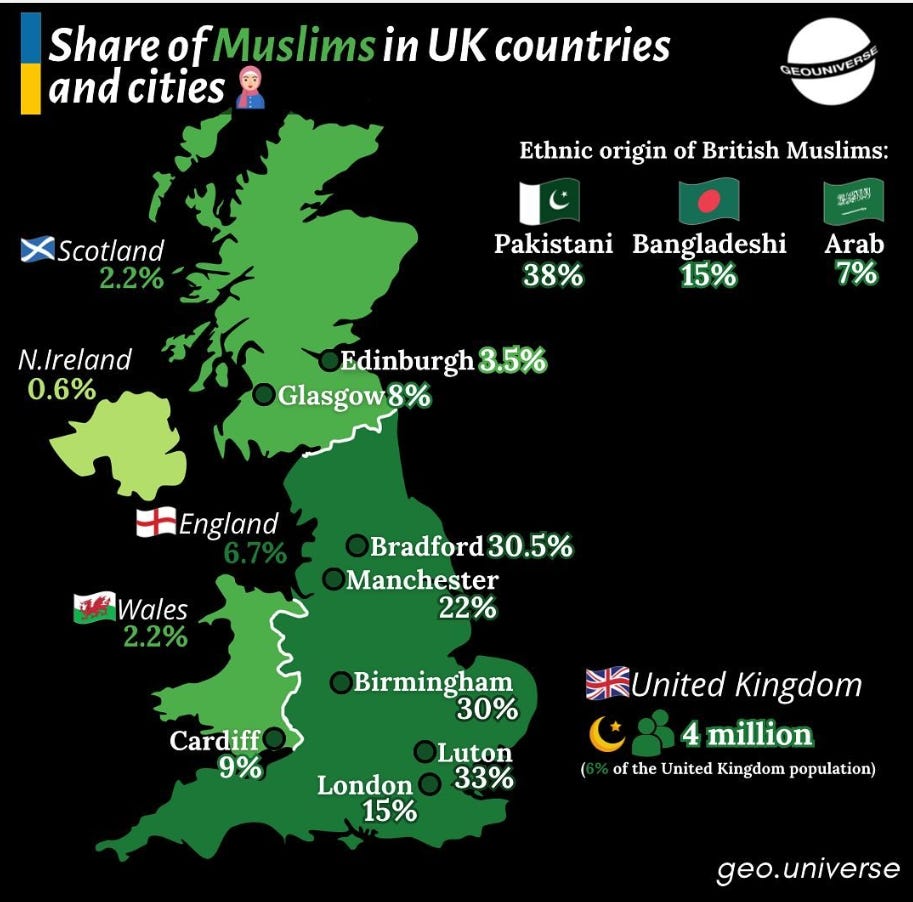
The Muslim population of the UK is less than 7%, a little over four million people (1.4 million in greater London) with the great majority being immigrant families from India, Pakistan, and Bangladesh. In several English cities — Lutton, Birmingham, Bradford, and Manchester — the percentages are between 25% and 30%. From Vivid Maps:
Is the act of highlighting Muslim population figures and English demographics ‘Islamophobic’? When 18 of the 20 most dangerous places for Christians to live are majority Muslim countries that actively discriminate and persecute non-Muslim infidels?
More to the point, in a book in which the Westminster Terrorist attack is featured and Islamic terrorism in the Middle East is highlighted, why is Rowling-Galbraith sure to include a refugee Dicken-esque crippled girl in a wheelchair and give her a ‘Lion’ name? The child cries out for our sympathy and we are obliged to admire the hard-working, long-suffering, and good-humored father with the no-confusion-possible Muslim name. The story needs some counter-balance to the very real menace of Islam in the West and Rowling is nothing if not nuanced. Beyond terrorist violence in London and abroad, the handicapped child being cared for lovingly in a Muslim family is a masterful fictional counter-stroke to the news of ‘Asian’ Grooming Gang abuse of young white girls and women crowding the headlines in the UK.
Beyond all that, I think Rowling has Hussein tell Tyler and Robin the name ‘Hafsa’ means “lioness cub” though it is a marker that the girl is Muslim almost as strong as the family surname (Hafsa - Mohammed = Wife of the Prophet - Prophet) because of the very British associations with lions in UK heraldry symbols, flags, and military token. Marking the child as a ‘lion',’ the name of the fatherless waif driving the Hallmarked Man Agency case, is wrapping her in the flag (see Ed Shardlow’s The Pride of Lions in ‘The Hallmarked Man’ for all that).
Speaking of Decima’s baby…
Lion Mullins Fleetwood
I covered ‘Fleetwood’ in the first cryptonyms post and ‘Mullins,’ too. Briefly, the surname, as we learned in Lethal White via the maiden name of Chiswell’s first wife, is a class marker, upper class, and ‘Mullins,’ Decima’s failed-marriage name, means ‘mill worker,’ a pointer in her case to the Fate-Weird-Sister who measures out the string of one’s life (Decima as Lachesis).
Ed Shardlow explored the meaning of Lion’s given name in ‘Pride of Lions:’
Rupert’s White Lion t-shirt. Lion is named Lion because Rupert had a lucky t-shirt for the Eighties band White Lion. He associates this with his deceased supposed father Peter Greenwood because he has a video of Peter singing him a White Lion song – Little Fighter. He then tears the t-shirt up before disappearing, presumably because he has learnt that Peter wasn’t his biological father, and is distraught at discovering who is, and what that means for him and Decima. The song Little Fighter is quite apt for a father to sing to their child, being one of encouragement to a “little fighter” who wants to change the world for the better. White Lion’s biggest global hit, “When the Children Cry”, is also from the perspective of an adult or parent singing to a child.
White Lion, it turns out, is an American rock band. They had their share of hits but I had no memory of them and could not have named a song they made famous to save my life. Two notes on this in addition to Ed’s notes:
First, what is it with American rock bands in Rowling’s work? It’s not a Golden Thread, but it’s a recurrent thing. There’s the One Direction inspired (?) boy band in the Casual Vacancy backdrop to the Mollinson family crisis, the Blue Oyster Cult infatuation of Peggy Nancarrow Strike, Rupert Fleetwood’s lucky White Lion shirt and favorite lullaby, and now the possibility that Strike 9’s title, Sleep Tight, Evangeline, is from the title of another defunct American rock band, The Whiskey Shambles. White Lion’s lead singer was born and grew up in Copenhagen so maybe the group doesn’t qualify as an American band…
Last, that ‘Little Fighter’ song that Peter Fleetwood sang to young Rupert has an interesting story.
“Little Fighter“ is a song by American-Danish glam metal band White Lion and was the first single released from the 1989 album Big Game.
The song charted at #52 on the Billboard Hot 100 and #12 on the Mainstream Rock chart in the United States, and #65 in Canada.
The end of the song’s music video features the Greenpeace boat Rainbow Warrior which was destroyed by the French intelligence service while docked in a harbor in Auckland, New Zealand in 1985, and which served as the inspiration for the Steven Seagal film On Deadly Ground. In 1989, a fundraising double album was released entitled Greenpeace Rainbow Warriors. In the liner notes for the Big Game album, the lyrics for “Little Fighter” state “In Memory of the Rainbow Warrior.”
That’s all fun, but, little secret, I think the lions of Hallmarked Man, to include the two ‘baby’ lion cubs, are alchemical markers and Christian symbolism more than tokens of the British empire or American rock bands. More on that in a post now in progress…
Jonathan Leonard Rokeby
Hallmarked Man features the Rocking Prune making his first face-to-face appearance with his oldest son Cormoran in the series to save the prodigal detective from a poisoned-pen tabloid newspaper article. What does his name mean?
Starting with the surname, it’s all about oak trees. As I wrote in my explanation of Carl Oakden’s role in Troubled Blood as Hermes the messenger of Zeus:
In the Dictionary of English Surnames we know Rowling uses, we learn that the surname [Oakden] means, as you might expect, “residence by an oak or group of oaks” (327). What you probably didn’t guess is that the name is tied to “ROKE,” and Rokeby which has the same meaning, “at the oak” (cf., 327, 381). Rokeby in the story version of Leda and the Swan that is Strike’s origin as ‘Pollux’ (rhymes with…) is the Swan or Zeus; Mercury-Hermes is the servant of Zeus, his fleet of foot messenger who moves across all boundaries to include life and death, the world and the underworld.
Why an “oak”? We might be meant to think of Odin and the World Tree/Axis which was an oak as Odin is considered both a Mercury and Jupiter figure to the Romans. I cannot say that with any certainty.
No certainty, but it fits with the Leda and Swan mythological template in play.
Jonathan? Let’s go straight to Wikipedia:
Jonathan (Hebrew: יְהוֹנָתָן/יוֹנָתָן, Standard: Yehōnatan/Yōnatan, Tiberian: Yŏhōnāṯān/Yōnāṯān) is a common name given to males which means “YHWH has given” in Hebrew. The earliest known use of the name was in the Bible; one Jonathan was the son of King Saul, a close friend of David.
Variants of Jonathan include Jonatan, Djonathan. Biblical variants include Yehonathan, Y’honathan, Yhonathan, Yonathan, Yehonatan, Yonatan, Yonaton, Yonoson, Yeonoson or Yehonasan. In Israel, “Yoni” is a common nickname for Yonatan (Jonathan) in the same way Jonny is in English.
If you follow the ‘Jonny’ link there, you’ll see that ‘Jonny’ is specific to ‘Jonathan’ and not to be confused with the diminutive ‘Johnny’ for ‘John,’ which has a different meaning. And that ‘Jonny’ is UK slang for a condom.
‘God has given’ and the condom resonance play well with Rokeby’s role as Zeus in Cormoran’s conception and the presumably lack of contraceptive care that led to Leda’s pregnancy (assuming Trevik and Ted were not involved).
And ‘Leonard’? It’s from the Old German words for ‘lion’ and ‘heart’ and ‘hardy’ which can be translated literally (why not?) as “lion-hearted” or figuratively as “brave man.” We know from his fictional Wikipedia page that his birthday is 1 August 1948, which makes him a first ten-days Leo by Western astrological star sign and an Earth Rat in Chinese astrological reckoning (much better than you’d think for a dirty rat!). He was 26 years old when Strike was born.
What is a ‘Leo’ in broad strokes, remembering that Rowling and Harry Potter, born on 31 July, are also Leos?
Bold, intelligent, warm, and courageous, fire sign Leo is a natural leader of the Zodiac, ready to blaze a trail, vanquish injustice, and make a name for themselves along the way. Blessed with high self-esteem, Lions know that they possess enviable traits—and they're proud of them. They don't believe in false modesty and will be the first to praise themselves for a job well done. But Leo isn't self-aggrandizing or unwilling to roll up those sleeves and do the work: this sign knows that in order to be respected and admired, he or she needs to put in the effort worthy of a leader.
There was another ‘Leonard’ in the Strike series — Running Grave’s Leonard Heaton, married to Shelley, who witnessed Daiyu’s death at the beach (sort of) 00 and there was Leonora Quine in The Silkworm, who, for all her simplicity was something of a lioness about her daughter and wayward husband.
There will be more to say about Leonard the Lion in my alchemical notes but for now I’ll say what Nick and I recently discussed: it seems as likely as not that Rokeby made his appearance when he has to introduce the important part he is to play in the last three books. He’s already saved the Agency from a devastating round of negative Culpepper-driven publicity. I think he’ll be doing much the same in Strikes 9 and 10.
Oliver Branfoot
Taking a break from the lion’s den, how about the Laughing Lord, Oliver Branfoot?
Nick Jeffery from our first Hallmarked Man conversations last year has made the case that this character is a cardboard cut-out and brutal depiction of Sir Boris Johnson. I am totally convinced by the several remarkable parallels between character and living archetype, but the name isn’t much help, at least not to this American cryptographer.
‘Oliver’ is a fun name, I think, because of its several meanings, most notably, “a small tilt-hammer worked by the foot” and “olive tree planter” whence “olive branch bearer” or “peace-maker.”
Two historical points of note: (1) for more than a century, ‘Oliver’ had the same death-by-association in England as ‘Adolph’ now has among Germans because of Oliver Cromwell, the Lord Protector. (2) It has made a great come-back from the name dustbin, I want to think consequent to the genius and great popularity of Dickens’ Oliver Twist.
Seeing any clear connections between those meanings and Rowling’s caricature of privilege, perversion, and public foppery disguising political power? Me neither.
‘Branfoot’ doesn’t have an obvious link, either. For one thing, it’s quite the rare name. ‘Branfoot’ is not listed in Reaney & Wilson, Rowling’s usual reference for English surnames, and the usual search for alternatives by switching out vowels and adding or eliding consonants didn’t work either.
There were quite a few associations, though, that had possibilities, most notably ‘Branford’ suggested by several sites online and ‘Branson.’ Which I think is what Rowling-Galbraith was aiming for, most specifically to point obliquely rather than making the satirical portrait too obvious with respect to Sir Richard Branson, the British Billionaire.
Rowling has at least two reasons to despise him. First, she hates tax cheats. Branson lives on a Virgin Island he owns and pays no taxes in the UK on his several billion dollar fortune. If that weren’t enough, he was a founding sponsor of the International Center for Missing and Exploited Children, a cause one would guess the Lumos founder would admire, and Branson was also a good buddy of Jeffery Epstein, to whom he wrote in 2013 that “"[I] would love to see you. As long as you bring your harem!"
Melt BoJo and Sir Richard into a single character and I think you get Oliver Branfoot.
Niall Semple
‘Niall’ is the Gaelic form of ‘Neal’ or ‘Neil,’ the given name of Rowling’s husband of twenty-five years come Boxing Day, Dr. Neil Murray. In old Irish it means ‘Champion’ (R&W, 321). Ed Shardlow suggests that it’s an anagram for ‘lion,’ which fits wonderfully with ‘champion.’
‘Semple’ shows up in Reaney & Wilson’s Dictionary of English Surnames with a double entry. The English name derives from variants on French locations called ‘Saint Paul.’ The Scottish ‘Semple,’ though, “has a different origin,” namely, “that it is identical with SIMPLE” (R&W, 400).
Which is an excellent match, I think, for the SAS soldier who did heroic service against Isis and Islamicists, but who, consequent to his brain injuries and relative naivete, even simplicity, was not able to reconcile himself to the horrifying and sacrificial death of his comrade overseas. A simple champion…
Rena Liddell
Rena Liddell is the surviving sister of Ben Liddell, the soldier who sacrificed his life to save Niall Semple in an SAS covert operation that went wrong. She haunts Strike and the Agency with phone calls telling him, not asking him, to meet with her at The Golden Fleece and other places. Strike and Pat try to get her to explain where that is and Pat searches for the pub’s location for most of Strike 8. When Strike makes the connection with Ben and Niall (and learns the Ralph Lawrence has had her sectioned (“psychiatric hold”) to prevent their meeting), they eventually meet under the bridge, one of Hallmarked Man’s better sketches of Strike’s transformation post Sark.
Her name? Well, ‘Liddell’ is an antiquating spelling for “little.” I don’t think Rowling is describing the height of Strike 8’s “Scottish Gateshead” with this surname, one she shares with one of the most famous children in English literary history. Alice Liddell was the girl who inspired Charles Dodgson (‘Lewis Carroll’) to write Through the Looking Glass and Alice’s Adventures in Wonderland.
‘Rena’ has a boatload of meanings from a variety of languages:
Rena is an English derivative of the French name René, which is a diminutive of the Late Latin name Renatus, meaning ‘born again.’ As such, Rena carries a similar connotation. In Greek, Rena refers to ‘one who is peaceful,’ while in Hebrew, it refers to ‘joyous song.’ The name is a short form of the Greek name Irene, meaning ‘peace,’ which is associated with the goddess of peace. However, in Hebrew, Rena means ‘melody’ and is related to Saint Irene, who is known as one of the three sisters martyred for their faith in Macedonia.
I’m going to go out on a limb (really, I live on the limb so there’s no ‘going’ involved) and say it’s the Hebrew. Her brother’s name, Ben, is Hebrew for ‘son of,’ so, even though gentiles also use the name, it leans Jewish. Rena’s understandable fear of Muslims after her brother’s death and service time fighting Islamicists is even more understandable if she is Jewish, as current events in the UK sadly confirm on a daily basis. Rowling reposted ten tweets and posted two of her own yesterday and today about the throat slashing murder by two Muslim men of two Jews in Golden Green. It’s not a stretch to think this is a hot button issue for her.
The Alice Liddell connection? Carroll was one of Nabokov’s favorite authors (his translation of the Alice stories into Russian are still considered the finest into any language by Carroll lovers) and I have to think the satire, the word-play, the world-invention, the parabolic mirror in parable form had to make Wonderland a favorite of Rowling’s, too. Rena’s dreamlike existence and experience of the world, alas, seem like a shadow of Alice’s experiences.
Laetitia ‘Tish’ Benton
'The ‘Benton’ entry in Reaney & Wilson is “dweller at the farm where bent grass or beans grow’ (40). ‘Laetitia’ is the Latin word for “happiness, joy, delight.”
As fun as I think the bean-farmer meaning is, when paired with ‘Laetitia’ and the cute ‘Tish’ nickname, I’m guessing Rowling is asking us to read this surname-to-given-name, a young woman bent on or consumed by thoughts of her own happiness.
Happy girl knew where Rupert was, that he was alive, and accepted the bribe of a fun job with travel and other perks from Tara Jensen to keep her mouth shut. Decima Mullins, single-mom abandoned by her son’s biological father and desperate for news of him, even just proof that he is dead? Not Tish’s problem.
Which echoes the meaning of Albie Simpson-White discussed in Part One of this series. Beans in a pod?
Jason Knowles
We’ve parsed four of the five candidates for the corpse in the Ramsay Silver Vault: Rupert Fleetwood, Tyler Powell, Daniel DeLeon, and Niall Semple. That leaves only the man that Murphy and the Masons at the Met were certain was the dead man, Jason Knowles. What does his name mean?
‘Knowles’ is listed in Reaney & Wilson with ‘Knoll’ and means, as you’d expect, “dweller at the top of the hill” (268, no bean farms). ‘Jason’ is derived from the Greek word for ‘doctor.’
Jason Knowles isn’t much of a character, right? The Riccis or his own father decide he is disposable and send him to ‘Barnaby’s for his corpse to be buried in steel. End of story line — unless you want to include the fall out at the Met about Shanker’s role in Strike figuring this out and Ryan F. Murphy’s issues with Robin.
I was tempted to scratch off this name as not especially meaningful. I decided to give it a longer look because his initials suggest the author is highlighting the name for our attention, even putting him up on a hill for clean lines of sight. If that wasn’t enough, we’re simultaneously told Knowles is the most likely corpse-candidate, that we cannot talk about him because of the Metropolitan Police undercover work with the Knowles Syndicate, and that Strike doesn’t think Jason is their man. Those mixed signals about taking this person seriously makes me think we’re obliged to take him seriously, at least with respect to his name.
If there’s a key to his name, it’s in Rena Liddell’s repeated calls to Strike to come to the Golden Fleece. Rowling the Classics major and lover of mythology gives us Jason and the Golden Fleece in the same book. I’m betting that she wants us to think about Hallmarked Man as some kind of re-telling of the Argonauts adventures, maybe even of Euripides’ Medea. You’ll note that Castor and Pollux are Argonauts…
Or she is setting us up for a Medea like reveal in the last two books in the series, in which Tara Claremont Campbell Longcaster Legard Jensen is revealed to have murdered her own child, Charlotte, as a twisted kind of revenge.
This will require a long post to unpack. Foe now, let’s just acknowledge the marker Rowling-Galbraith put on Jason-on-the-Hilltop. [Paging Dr. Fimi!]
Kenneth Ramsay
Let’s end with a brilliantly drawn character, the owner of the Ramsay Silver Shop and the man all but ruined by the murder in and seeming robbery of its vault, Kenneth Ramsay. There’s a lot to play with.
I confess that my first idea, one tossed around the Hogwarts Professor Moderator Channel but never chased down, was that Rowling embedded a character whose name or actions signaled an astrological sign. ‘Ramsay’ from this view starts off the show as Ram-sey, like-a-ram, ergo Aries, the first sign. I think Nick came up with seven or eight correspondences before we stopped stretching the idea beyond all possibility.
Yes, if one reader wants to hear all those, I’ll ask Nick if he remembers his list. I hope everyone can name a few Leos.
Kenneth, though, besides the name doesn’t strike me as a Ram, Aries, or anything like a Golden Fleece wearer.
What do Reaney & Wilson say? Ramsay, it turns out, assonant with ‘Ramsey’ simply means “from Essex” because of the small town there named Ramsey. For Americans, Essex means next to nothing, a county just north and east of London. For Brits, though, it has taken on all sorts of meaning due to a television show called ‘The Only Way is Essex’ or TOWIE. “Essex Girl” has made it to most English dictionaries with a meaning akin if not exactly like the American “Valley Girl,” stupid, vapid, bad taste, poor speech, buxom, blonde, and promiscuous…
The stereotypical image formed as a variation of the dumb blonde/bimbo persona, with references to the Estuary English accent, white stiletto heels, mini skirts, silicone-augmented breasts, peroxide blonde hair, over-indulgent use of fake tan (lending an orange appearance), promiscuity, loud verbal vulgarity, and socialising at downmarket nightclubs, considered to be inexpensive and less prestigious.
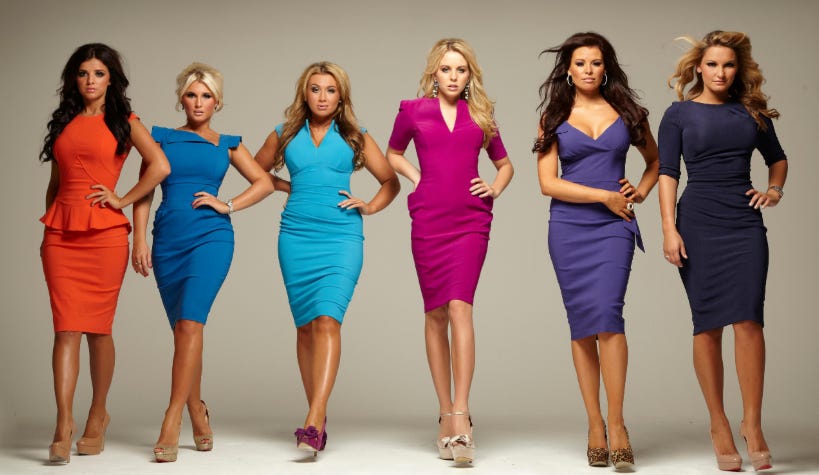
Meaning of Essex girl in English: Essex girl
noun [ C ] an insulting word for a young woman who dresses and behaves in a way that attracts attention, and shows that she is not intelligent or stylish, thought of as typical of some people from the English county of Essex:
When I came up to Cambridge, I never expected to be taught by someone who wears five-inch heels, has tattoos, and speaks like an Essex girl.
This is one of London’s more exclusive hotels. No loud Essex girls at the reception here.
These were Essex girls with the funds to fly anywhere but who wouldn’t dream of exchanging any holiday for their twice-a-year jaunts in a cramped caravan living on vodka and baked beans.
She’s an authentic Essex girl - born in Basildon to a Tilbury docker - who loves to shock.
As you’d imagine, there are campaigns, to include documentaries, one woman plays, and social media efforts to combat the pervasiveness of this pejorative phrase (and nonsensically to remove it from all dictionaries, as if lexicons condone or promote usage rather than report meaning).
What does this have to do with Kenneth Ramsay? Forgive me for thinking of him as a kind of ‘Essex Guy.’ With a Kenneth spin!
‘Kenneth’ literally means “handsome,” “on fire,” even “lord.” I think we’re better off just thinking of ‘Kenneth’ as an upper class version of ‘Ken’ which, as in ‘Kendra,’ comes from the Scottish for “to know, to have perception or understanding” and from the Sanskrit and Greek words for “center” (as in “metaphysical origin, omniscient”).
Could there be a better name for a Mason who doesn’t quite fit into his wife’s social circle and who overreaches his capacity continuously to appear to be something he’s not?
And that’s ten names, I have ten more in queue, and I welcome your requests and corrections for this exercise in literary Rorschach testing — cheers!
Another association I took from "Dick" de Lion and his brother Richard de Leon, was that of Richard the Lionheart - anglo-norman King and crusader.
There's another Jason in the book too. Carmen's Ex-Calibur is also a Jason.
I think this points to the Golden Fleece mythology. I hypothesise that the Golden Fleece is a symbol for Robin - daughter of the sheep reproduction expert.
I don't think Pat searches for the Golden Fleece. She's mainly preoccupied with finding the pub that Tyler might be working at. The clue for that is a name with a different precious metal. I don't think the agency ever considers that the Golden Fleece might be the pub Tyler's working at, despite the shiny adjective. But that fits a repeating pattern of Strike overlooking patterns and possible routes of enquiry in THM.