
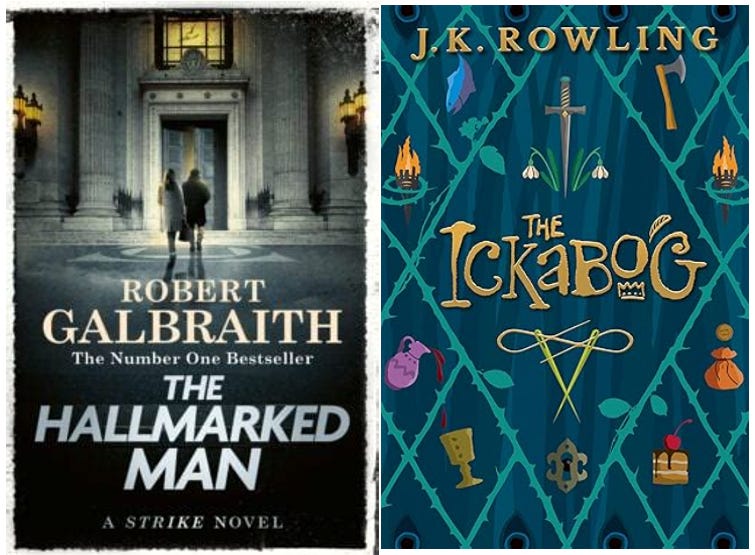
Soon after Ed Shardlow joined the Group Adventure in Charting The Hallmarked Man, he began noting with wild regularity the echoes he was seeing between Strike 8 and Rowling’s Covid-era fairy tale for lockdowned children everywhere, The Ickabog. Evan Willis in his Tetractys Theory posts about the ten book structure of the Strike-Ellacott series had proposed that Rowling-Galbraith would continue ‘his’ Parallel Series fun with either Casual Vacancy or The Ickabog, noting that either one could follow as the ‘first book post Potter’ because the former was the first book published and the latter the first book conceived and largely written.
There was some chatter in the first week that Casual Vacancy was the obvious book-behind-the-Strike-novel because Ironbridge and Pagford seemed to be sister cities and each book ‘begins’ with the sudden and tragic death of a man who haunts the rest of the novel, Barry Obama Fairbrother and Tyler Powell. The peanut allergy seemed a pointed reference, too.
I think after reading Ed Shardlow’s exegesis you’ll agree that the book-in-parallel with The Hallmarked is indeed The Ickabog. Enjoy! [John, exiting stage left]
The Parallel Mysteries of The Ickabog and The Hallmarked Man
Prior to the release of Strike 8, there was good reason to believe that the first seven Strike books could be seen as parallels to the seven Harry Potter books, each corresponding to the respective counterpart in the other series. This has been dubbed the Parallel Series Idea (PSI). Having exhausted the Potter series, there was fair speculation that Rowling in the remaining three books of the Strike & Ellacott series would draw inspiration from her three standalone books – The Ickabog, The Casual Vacancy and The Christmas Pig.
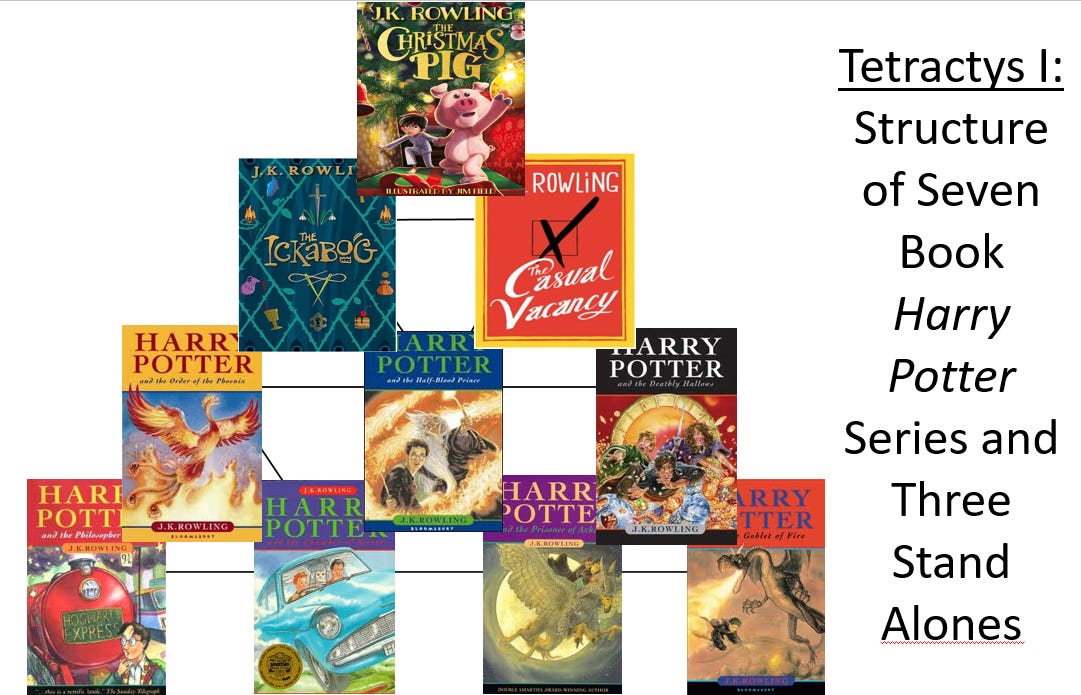
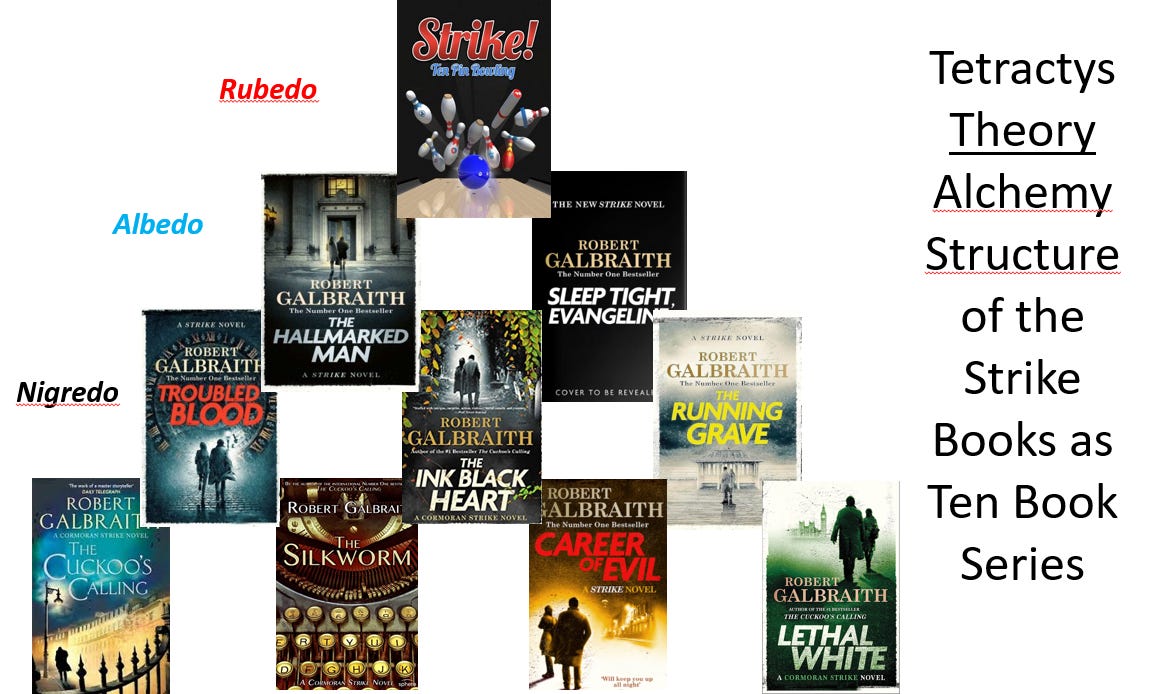
There were various suggestions about which of those might come first. But there was no clear consensus, with factors such as date of publication, date of conception or writing, alchemical progressions and mythological allegories failing to agree on an obvious candidate. And that’s before we even get started on what the geometric structure of the series might be if it wasn’t going to be another seven-book ring cycle.
So, on my first reading of The Hallmarked Man, I was looking for signs that it reflected one of those three books, with an agnostic and open mind as to which it would be. Then, right from the off with Decima’s interview, the plot elements of a man being killed in circumstances surrounded by mistaken and disputed events, and the importance of finding out the truth – for Decima, but also in other ways for Strike and Robin – made me look to The Ickabog as the most likely parallel text. A book all about the importance of telling the truth, a killing that’s subject to a cover-up, and an eponymous figure whose identity, true nature and very existence are in question,
Both books draw comparisons and contrasts between the powerful and the vulnerable in society. From the prosperous capital city to the desolate Marshlands. From Heberley House to a filthy council flat. From the castle to the orphanage. From The Dorchester to the foodbank. From the rich who can do what they want, to the poor who must do whatever they can to survive.
The Ickabog uses a medieval feudal setting to show a simplified model of society. In The Hallmarked Man we visit Sark, which is pretty much as close as one can get to a feudal country in the modern world.
So, with various aspects framing a potential connection to The Hallmarked Man, I have given The Ickabog a re-read to see how well that theory lines up with the text. I will run through a number of correspondences that were apparent as I came across them, list some characters with their possible analogues in the other work, and finish with a few key convergences, that satisfy me that there is a deliberate synchronicity between The Ickabog and The Hallmarked Man.
Firstly, sheep play a role in both books. There are various sheep references in The Hallmarked Man; perhaps most emphatocally the Golden Fleece, and most significantly the sheep charm on the bracelet Strike gives Robin. Sheep also pop up at a few key moments in The Ickabog; from the shepherd who provides the trigger for the whole story with his petition to the King, to the scraggy sheep of the Marshlands that provide the Ickabog with wool fibres, and finally the healthy and well-fed sheep tended by Roderick Roach in the new Cornucopia.
The shepherd’s lost dog is a rather tragic figure, who gets caught in brambles and once freed receives a kick from Spittleworth. There’s an echo there with the cruel and violent treatment of the dogs involved in the illegal fighting in The Hallmarked Man.
Fish are a recurring theme of The Hallmarked Man – with Strike-the-fish, countless servings of fish and chips, and the strongly seafood-themed dinner at the Dorchester. Fish also crop-up in a few key moments in The Ickabog. Firstly in the form of King Fred’s erstwhile Chief Advisor, Herringbone, who sadly pays the ultimate price for his integrity, and then in the form of the old woman expert on the country’s fish, who is the first victim of the Ickabog Defence Brigade, and is later recalled with the fish prospering in the River Fluma. Indeed, the old woman has fish tanks that get smashed up, leaving prone fish floundering on her floor, reminiscent of Strike-the-fish going belly-up and needing resuscitation.
In fact the fish in the river are described as “silver salmon and trout”. Silver is another vital theme in The Hallmarked Man, and there are a few other instances of silver in The Ickabog. There’s the silver-topped cane with which Ma Grunter administers punishments, the silvery mushrooms that the Ickabog is partial to (“You don’t get many silver ones on the marsh”), and most crucially the silver medal, posthumously awarded to Major Beamish, which saves both Bert and the Ickabog when he dives in front of Flapoon’s bullet.
Otto Scrumble wears a couple of different wigs to disguise himself as Widow Buttons and Professor Fraudysham, and Griff wears wigs and disguises to perpetrate his crimes.
Griff kills Sofia by taking her to the woods and burying her there. Private Prodd in The Ickabog has a similar fate planned for Daisy.
The twin cities in the middle of Cornucopia – Kurdsburg and Baronstown — are linked by a bridge. Bridges are a recurrent theme in The Hallmarked Man, not least the town Ironbridge and its eponymous bridge, in the middle of Britain and home to Griff and Tyler.
Absolutely central to the plot of The Ickabog is the killing of Major Beamish and subsequent cover-up. That’s a plot point reflected in The Hallmarked Man in the form of the killing of Ben Liddell, tragically killed, not in combat, but when unarmed and vulnerable, and subsequently covered up by his own government, that should have protected and honoured him.
The police in The Hallmarked Man are shown to be flawed – lacking investigative ability, prone to corruption, inept even. All of these are criticisms that can be laid at the Royal Guard and especially the Ickabog Defence Brigade. On the other hand, the treatment of Ickabog by the authorities has similarities to the response to terrorism in The Hallmarked Man, especially the fear generated and spread about it.
Ma Grunter twice hits Daisy on the ear with her cane, reminiscent of the blow that Strike receives from Griff and the subsequent damage done to his ear.
Lady Eslanda being imprisoned in Spittleworth’s home has echoes of first Chloe and then Sapphire being imprisoned in Griff’s house. The name Eslanda has quite an overlap with the name Jolanda, and there’s some suggestion that it can mean “violets”, like Jolanda does, or “emerald” (like a variation of Esmerelda) which links to Sapphire as another precious stone.
Towards the end of each book, the female protagonist has finally found the elusive subject of the book, and persuades them to reintegrate with society, because humanity is worth it: Daisy in talking the Ickabog into the planned reveal to the people of Cornucopia, and Robin in persuading Rupert to come back to the UK and be a father to Lion. In both cases it is the noble role of the parent that she appeals to.
The Ickabog combines aspects of both male and female and is able to reproduce with no outside assistance. Rupert and Decima are male and female and consider themselves soul mates – two halves reunited. They also are two aspects of a single Longcaster essence, through their shared father, who combine to produce a healthy offspring.
In those aspects Rupert could be the Ickabog, but perhaps he is also King Fred – well-intentioned but rather naïve, and responsible for untold suffering because he runs away from his problems rather than confronting them. King Fred, like Rupert and the Ickabog, is also rehabilitated by taking on a fatherly role.
Here are some other suggested corresponding characters between the two books:
Captain Goodfellow – Niall Semple, or Tyler Powell
Major Beamish – Ben Liddell
Lord Spittleworth – Lord Branfoot (and Griff)
Daisy Dovetail – Chloe (and Robin)
Bert Beamish – Strike
Cankerby (the sneaky, eavesdropping footman) – Shanker
Roderick Roach (guardsman turned sidekick) – Wardle
Lord Flapoon – Todd Jameson
Spittleworth’s Mansion – Heberley House
Each book is driven by finding the answers to two or three key questions. In The Ickabog these are: Who killed Major Beamish? And, is the Ickabog real? In The Hallmarked Man, it’s: Who is the body in the vault? Does Rupert love Decima? And, Robin questioning Strike's true feelings and intentions.
Perhaps the match between those is that despite the fact that the Ickabog is in fact real, it didn’t kill Major Beamish. And despite the fact that Rupert did really love Decima, he wasn’t the body in the vault. But in both cases those simple truths are hidden from the protagonists by a web of lies and deception.
One very important connection between the two books was pointed out by Sandy Hope. A footprint provides a key piece of evidence in both. In fact in both cases the footprint reveals not one, but two findings. In The Ickabog, the people of Cornucopia realise that all the footprints are identical and the Ickabog must be hopping on one foot. Bert also realises that the footprints are exactly the same as the feet of the toy Ickabog carved by Dan Dovetail, and deduces that the attacks are being faked using feet carved by the imprisoned carpenter. In The Hallmarked Man, the bloody footprint under the body in the vault shows that significant time elapsed between the killing and the mutilation, and also that the killer seems to have a limp.
When setting out on his Ickabog hunting spree, King Fred imagines himself spearing a serpent-like monster. This is the image of St George, who is a recurrent theme in THM – lots of St George’s flags, the St George’s cross on the flag of Sark, St George’s Avenue and the Liberty Clock which plays out that scene in diorama.
The Ickabog’s cave; dark, cosy and lit by a fire, is like the Old Forge on Sark. In the latter, Robin finally tells Strike about her ectopic pregnancy. In the former, the Ickabog tells Daisy about the nature of Ickaboggle births, saying, “When babies are bornded, we who have bornded them die”. Just like an ectopic pregnancy.
When Bert confronts Spittleworth at the mansion, the book reads, “Spittleworth had the crazy notion that Major Beamish had risen from the dead to punish him”. As John Granger has pointed out, at the climax of The Hallmarked Man, Strike takes on the role of an avenging angel. Through the cocktail of bravado, alcohol and righteousness, he becomes possessed by the spirit of Tyler Powell, dispensing justice from beyond the grave to Griff and his cronies.
So, lots of connections. Some stronger than others, but a few there that I find convincing. I’m sure I’ve got some of them wrong and I hope that some of these ideas inspire others to provide greater clarity or pick up on other links that I have missed.

The masculine/feminine pairings with Decima and Rupert and the Ickabog are the most convincing part of this to me. I was skeptical but you present a very solid argument!
One of the traits of Daisy Dovetail is her determination to hold on to her name and identity. Chloe has been forced to hide and conceal hers, but secretly she holds onto who she is and hasn’t forgotten. At some point she must have told Tyler for him to buy the bracelet and plan her rescue just like Bertie and Daisy.
Strike (and Charlotte) are kind of Ickaboggles who had a bad bornding… and the whole series is asking whether or not that can be truly overcome…
One of my favorite parallels you mention is the Old Forge and the Ickabog's cave, in which both Robin and the Ickabog tell tragic stories of birth. The Old Forge also reminds me of the transformation of the dungeon once Mrs. Beamish gets a stove installed and starts baking and feeding the prisoners. Mr. Dovetail's broken mind is restored by Mrs. Beamish helping him remember better times, and Robin's own brokenness is soothed by Strike's transformation from a self-serving, manipulative jerk to a selfless, compassionate listener and genuine friend. In both stories the fire is warm and purifying.