This video podcast is the third in a series of three posts about the Hidden Hold of Horrors Golden Thread in the work of author Rowling-Galbraith. A Golden Thread is a plot point, scene, or character type that recurs repeatedly through an author’s stories, a commonality that is evident only when looking at the writer’s writings viewed as a whole. The ‘Hidden Hold of Horrors’ repeated scene is of a location underground, be it a cave, a cellar, a tunnel, a tomb, or a basement pool, in which a frightening confrontation, a Near Death Experience, flat out murder, or transformative revelation occurs.
The first post in this series was Nick Jeffery’s exploration and explanation of Rowling’s Church Cottage childhood home in Tutshill and its remarkable cellar beneath a covered access port, what has been mistakenly referred to as a “trapdoor.” In The Hidden Cellar Beneath J. K. Rowling’s Childhood Home, Nick shares why a building in West England on the border with Wales from the mid 19th Century that was built as a Church of England school would have a substantial brick and cement vaulted basement and what this room, originally a cistern to prevent cholera outbreaks, was probably like during Rowling’s childhood.

[Golden Thread Image: Wovex.com; Ladder to Cellar Under Access Port: Pinterest]
The second post was one I sent out yesterday in which I shared Nick’s and my off-the-top-of-our-heads catalog of everything subterranean, frightening, and damp in Rowling’s oeuvre, that is, her seven Harry Potter novels, eight Cormoran Strike mysteries, the Cursed Child ‘collaborative’ play script, her Beedle the Bard fairy tale collection and Ickabog “political fairy tale,” the three Fantastic Beasts screenplays, her border-line autobiographical Casual Vacancy, and the Dante-meets-Dickens Christmas Pig classic. Rowling Golden Thread: The Hidden ‘Hold of Horrors Downstairs, Beneath the Trap Door
The morning after posting it, readers are already adding scenes Nick and I overlooked and I am kicking myself for not including the “deepest dungeon” in ‘The Warlock’s Hairy Heart’ and “the trapdoor beneath the rug” concealing the tunnel beneath Poem and Pretense’s sanctuary from the Loss Adjustors, a tunnel reached via a ladder. ‘The Tunnel’ takes them “to the bottom of the mountain” where Compass joins them for their flight to the City of the Missed across the Wastes of the Unlamented, Pig’s story turn and meaning-in-the-middle. As Nick and I note in the conversation above, a comprehensive list will require a repeated reading of Rowling’s complete writings. Please add the ones you think of that we missed in your comments below, especially for Cursed Child, the only book for which Nick and I drew a complete Golden Thread blank.
Those first two posts cover half of the four subjects Nick and I tackle in this Golden Thread conversation; the Ten Questions guiding that discussion with the relevant links and notes from our answers can be found below. What I want to write out here briefly are some notes about Golden Threads in general, their place in a Lake and Shed bifurcated critical environment, and then the importance of the ‘Hidden Hold of Horrors’ Golden Thread specifically for understanding Rowling’s work, its inspiration and intentional artistry, and for seeing what will happen in the remaining Strike novels.
Not to mention the meaning of Hallmarked Man’s fictional silver oligarch Murdoch’s name!

{Lake image source; Golden Thread image source; Shed image source]
Are ‘Golden Threads’ Evidence of ‘Lake’ Inspiration or ‘Shed’ Intentional Artistry?
Since the time of our first Hogwarts Professor Substack posts and podcasts, Nick and I have described what we are trying to advance here in the niche field of Rowling Studies is Fourth Generation work. For a discussion of the four generations of Rowling scholarship, listen to On Reading ‘On Writing.’ where we discussed the evolution of reader approaches to Rowling-Galbraith texts and how each generation, while typical of a specific time period, continues into the other generations (most of Strike-Ellacott fandom, for example, is reading that series as the ‘Shippers and speculators did the Hogwarts Saga during Potter Mania, the first generation of Rowling Studies).
What distinguishes Fourth Generation thinking is, in essence, (1) the incorporation of biographical material in understanding the inspiration of Rowling’s work (per her implicit instruction since the late 2019 Lake and Shed metaphor interview), (2) the creation of a gauge to measure the success or failure of her work out of the intention evident in her choices of literary tools, her Shed artistry, and (3) shifting the critical focus from the latest work and the book-next-in-queue to the oeuvre as a whole, everything she’s written. The bumper-sticker version of that?
Lake — Shed — Golden Threads.
Lake? Rowling describes the source of her stories’ inspiration as the ‘Lake’ of her unconscious mind, her personal issues, the events of her life, her reading and education. This is the work of Fourth Generation specialists who sift through what is known about Rowling’s life in pursuit of clues to the source material of her stories.
Shed? Again, Rowling’s bipolar metaphor for her creative process has a marker, her ‘Shed,’ that represents the alocal place ‘where’ she deploys her traditional tools to craft archetypal story out of her very personal Lake inspiration. These tools — I focus on seven — have a specific quality, both antiquarian and profoundly effective in producing the effect Rowling desires on her reading audience.
And, at last, the Golden Threads, which are not explicitly Lake or Shed findings, but, as noted above, “a plot point, scene, or character type that recurs repeatedly through an author’s stories, a commonality that is evident only when looking at the writer’s writings viewed as a whole.” Examples?
In two episodes of The Kanreki Series last July (here and here), Nick and I discussed fourteen Golden Threads in Rowling’s work: The Bad Dad, Writing about Writing, Violence against Women, the Evils of Fleet Street, Mother Love, Ghosts, Pregnancy Traps, the Lost Child with Grieving Steward, Evil Government, Occult tropes, the Embedded Author, the Search for the Real, Embedded Texts, and Shadow Doppelgangers. ‘Blood’ makes fifteen (see here, here, and here for that) and my post yesterday about the ‘Hidden Hold of Horrors’ is sixteen.
As Nick and I explain in the conversation above, most of these Golden Threads have a Lake element or point of origin, e.g., the Cholera Cistern cellar beneath Church Cottage. Understanding why Rowling returns to them again and again in reinventive ways in her work, though, requires more than a psycho-biographical connection. This is obviously the case with all the underground terrors to be found in Rowling’s stories.
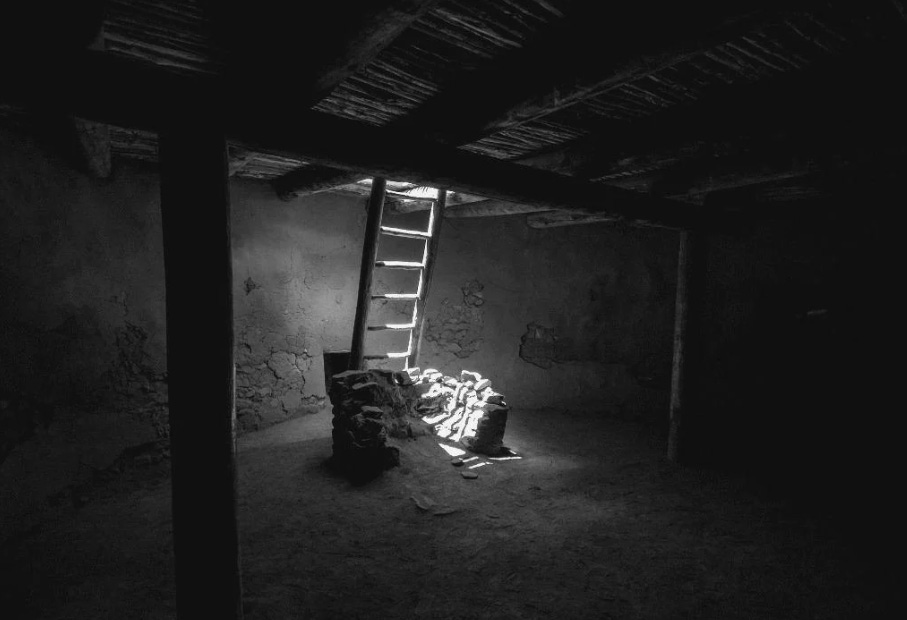
[Basement Image from WallPaperAccess.com]
How are We to Understand the ‘Hidden Hold of Horrors’ Golden Thread? What does it mean?
As I listed at the end of yesterday’s post and the conversation with Nick above, Rowling’s childhood home with its hidden depths beneath the floorboards and neighboring graveyard and attendant ghosts is only one part of the explanation for the Hidden Hold Golden Thread. It’s a wonderful point of origin and launching pad for inspiration, certainly, but restricting the interpretation of her usage of this meme to nightmares and flights of fancy she had as a child about the sublimely subliminal spaces around her is, for lack of a better word, lazy.
Her use of these spaces again and again reflects, I’m sure, to a certain degree her psychological Default Setting from childhood memories of the ‘Wet Nightmare Place’ under the dining room table and next door. But Rowling’s mind was shaped as much by her bibliography, the books she read and loved, as by her biography, the exterior circumstances of her life. Her reading is the bridge linking her Lake and Shed creative process and it plays an outsized role in her Golden Threads as well.
Granting that the first inspiration of her unconscious mind may just have been childhood fears and fantasies, knowing that Rowling has read Homer, Virgil, and Dante and studied Greek mythology from her time at Wyedean Comprehensive through UExeter means that a Trip to the Underworld to speak to the dead is a touchstone of myth and epic. There’s a word for this commonplace, katabasis, the going-down-and-coming-back.
Odysseus visits Tiresias, Aeneas his father Anchises, Dante with Virgil tours the Inferno’s multiple levels — and Psyche is sent by Venus into Hades on the last of her purgative trials.· Rowling, having entered into these stories, knows they are delivery vehicles for the cathartic transformative change to be found in consultation with the dead and in thinking about death.
Joseph Campbell famously argued in Hero with a Thousand Faces that per James Joyce, ethnographers, and comparative mythology experts this descent into the nether worlds and return was an essential aspect of the “monomyth” or Ur story underlying all story and myth. Campbell’s more important contribution was arguing that this was not an abstract historical or literary assertion but one fundamentally important in every human being’s life and psycho-spiritual development.
The Journey to the Underworld from this perspective is that it represents the conscious entry into the Unconscious Mind, the Hidden ‘Depths’ of the Person Behind the Persona-Mask. Rowling has said that, if the writing dream had not worked out, she would have studied to become a psychologist. It is a touchstone belief of Fourth Generation Rowling Studies that, even though the writing gig did work out, that Rowling-Galbraith still became a psychologist in the sense of a person working to help her client-readers experience meaning (logos) more profoundly in their souls (psyche).
Every time we descend into the depths with Harry, Ron, and Hermione, with Cormoran and Robin, or with Jack Jones, we jump into a shared psychological crucible for our alchemical dissolution, purification, and reintegration. In this Golden Thread, we can see the Shed tools of literary alchemy, mythology, psychomachia, Christian symbolism, chiastic writing, and cathartic shock all at work.
And, though speculating about the novel-on-the-near-horizon isn’t a signature quality of Fourth Generation reading, I would be remiss not to point out that Rowling-Galbraith has left pointers in Hallmarked Man and throughout the Strike series that Robin Ellacott is on a ‘Heroine’s Journey’ — and overdue for a trip to Hades.

Pointers to Trips Underground to Come in the Cormoran Strike Series’ Remaining Books
Subscribers to Hogwarts Professor are familiar with Rowling-Galbraith’s use of the Cupid and Psyche Myth as a template for the Strike-Ellacott series, a use the author highlighted in a tweet after the publication of Strike 8. That myth is about the Soul’s trials to be worthy of Divine Love, Psyche being the Greek word for Soul and Cupid or Eros for love (Anteros for True Love). Psyche’s great trial is her descent into Hell at Venus’ command to receive from Persephone a gift for the Goddess of Beauty. As infernal as Robin Ellacott’s sufferings have been, Serious Strikers have been anticipating that she will at last ‘go there’ for real in Strike 9.
Iris T. M. wrote in The Rowling Library Magazine, Issue #99 (March 2025), her belief that Robin’s story arc conformed, intentionally or not on the author’s part, with ‘The Heroine’s Journey.’ See ‘Robin’s Heroine’s Journey: How J. K. Rowling’s Robin Ellacott from the Strike Series Follows the Classic Path of Self-Discovery’ in that archived issue of TRL (and say a prayer for the return of The Rowling Library in 2027!). Iris mentions psychotherapist Maureen Murdock as the original advocate of a ‘Heroine’s Journey’ distinct from a Campbell-esque ‘Hero’s Journey,’ but uses the ‘Aletis’ archetype of Jody Gentian Bower as her framework for tracing Robin’s story arc. It’s a brilliant exegesis and well worth reading in full.
It misses the mark, however, in at least three important respects.
First, it makes no mention of the Cupid and Psyche myth, which conforms to every ‘Heroine’s Journey’ marker and is Rowling’s only admitted mythological template for the series;
Second, it was written before the publication of Hallmarked Man so Iris T. M. could not have seen that Rowling-Galbraith gave a historical character, a 19th Century Freemason, silver millionaire, and author of Secrets of the Craft (see Ed Shardlow’s discussion of his importance here), the name Alexander Hughson Murdock. Taking that as a pointer to Maureen Murdock and her groundbreaking The Heroine’s Journey: Woman’s Quest for Wholeness, we’re obliged, I think, to look at the stages Dr Murdock assigns to this transformative odyssey.
Last, that look reveals a stage that Iris, Bower, or both neglect, namely, ‘Initiation and Descent to the Goddess’ after ‘Awakening to Feelings of Spiritual Aridity/Death.’ Iris following Bower looks for a ‘Dark Night of the Soul’ and attendant “descent into the underworld,” which she ties to Robin’s being buried alive at the UHC’s Chapman Farm in Running Grave. She argues that after this experience “two key stages remain in the Aletis Journey: Self discovery and integration—where she fully embraces her skills and authenticity—and the Establishment of a new home, where she builds a life that reflects her true self and her desires.”
A Murdock reading, in contrast, suggests that Robin’s descent into hell has not yet begun or is not yet over.
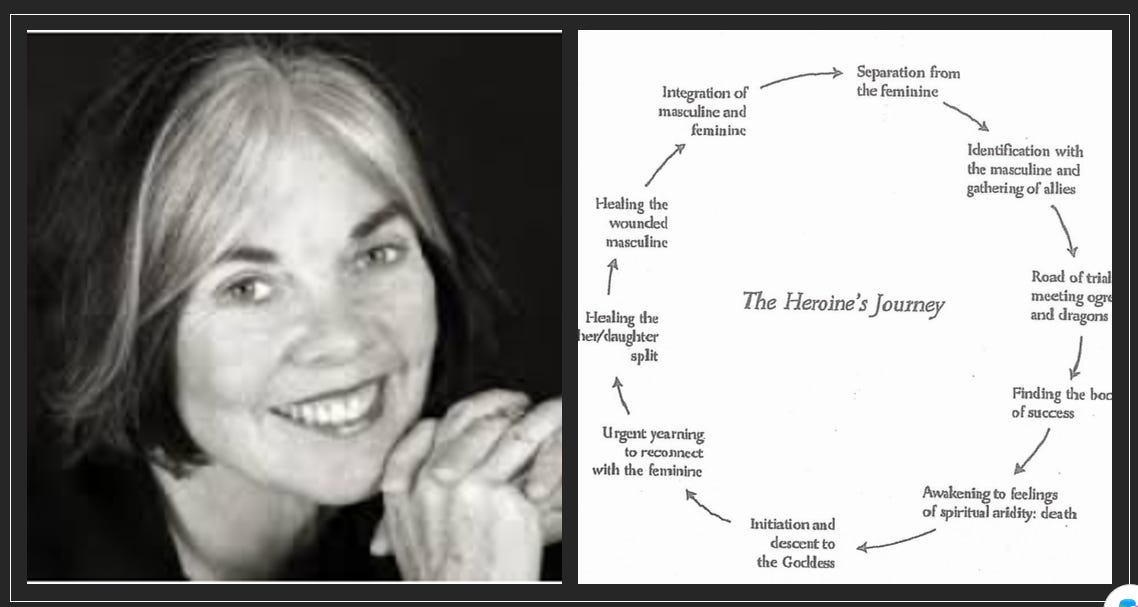
Heroine Journey’s Cycle image source; Maureen Murdock image source
Murdock’s ten stage Heroine’s Journey looks like this per HeroineJourneys.com with my notes in [Brackets}:
HEROINE SEPARATES FROM THE FEMININE. The “feminine” is often a mother/mentor figure or a societally prescribed feminine/marginalized/outsider role. [Robin’s decision to pursue her vocation to be a private detective despite her fiancee’s and family’s disapproval, especially Linda’s]
IDENTIFICATION WITH THE MASCULINE & GATHERING OF ALLIES. The heroine embraces a new way of life. This often involves choosing a path that is different than the heroine’s prescribed societal role, gearing up to “fight” an organization/role/group that is limiting the heroine’s life options, or entering some masculine/dominant-identity defined sphere. [Her move from secretary to detective to partner at the Agency]
ROAD/TRIALS AND MEETING OGRES & DRAGONS. The heroine encounters trials and meets people who try to dissuade the heroine from pursuing their chosen path, or who try to destroy the heroine. [Insert list here of those who try to convince Robin to leave the Agency or to kill her.]
EXPERIENCING THE BOON OF SUCCESS. The heroine overcomes the obstacles in their way. (This is typically where the hero’s journey ends.) [Partner status and respect of Strike and the Met as a First Tier detective]
HEROINE AWAKENS TO FEELINGS OF SPIRITUAL ARIDITY/DEATH. The heroine’s new way of life (attempting the masculine/dominant identity) is too limited. Their success in this new way of life is either temporary, illusory, shallow, or requires a betrayal of self over time. [Robin’s growing awareness that her vocation as a detective is in an undefined but certain way in conflict with her life as a woman and the roles of wife, daughter, and mother]
INITIATION & DESCENT TO THE GODDESS. The heroine faces a crisis of some sort in which the new way of life is insufficient, and the heroine falls into despair. All of the masculine/dominant-group strategies have failed them. [Strike 9! Robin breaks down but conferring with the Goddess-Crone, her Jungian psychoanalyst, she learns how imbalanced her life has become; she makes decisions a la those of Psyche in Hades per the Crone’s instructions]
HEROINE URGENTLY YEARNS TO RECONNECT WITH THE FEMININE. The heroine wants to, but is unable to return to their initial limited state/position. [Ditto]
HEROINE HEALS THE MOTHER/DAUGHTER SPLIT. The heroine reclaims some of their initial values, skills, or attributes (or those of others like them) but now views these traits from a new perspective. [I suspect this healing will be akin to Strike’s Chapel ‘conversation’ with the late Charlotte Campbell; for reasons to be discussed, I think Linda Ellacott dies in Strike 9 which precipitates Robin’s mental crisis]
HEROINE HEALS THE WOUNDED MASCULINE WITHIN. The heroine makes peace with the “masculine” approach to the world as it applies to them. [Strikes 9 and 10]
HEROINE INTEGRATES THE MASCULINE & FEMININE. In order to face the world/future with a new understanding of themselves and the world/life, the heroine integrates the “masculine” and “feminine” qualities/perspectives. This permits the heroine to see through binaries and to interact with a complex world that includes the heroine but is also larger than their personal lifetime or their geographical/cultural milieu. [The Alchemical Hermaphrodite or Rebis, Strike 10]
I think there are two more Golden Threads to be explored in Rowling’s work that are rooted in Tutshill’s Church Cottage and Rowling’s life there, both of which I began to pull in the conversation with Nick above, namely, the Nightmare Upstairs Room and the Neglected Dead Mother. But those will have to wait for another day!
Hats off in salute to Iris T. M. for her work with Robin’s ‘Heroine’s Journey’ (and Strike’s in TRL Issue #100)! Writing as she was before Hallmarked Man and not being familiar with Rowling’s Shed tools and how they work together, she still revealed the psychological template Rowling is deliberately following, it seems, if the Murdoch name drop is any indication.
The Hidden Hold of Horrors, then, is an especially rich Lake-Shed-and-Golden-Thread story point in Rowling’s work. Stay tuned for more of the same with respect to Mums and Upstairs Nightmares!
The Ten Questions with Notes and Links
1. Good day, Nick! What can you tell me about the trap door basement in Rowling’s childhood home, Church Cottage in Tutshill?
2. So, it’s bigger than I once thought. Are you asking for the reasons I think you’re asking?
Golden Thread discussion above
3. So, yes, that Ironbridge cellar and my recent revisits to Harry Potter and the Philosopher’s Stone with its gauntlet run beneath a trapdoor, made me wonder: is the nightmare basement a Rowling Golden Thread? It’s not as if all of them have been identified; you just came up with the Crimson Golden Thread this year --
4. How many Golden Threads have we discussed, John? Why do we care again?
Golden Thread 1: Kanreki (Bad Dad, Writing about Writing, Violence against Women, the Evils of Fleet Street, Mother Love, Ghosts, Pregnancy Traps, the Lost Child with Grieving Steward)
Golden Thread 2: Kanreki (Evil Government, Occult tropes, the Embedded Author, the Search for the Real, Embedded Texts, and Shadow Doppelgangers)
See Golden Thread discussion above.
5. So it’s a Big Deal, really. Care to join me in reviewing Rowling’s work to see what’s lurking in her basements? (Harry Potter back and forth)
6. How about the Stand-Alones, John: Casual Vacancy, the Ickabog, The Christmas Pig? And the collaboration exercises, Cursed Child and Fantastic Beasts (back and forth)
7. And Cormoran Strike? (back and forth)
Rowling Golden Thread: The Hidden ‘Hold of Horrors Downstairs, Beneath the Trap Door
Nick: “And the Dell, of course, in Lethal White’s Chiswell House, where the remains of the Shetland pony are dug up in the pink blanket.”
8. Okay, that was fun -- and we have sufficient evidence to say that Rowling thinks of the spaces downstairs as wet, scary, even horrible. So what? Tell me this isn’t just a Lake inspiration bit; what is this very deliberate artist choosing to do with the basement image? Do we have any bibliographic pointers?
Discussion Above in text.
9. What about the psychological piece here? Rowling has said she’d have been a psychologist if the writing gig hadn’t worked out. Is her ‘underground’ piece of Harry’s Journey everywhere our moving into the subconscious of depth psychology?
Joseph Campbell ‘Hero’s Journey,’ Joyce scholar, Jung disciple, monomyth advocate – myth not only historical but important as individual psychological template;
Maureen Murdock ‘Heroine’s Journey,’ Jungian psychotherapist, writing for therapiss and patients not writers on Campbell model, “Initiation and Descent to the Goddess”
Victoria Lynn Schmidt ‘Heroine’s Journey for Writers’
Iris T. M: The Heroine’s Journeys of Robin Ellacott (TRL #99) and of Cormoran Strike (TRL #100)
10. Do you think we’ll be going underground in the last two Cormoran Strike novels?
YES, we will!