
Introduction
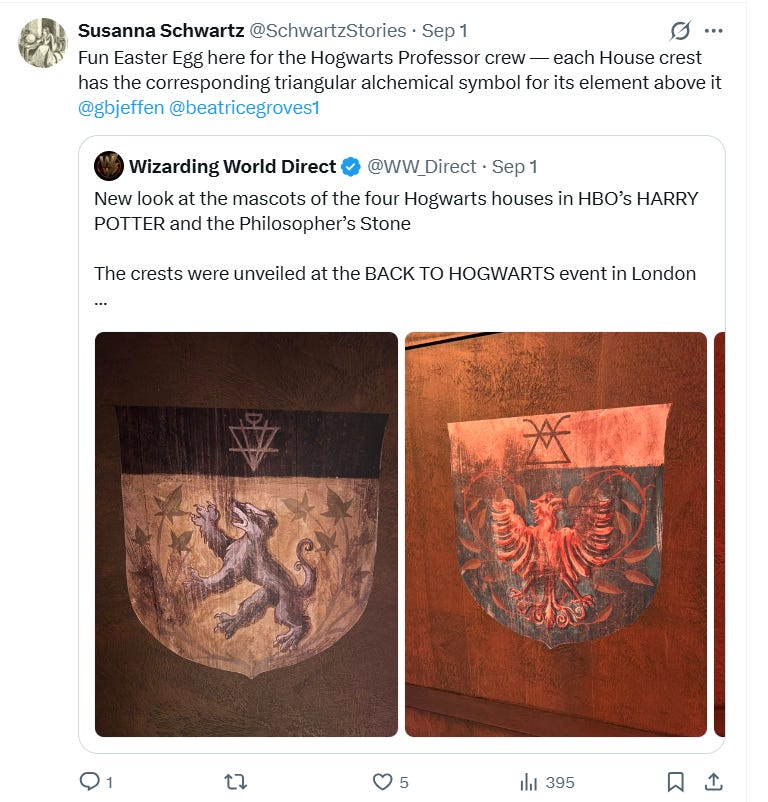
Wizarding World Direct Twixter Url
Long-time friend of Hogwarts Professor Susanna Schwartz threw down the gauntlet for the “crew” here to unpack, if you will, the “Easter Eggs” within the Bronte Studios/HBO+ Harry Potter adaptation versions of the Hogwarts House emblems. Susanna spotted the triangular symbols of the Four Elements above the appropriate houses, but, it being only a tweet (and a tease), she left it for us to explore here why those four triangular symbols represent Earth, Air, Fire, and Water, and to add some some notes about the heraldry of it all.
Which I’m delighted to do! Tomorrow I hope to take up another challenge question of Susanna’s but today it’s all alchemy, heraldic plant ornamentation, and a little fan servicing, a bunch to explore in search of explanation.
First, though, what are we talking about? What new Hogwarts House emblems?
New and Old Hogwarts House Emblems
The House emblems that we’re used to seeing are the ones that were used in the Warner Brothers film adaptations and consequent flood of merchandise and the fandom art largely derived from the movie markers (sometimes called “crests” or “shields” but properly [?] “emblems”). Here are those emblems courtesy of Nerdcottics at r/HarryPotter:
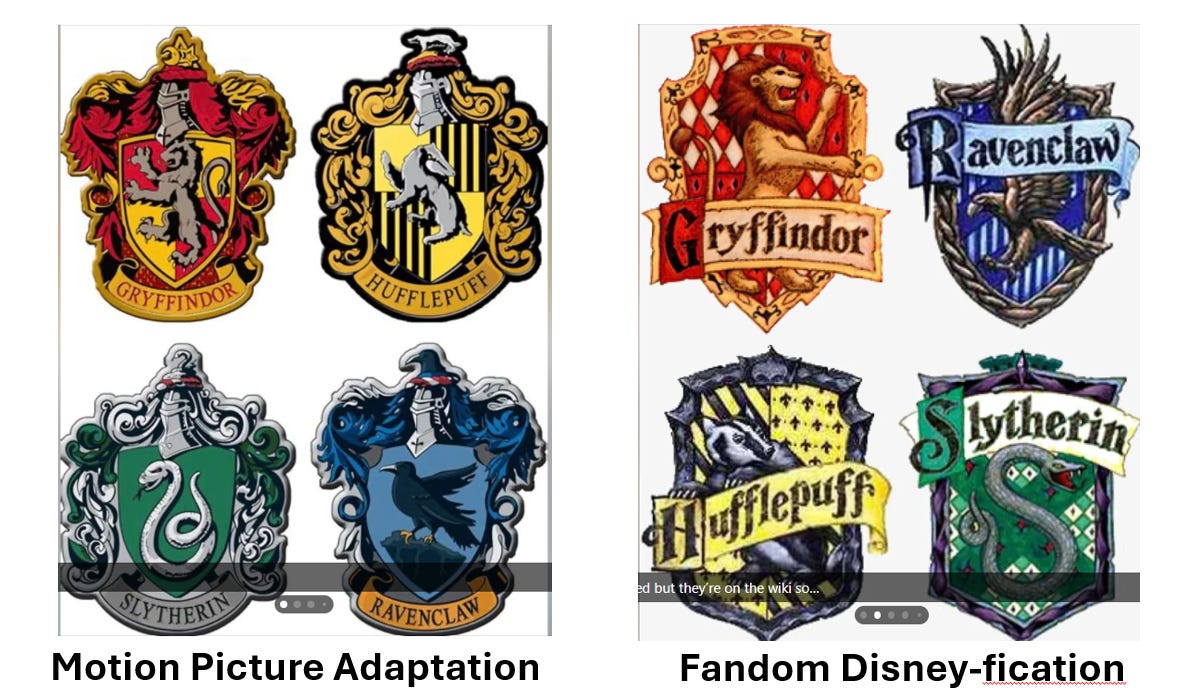
There were complaints about these emblems from their premiere in the first Warner Brothers effort in 2001, just as there are now complaints that the new emblems are not as good as the film emblems. Ravenclaw members were especially put out because the book emblem features an eagle, not a raven, and the colors blue and silver in the films supplanted the original blue and bronze, the latter supposed to reflect the color of eagle’s feathers.
If you read those who reject the new emblems, the complaints are mostly from the relatively direct circles seen very briefly in this Instagram film at HBOmaxANZ. They look like this:
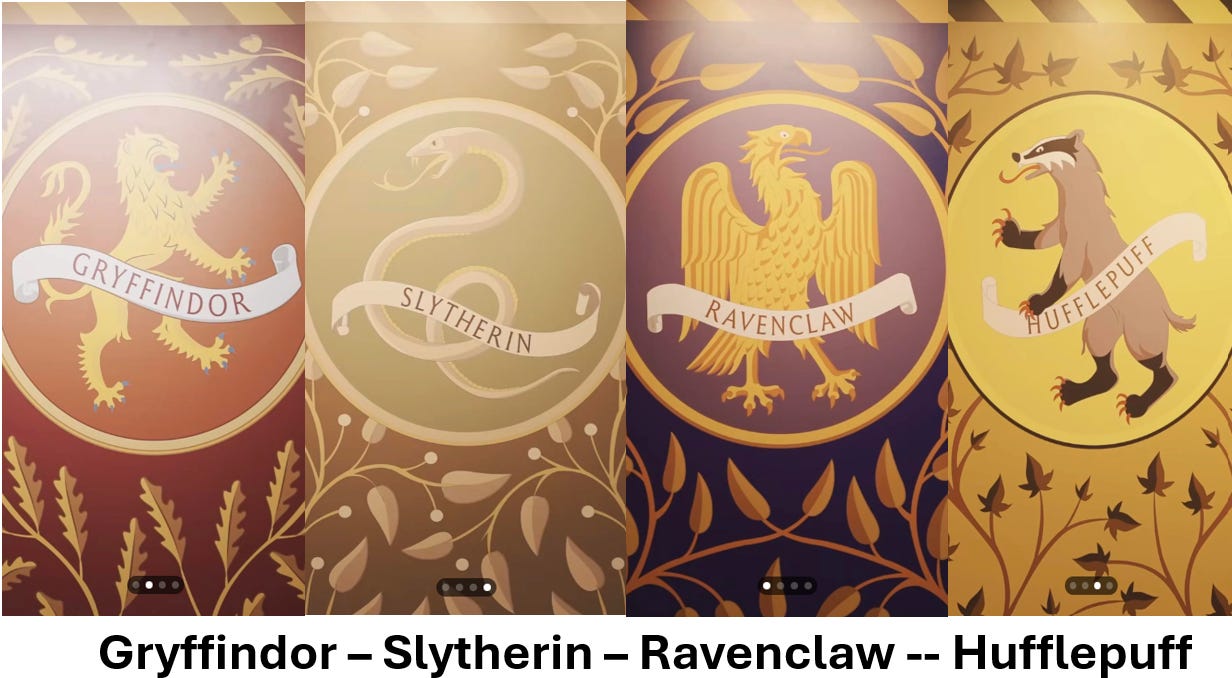
Hat Tip to Sad-Ad-9273 at r/HarryPotteratHBO for these screen catches!
My favorite description of them has been that they look like AI generated stickers from a children’s game or the dentist’s office. The defense is that that these relatively simple images are not emblems per se but banners that hang in the Houses and the Great Hall. De Gustibus…
The proper emblems seen in the 1 September Wizarding World Direct tweet that Susanna Schwartz asked us to unpack are quite different, much less slick if you will, and with much more detail to come to terms with. From the Wizarding World Direct images:
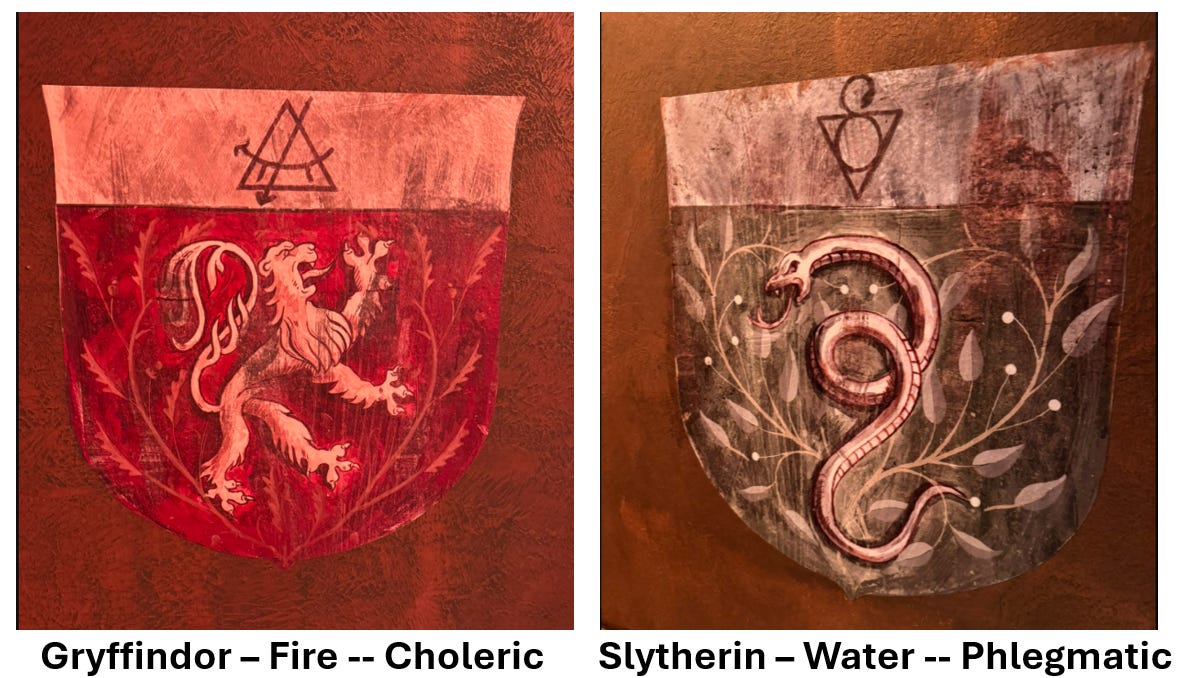
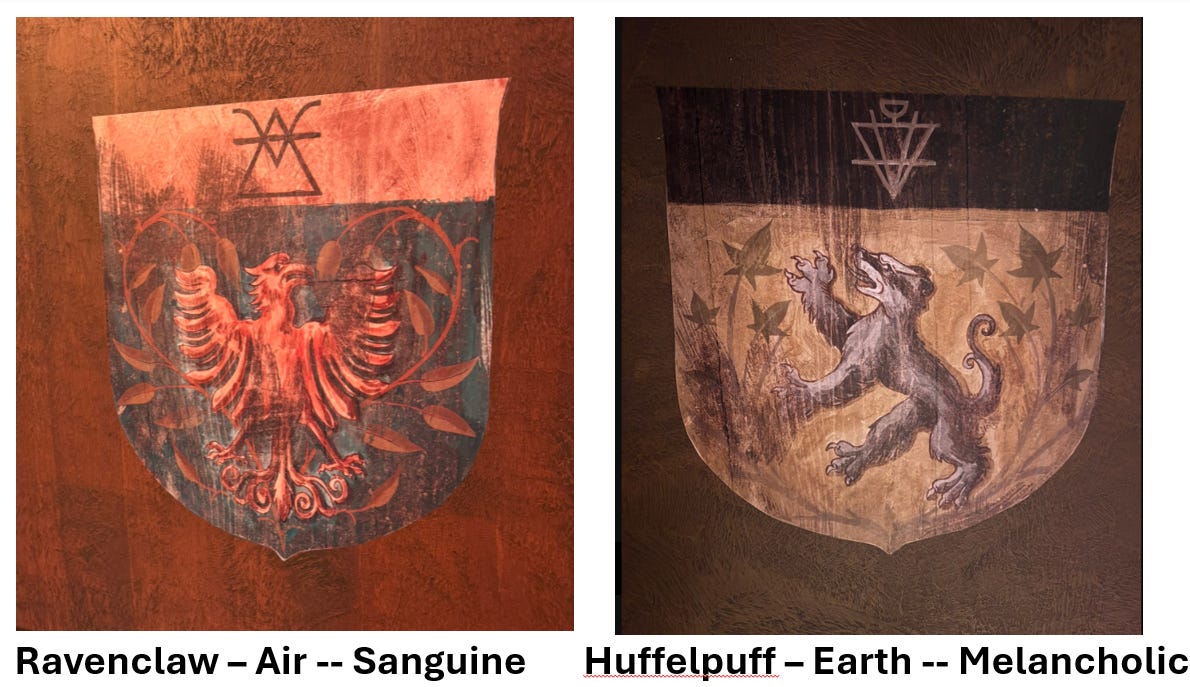
The heraldic beasts and plant ornamentation reflect the banner imagery spot on. The conversation starts with the blended symbolism of the images at the top of the emblem, in the center of which band is the symbol of the four elements used by alchemists assigned to each House by Rowling in a 2005 interview with a pointer to the House Founders and the signature quality of their namesake houses.
Before we get to the points of interpretation, though, let’s review that 2005 interview. Rowling was discussing the relationships of the Houses with Emerson Spartz of MuggleNet and Melissa Anelli of The Leaky Cauldron the day after the publication of Harry Potter and the Half-Blood Prince. From Accio-Quote’s archives:
JKR: But they’re not all — don’t think I don’t take your point, but — we, the reader, and I as the writer, because I’m leading you all there — you are seeing Slytherin house always from the perspective of Death Eaters’ children. They are a small fraction of the total Slytherin population. I’m not saying all the other Slytherins are adorable, but they’re certainly not Draco, they’re certainly not, you know, Crabbe and Goyle. They’re not all like that, that would be too brutal for words, wouldn’t it?
ES: But there aren’t a lot of Death Eater children in the other houses, are there?
JKR: You will have people connected with Death Eaters in the other houses, yeah, absolutely.
ES: Just in lesser numbers.
JKR: Probably. I hear you. It is the tradition to have four houses, but in this case, I wanted them to correspond roughly to the four elements. So Gryffindor is fire, Ravenclaw is air, Hufflepuff is earth, and Slytherin is water, hence the fact that their common room is under the lake. So again, it was this idea of harmony and balance, that you had four necessary components and by integrating them you would make a very strong place. But they remain fragmented, as we know.
The glyphs in the bands, then, for starters reflect Rowling’s plan for Hogwarts House symbolism. We will have to come back to this, of course, but let’s grab the low-hanging fruit first.
Points of Interpretation: The House Founder Signatures, Voldemort’s Horcruxes
Harry Potter online fandom is much more aware of the depth of Rowling’s artistry with symbols than Generation Hex was; note that Anelli and Spartz, both very intelligent people and very serious readers of the six books they had in hand, didn’t follow up Rowling’s answer about the four elements with a question about the alchemy of the series. Today, the alchemical markers for the elements appeared and the reddit fandom had its instant translation into Rowling’s 2005 House assignments. Which didn’t explain the symbolism of the triangles but we’ll get to that in a minute.
First, the fan servicing piece that is a lot of fun. The four elemental triangles have tokens above and within them corresponding to House Founder items that became Voldemort Horcruxes:
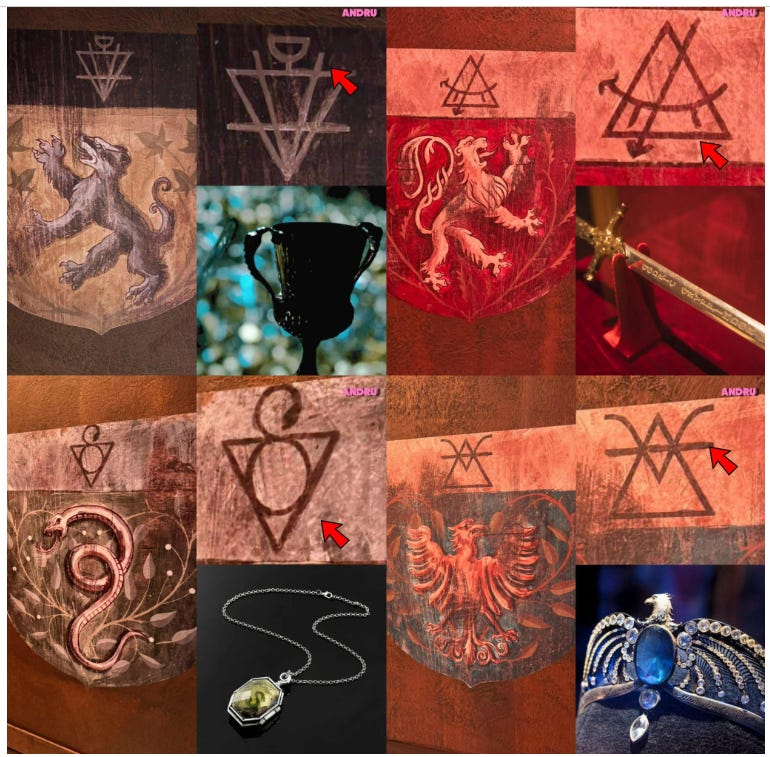
[Hat Tip to LightAngel452 at r/HarryPotteratHBO for the brilliant graphic! LightAngel also picked up on the alchemical symbols.]

Without squinting too hard or crinking one’s neck, you can make out the Slytherin locket, the Ravenclaw diadem, the Hufflepuff cup, and the Sword of Gryffindor slaying a neolithic beast (a White Horse of Uffington?). Ah, but there’s more!
Points of Interpretation: The Triangles of the Four Elements
Nick Jeffery wrote up the new emblems, HBO’s Harry Potter and the Alchemical Symbols, at the Hogwarts Professor weblog — and he found the alchemical symbols on Wikipedia’s page for such things.
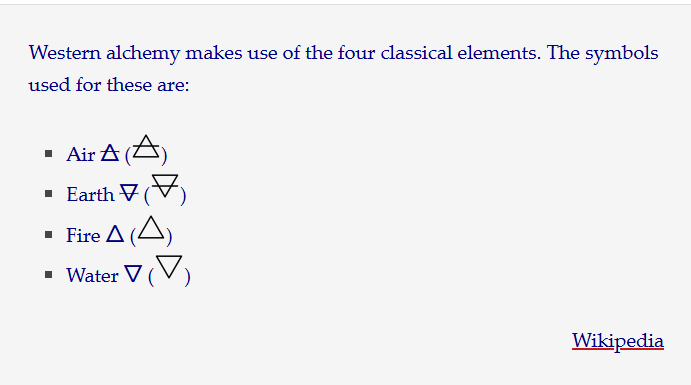
No, I don’t know why Wikipedia repeated the symbols within parentheses immediately after showing the symbols with their respective element.
Connect the dots, though, between the triangles representing each element and the triangles in the emblem heading for each house: Right side up equilateral triangle, Fire, Gryffindor; right side up equilateral triangle bisected left to right, Air, Ravenclaw; Upside down triangle, Water, Slytherin; and Upside down bisected triangle (left to right), Earth, Hufflepuff. Direct hits for the Rowling 2005 assignments, every one.
Which is neat, right?
But why do these triangles represent the four elements? Whence the symbolism and what does it mean?
Susanna Schwartz asked the “Hogwarts Professor crew” to unpack these “Easter Eggs” because she knew we’d love to write it up (I’m guessing Susanna already knows the origin of the symbolism; 10 points to Ravenclaw for humility and kindness in letting us spell it out.)
In brief, it’s from the Seal of Solomon the alchemists considered their touchstone image, the symbol known today as the Star of David. Titus Burckhardt explains it in real detail in the fourth chapter of his Alchemy: Science of the Cosmos, Science of the Soul, ‘Spirit and Matter:’
The application of the mutually complementary concepts forma and materia to the realm of the soul makes it clear in what sense certain sensible data such as the four elements are to be transposed onto the psychic plane. Just like the corporeal materia, which manifests itself most readily in the four elements, so the materia of the soul, in its deployment, has several mutually opposing tendencies.
It has a tendency ‘downwards’, towards inertia and earthy denseness.
At the same time it has a tendency ‘upwards’ like the element fire, towards the Spirit.
Again it has a tendency towards expansion – either passive and relatively inert, like that of water, or more active and mobile, like that of air.
As applied to the soul, ‘earth’ is that aspect or tendency which causes it to sink into the body and which attaches it to the latter. ‘Fire’ has the same purifying and transmuting character as outward fire. ‘Water’ is capable of assuming all forms. In its original and uncorrupted nature water is, in the words of St. Francis of Assis, umile e Preziosa e casta (‘humble and precious and chaste’). For the soul, ‘air’, free and mobile, envelops all forms of consciousness.
The signs of the four elements derived from the Seal of Solomon are particularly lucid when it comes to their application to the soul.
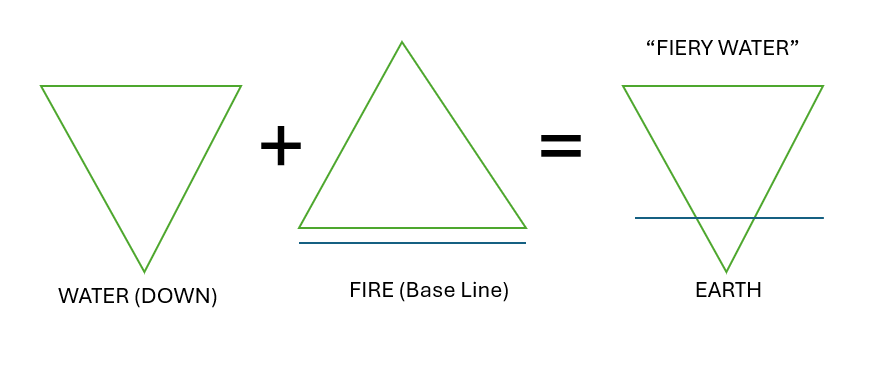
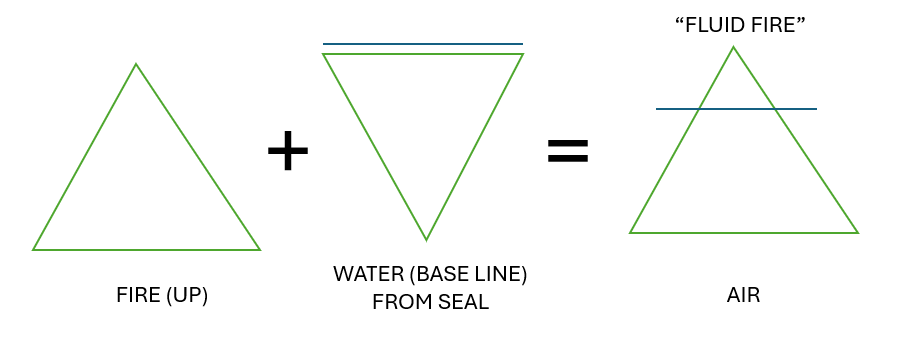
From them, it can be seen that the plurality of the elements derives from the opposition of fire and water, that is, from the pair activity-passivity (which of course corresponds to the pair forma-materia). It is the same opposition which we shall later encounter in the form of sulphur and quicksilver.
Through the union of opposites the soul becomes ‘fluid fire’ and ‘fiery water’, and at the same time also acquires the positive qualities of the other elements, so that its water becomes ‘stable’ and its fire ‘non-burning’; for the ‘fire’ of the soul is that which confers stability on its ‘water’, while the ‘water’ of the soul confers on ‘fire’ the mildness and ubiquity of ‘air’.
The ‘inward elements’ may also be considered as pure qualities of the spirit, and ultimately as immutable aspects of Being. Seen in this way, their union and reconciliation consists in the fact that in each individual elemental quality the others are also contained, for Pure Being is both simple and inexhaustibly rich.
The highest meaning of alchemy is the knowledge that all is contained in all, and it magisterium is none other than the realization of this truth on the plane of the soul. This realization is effected by means of the creation of the ‘elixir’, which unites in itself all the powers of the soul, and thus acts as a transmuting ‘ferment’ on the psychic world and, in an indirect fashion, on the outward world also.
As there is no corporeal substance that is completely cut off from the higher modes of being it is possible in certain circumstances to transpose powers pertaining to the soul or spirit onto a corporeal substance, so that in a certain way they become attached to it. Thus the inward elixir of the alchemists may in some cases have an outward counterpart. (Highlighting and paragraphing added; pp 74-75)
That’s rough sledding even for seasoned Perennialists if you haven’t read the first four chapters of the book. Burckhardt, who probably had forgotten by the time he wrote this book a time when he didn’t know that the four signs for the Elements used by alchemists derived from the Seal of Solomon, doesn’t make it easy on the reader not willing to pause and figure out what he means here.
How about some helpful illustrations? The Seal of Solomon, for starters, is the symbol of the conjunction of heaven and earth, specifically of the opposites ‘Fire’ and ‘Water,’ hot & dry and cold & moist, respectively. Fire is the right side up triangle pointing upward as it rises naturally; water is the upside down triangle of rain descending sky to the earth and of the tides.
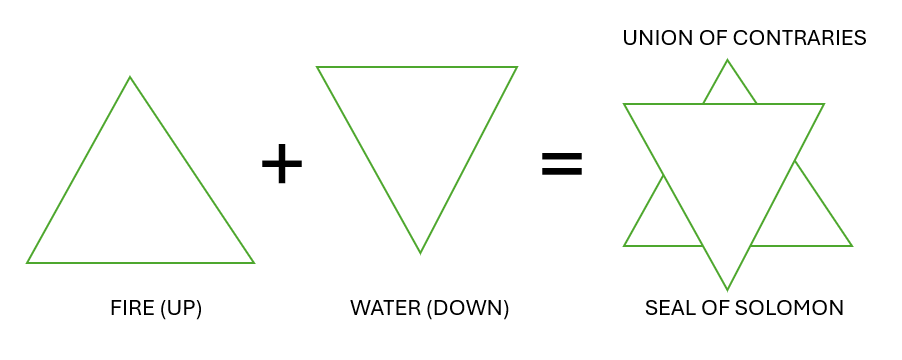
Whence cometh the Earth and Air bisected triangles? Earth is primarily a ‘downward’ or materia element, do its triangle is derived from water’s. Just as a human being in a body is animated by the upward element of the soul reaching for the spiritual realm, however, earth is water as influenced by the base of the fire triangle in the Seal of Solomon that bisects the reversed apex of the water triangle:
And the same in reverse for fire as influenced by the base line of Water yielding the “Fluid Fire” of Air:
This is the iconography of Creation in which the simultaneously Transcendent and Immant God is visible everywhere and in every thing, visible and invisible, whence Nature being a theophany as great as Scripture, perhaps even greater because of its ubiquity and value for meditation (cf. Romans 1:20 for St Paul’s statement of the obvious in his time, the E=MC2 of the Apostolic Mediterranean world’s Four Element physics. It would be impossible to overstate the centrality of this understanding to alchemy — and to literary alchemy because, as Burckhardt noted, it is most profound when applied to the soul in its longing for spiritual transformation, psychic lead to the pure light or gold of the Spirit.
Scroll back up to what Rowling said she was trying to represent with the Houses allegorically: “it was this idea of harmony and balance, that you had four necessary components and by integrating them you would make a very strong place. But they remain fragmented, as we know.” I offer it as a point of reflection that this is her exteriorization of the interior transformation going on in Harry Potter that will result in his sacrificial death and victory over death at the end of Deathly Hallows, the apotheosis that was the goal of esoteric metallurgical alchemy. The symbolism and cathartic effect of which was lifted by the playwrights, poets, and prose writers of the English hermetic tradition.
That’s why, in the end, the HBO+-Bronte Studios folks embedded the alchemical signs for the Four Elements within the new House emblems. It’s part and parcel of Rowling’s revived literary alchemy, the subliminal artistry to turn us right side up and inside out, soul seeking its end in Spirit.
Points of Interpretation: Plant Ornamentation, House Leaves
I was way out of my league on the leaves decorating each banner and emblem (and I left all my Heraldry symbolism books in Oklahoma City, alas and sigh). So I took the cowards way out: I contacted Sandra Miesel Kopec, an undisputed and brilliant Subject Matter Expert on all things Heraldry with a special affection for plant lore. Which is not to mention her Order of Merlin, First Class, during the Potter Panic years, earned in continuous combat with Catholic Harry Haters far and wide.
I sent Sandra the banners and emblems and begged for help. She responded almost immediately:
Hi John,
I love this topic!! Gardens are my happy place.
Based on the Hogwarts song, Slytherin are from a fen, and yew trees grow well in wet conditions. They also have berries and all parts are toxic. We know Voldemort’s wand was from yew.
Gryffindor is associated with moorlands, which like fens don’t have a lot of trees, but hawthorns do quite well, able to withstand the wind. The heraldic hawthorn leaves look just like the picture for Gryffindor.
Laurel trees seem like a good choice for Ravenclaw because of their association with scholarship. Also laurels do well with the better drainage of mountain glens.
I wonder if the picture of Hufflepuff heraldry has ivy leaves. Vines symbolize hardwork and prosperity which sounds like Hufflepuff. It could also be grapevines...
That’s my initial thought. But now I’m really curious.
Sandy
I’m going to leave it to you all to connect the dots Sandra has given us for the House trees with the symbolism she has has all but spelled out via a website devoted to these things: ‘What Do Leaves Represent on a Coat of Arms’
Points of Interpretation: Alternative Ideas (‘V’s in Ravenclaw and Hufflepuff ‘Crowns’)
There’s more about these symbols that I didn’t understand than just the plant ornamentations. The ‘V’s in the Ravenclaw and Hufflepuff emblems, for instance, left me scratching my head and just plain guessing.
The answers, though, are out there. Here is a Redditor who I think has drilled the answer to the ‘V’s, oidit at r/HarryPotteratHBO:
They also represent a stylized version of their animals: the curved drawing on the gryffindor one is a lion, the two diagonal stripes on hufflepuff’s are the badger face stripes, a V to represent the eagle for Ravenclaw, and the S symbol in slytherin is both a snake and the medal.
So each symbol contains three separate meanings: their element, the animals and the hallow.
They cooked with these symbols
Conclusion: Team Rowling is Paying Attention to the Details
I don’t agree with oidit on everything there, but I sure am on board with that conclusion. I’m sure some readers thought I went overboard last week in my explanation of Rowling’s tweeted Heart, Owl, and Lightning Bolt to say what she wanted to say about the new teaser trailer for the HBO+ adaptation: The HBO+ Potter Trailer: The Meaning of Rowling’s Heart, Owl, and Lightning Bolt.
Read the post above again if you think Rowling and Company are not going all in on the detail work for this adaptation. Compare the depth of meaning and artistry in the new emblems with the marketing crests created by Warner Brothers back in the aughts. There really is no comparison, even putting aside the errors in the film House glyphs.
Let me know your thoughts on all this in the comment boxes below! Tomorrow another Susanna Schwartz challenge on a much more explosive subject. Stay tuned!
Whoops! I wrote to Sandra Miesel Kopec to ask for her help interpreting the heraldic symbolism of the plants on the new Hogwarts House emblems.
Before she could answer I sent her a second email with the new banners which had clearer pictures of the plants.
She responded immediately to that note and I quickly put up her response and mailed it out to y'all.
But I made a mistake.
I sent the second note to Sandra *Hope* not *Miesel Kopec*; Sandy responded immediately and neither one of us caught my mistake. Because of our frequent correspondence on the Moderator Backchannels, especially during the Team Charting of Hallmarked Man, she is my default *Sandra* in Gmail.
So, the helpful notes about Plant Symbolism are from Sandra Hope, not Sandra Miesel Kopec. My apologies to both women for this gaffe!