
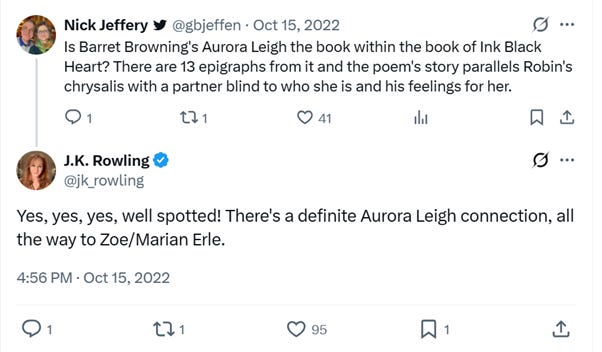
Among our first discussions after the publication of The Hallmarked Man, we asked the question if among the epigraphs, there was a hidden ‘book-within-the book’. John Granger, brilliantly, identified Aurora Leigh as that book within The Ink Black Heart, and when I asked J. K. Rowling that question, she enthusiastically confirmed it.
With six epigraphs contained in The Hallmarked Man John Granger has speculated, both on our podcasts and privately, that Rober Browning’s The Ring and the Book would be the book-in-the-book for Strike 8. It will come as no surprise, that John was right. Browning’s epic poem contains clear correspondences with The Hallmarked Man and forms the template of the Ironbridge mystery on which the whole complex plot depends. Getting to that understanding, however is no easy task.
The Ring and the Book
The Ring and the Book (1868–1869) is Robert Browning’s epic verse novel, a 21,000-line dramatic poem structured as 12 books in blank verse. It retells a real 1698 Roman murder trial from an “Old Yellow Book” Browning found in Florence. It follows multiple perspectives through dramatic monologues, exploring themes of truth, perception, justice, morality, and human nature.
The Ring and the Book by Robert Browning is generally considered difficult to read, especially for modern readers or those not already familiar with Victorian poetry, dramatic monologues, or dense blank verse. For the first book, entitled The Ring and the Book, I would revise this opinion to near impossible. Browning’s blank verse is often convoluted, with long sentences, elliptical syntax, archaic and Italianate phrasing (to evoke the period), frequent use of classical and legalistic Latin, heavy allusions, and psychological depth that demands close attention. Book one, particularly, seems dense, clogged, turgid, and requires hard work to follow.
It’s Browning’s longest and most ambitious work—a verse novel of over 21,000 lines structured as multiple dramatic monologues retelling the same 17th-century Italian murder trial from different perspectives (including the murderer, the victim, lawyers, and the Pope).
Fortunately for the beleaguered modern reader, from the second book, the gossipy Half Rome, there is enough narrative to propel you forward, even with frequent stops to look up words and phrases that are antique (and frequently uniquely coined by Browning).
Core Story (the Historical Events)
In 1693–1694, the impoverished middle-aged Count Guido Franceschini, a nobleman from Arezzo, marries the beautiful teenage Pompilia Comparini (around 13–14 years old) in a transactional arrangement. Pompilia is the daughter of the middle-class Roman couple Pietro and Violante Comparini; Guido seeks her dowry and an heir, while the Comparini gain aristocratic status. The marriage quickly turns abusive and miserable, with Guido mistreating both Pompilia and her parents in their Arezzo home, forcing them to flee penniless
Violante later confesses that Pompilia was not her biological child but one bought from a prostitute to secure an inheritance. Pompilia, unhappy and mistreated, flees Arezzo in 1697 with help from the young canon Giuseppe Caponsacchi, who escorts her back to Rome to her parents. Guido accuses them of adultery and pursues them; the pair is caught, Caponsacchi is exiled, and Pompilia is briefly placed in a convent before returning to her parents in Rome.
On January 2, 1698, Guido and four hired accomplices burst into the Comparini home, brutally murder Pietro and Violante, and stab Pompilia repeatedly (leaving her for dead). Pompilia survives long enough to give a deathbed deposition and dies four days later. Guido is arrested while fleeing, tried in Rome, convicted of murder, and sentenced to death. He appeals to Pope Innocent XII, who upholds the verdict, and Guido is executed.
statement affirming her innocence before dying.Guido is captured while fleeing, tried in Rome for murder, convicted, and sentenced to death. He appeals to Pope Innocent XII, who upholds the verdict. Guido is beheaded.
Structure of the Poem (12 Books)
Browning presents the same core events repeatedly through different unreliable narrators, creating an effect where truth emerges gradually from conflicting accounts:
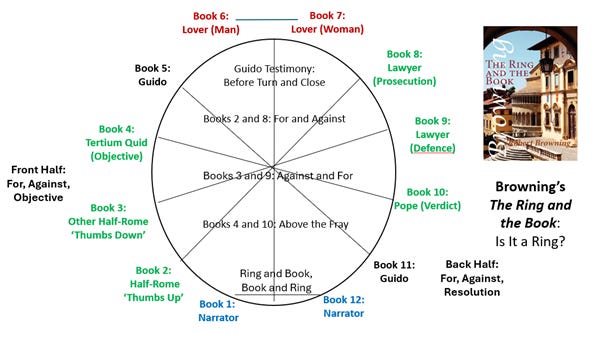
Book 1: The Ring and the Book — The poet/narrator (a stand-in for Browning) describes finding the “Old Yellow Book” (a collection of trial documents) in a Florentine market and outlines the story.
Books 2–4 — Public opinion in Rome: “Half-Rome“ (sympathetic to Guido), “The Other Half-Rome“ (sympathetic to Pompilia), and “Tertium Quid“ (a sceptical third view).
Books 5 — Guido’s monologue (before conviction), defending himself cynically and viciously.
Book 6 — Caponsacchi’s passionate defence of his actions and love for Pompilia (platonic or romantic, depending on interpretation).
Book 7 — Pompilia’s poignant, innocent monologue (often considered the emotional and moral heart of the poem).
Book 8-9 — The lawyers’ arguments (prosecution and defence).
Book 10 — The Pope’s reflective monologue, weighing evidence and ultimately condemning Guido.
Book 11 — Guido’s final desperate plea (his second monologue, more unhinged).
Book 12: The Book and the Ring — The poet/narrator concludes, affirming truth and art’s role in revealing it.
Ring Structure

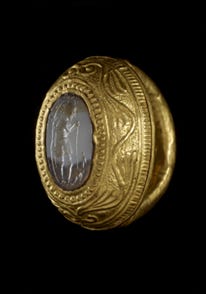
Unlike Elizabeth Barrett Browning’s Aurora Leigh, her husband Robert Browning’s The Ring and the Book is not obviously chiastic, despite a very firm latch in books 1 and 12. The poem begins and ends with the poet/narrator’s voice. This voice describes two objects the “Old Yellow Book” and the “Ring”. The book is a physical artifact and was donated to Balliol college by Fannie Barrett Browning. Together with the book she donated a ring, but it is clearly not the ring that is described in the poem. Balliol have identified a ring that matches the description (ring 356 in the British Museum) but this is an Etruscan original rather than a Castellani (18th – 19th century Roman jewellers) imitation.
Do you see this Ring?
‘Tis Rome-work, made to match
(By Castellani’s imitative craft)
Etrurian circlets found, some happy morn,
After a dropping April; found alive
Spark-like ‘mid unearthed slope-side figtree- roots
That roof old tombs at Chiusi: soft, you see,
Yet crisp as jewel-cutting. There’s one trick,
(Craftsmen instruct me) one approved device
And but one, fits such slivers of pure gold
As this was, such mere oozings from the mine,
Virgin as oval tawny pendent tear
At beehive-edge when ripened combs o’erflow,
To bear the file’s tooth and the hammer’s tap:
Since hammer needs must widen out the round,
And file emboss it fine with lily-flowers,
Ere the stuff grow a ring-thing right to wear.
Book 1- The Ring and the Book
The Ring of the title symbolizes how raw historical fact is wrought with poetic imagination to form a complete, unified artwork that returns to its starting point enriched.
The core events (the murder trial) are circled around repeatedly through multiple perspectives, creating a kind of recursive loop of interpretation. This creates a sense of enclosure, repetition, and return, with the narrative encircling the truth rather than progressing linearly. Some analyses describe the interpretive layers as “recursive” or “self-referential rings of interpretations,” and the framing device reinforces a circular feel.
Dramatic monologues arranged to build towards an emotional centre with Pompilia in Book 7 and Caponsacchi in Book 8, and a moral centre with the Pope in Book 10.
With the imagery of the ring, and the overtly chiastic structure of Aurora Leigh, I was sure that there must be a ring structure that I was missing. I appealed to our ‘Chiastic All-Stars’, when we recorded our Hallmarked Man part 7 ring for the paid subscribers and John Granger, as always has come up trumps! He has identified an asterisk, or mirror image chiasmus:
The Hallmarked Man in Conversation with The Ring and The Book
Even a cursory glance at the plot of The Ring and the Book will demonstrate that this poem forms the pattern and scaffold for both the plot and the characters of the ‘Ironbridge Mystery’ element of The Hallmarked Man.
Chloe Griffiths (Jolanda Lindvall) - Pompilia Comparini. A daughter who isn’t really a daughter. Entrapped while still a child, with her mother, to a violent sadist and sexual predator. Forced to survive alone with her tormentor, she seeks escape with a brave and ant-erotic partner, though pregnant with her abuser’s child.
Ian Griffiths - Guido Franceschini. A deeply monstrous figure and a charismatic manipulator, he fabricates messages from both his captive and the young man who seeks to rescue her. He spreads lies throughout the town to target the young lovers and constructs a false narrative to hide his crimes. Acts in concert with a group of men to attack defenceless women.
Tyler Powell - Giuseppe Caponsacchi. Brave and noble, alone among the townsfolk he aims to rescue the heroine. Adopts disguise to aid escape, but through the villain’s machinations, is separated.
Both works critique abusive relationships and patriarchal power: Guido’s control of Pompilia and Dino Longcaster’s control of Decima Mullins. The legal system (Books 8–9 especially) is satirized as formalistic, pedantic, and often blind to moral reality. True justice requires personal moral intuition beyond mere evidence or procedure. The Pope’s monologue (Book 10) weighs this tension most profoundly. In The Hallmarked Man the police are slow to act on new information gained by Strike and Robin and Farah Navabi manages to hoodwink the courts into escaping punishment for her part in Patterson’s crimes.
The Ring and The Book dramatizes the eternal struggle between good and evil. Pompilia embodies instinctive purity, sacrificial love, and spiritual insight despite her suffering. Guido represents sophisticated, calculating evil that twists morality to justify cruelty. Browning affirms that evil exists but that good can somehow arise from or shine through evil’s consequences. In The Hallmarked Man evil is real, monstrous, and often cloaked in normalcy or power structures, but it can be exposed and defeated through persistence, intuition, and moral courage.
The Ring and the Book in Conversation with Aurora Leigh
Aurora Leigh is a nine-book verse-novel blending autobiography, romance, and social commentary in relatively flowing, accessible blank verse. It follows a linear narrative through Aurora’s life as a woman poet.
The Ring and the Book, in twelve books, adopts a more complex, multi-perspective structure, with multiple dramatic monologues which circle around a single historical murder trial
Browning invokes Elizabeth as “Lyric Love” in the framing books (e.g., invocations at the end of Book I and Book 12), addressing her directly and using the “ring” metaphor (the poem as a crafted gold ring from raw historical “ore”) to symbolise his work. This contrasts with her more straightforward “novel-poem,” positioning his as denser, darker, and more epic in ambition (drawing on classical models like Milton or Virgil, while hers is more modern and more like a novel).
This arc, by furtherance of such alloy,
And so, by one spirt, take away its trace
Till, justifiably golden, rounds my ring.
A ring without a posy, and that ring mine?
O lyric Love, half-angel and half-bird
And all a wonder and a wild desire, —
Boldest of hearts that ever braved the sun,
Took sanctuary within the holier blue.
Book 1 - The Ring and the Book
If the rough ore be rounded to a ring,
Render all duty which good ring should do,
And, failing grace, succeed in guardianship, —
Might mine but lie outside thine, Lyric Love,
Thy rare gold ring of verse (the poet praised)
Linking our England to his Italy!
Book 12 - The Book and the Ring
Both poems explore truth, justice, gender roles, motherhood, and the artist’s role in society. A notable shared motif is motherhood arising from sexual violence: In Aurora Leigh, Marian Erle bears a child from rape but heroically protects it; in The Ring and the Book, Pompilia (the murder victim) is pregnant from assault and fiercely defends her “unborn child” as a “right of life.”
So did the star rise, soon to lead my step,
Lead on, nor pause before it should stand still
Above the House o’ the Babe, — my babe to be,
That knew me first and thus made me know him,
That had his right of life and claim on mine,
And would not let me die till he was born,
But pricked me at the heart to save us both,
Saying “Have you the will? Leave God the way!”
Book 7 - Pompilia
Elizabeth died in 1861; Robert published The Ring and the Book in 1868, amid grief and renewed ambition on his return to England. The poem’s invocations to her serve as elegy and tribute, drawing on her lyric authority to “complete” his ring-like structure.
Robert Browning directly engages Elizabeth’s masterpiece. This enriches both poems as complementary peaks of Victorian long-form poetry.
Foe those keeping score at home!
Hallmarked Man Epigraphs: The Tally Sheet
Matthew Arnold: 17 poems, 25 epigraphs, 6 from Merope: A Tragedy
3, 17, 52, 103, 108, 110 (Merope), 21, 33, 68, 38, 97, 41, 45, 59, 58, 69, 73, 76, 80, 86, 96, 106, 119, 122, 124
Robert Browning: 26 poems, 38 epigraphs including frontispiece, 6 from The Ring and the Book
44, 75, 62, 64, 102, 118 (Ring and Book), frontispiece, 2, 9, 11, 107, 13, 16, 20, 26, 28, 32, 35, 37, 114, 39, 42, 93, 44, 75, 47, 51, 62, 64, 67, 116, 71, 77, 79, 84, 87, 120, 90, 91, 100, 102, 109, 118, 126
A. E. Housman: 5 works, 25 poems, 28 epigraphs, 10 from Last Poems
1, 5, 7, 53, 19, 92, 56, 65, 74, 105 (Last Poems), 23, 30, 34, 36, 40, 43, 46, 49, 57, 63, 78, 82, 89, 94, 98, 112, 115, 125
John Oxenham: 1 work, 26 epigraphs
Parts 1-10, Epilogue, 15, 18, 22, 25, 27, 55, 60, 66, 83, 85, 88, 95, 111, 113, 127 (Maid of the Silver Sea)
Albert Pike: 3 works (?), 22 epigraphs, 16 from Morals and Dogma
4, 16, 12, 121 (Liturgy), 8, 10, 14, 29, 31, 48, 50, 54, 61, 70, 81, 99, 101 (Morals and Dogma), 24, 72 (Ancient and Accepted Rite?)
Most epigraphs: Robert Browning
Frontispiece: Robert Browning
Most from one poem: Tie, Robert Browning 6 Ring and Book, Matthew Arnold 6 Merope: A Tragedy
Most from one novel: John Oxenham 26 Maid of the Silver Sea
Most from one didactic or discursive argument: Albert Pike 22 (24?) Morals and Dogma
Conclusions: Re-read Maid of the Silver Sea, read Merope: A Tragedy
Nick, I'm so impressed, not only with what you did with TRATB, but how you compared the two Browning epic poems. I have come to love poetry late in life, so the epic poems overwhelm me. I love poetic prose, word play and just iridescent ways of looking at the everyday. But what you've done here is epic in its own right. I was almost moved to pity Guido till you helped me see how like Griff he is. And to think he was a real person, unlike Griff. And of course John was able to ride in on his Browning-wreathed steed and seal the deal.
This after Elizabeth and Dimitra?? Never a dull moment at HogPro!