
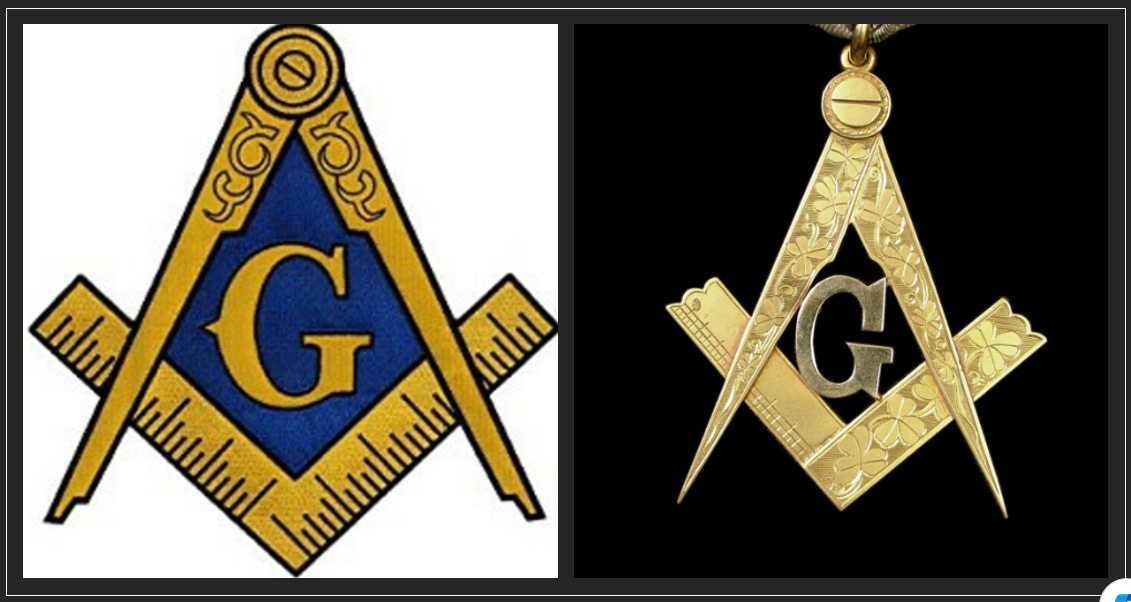
[Left image source, Right image source]
‘Coloration’ is a term used to describe background information that lights or shades the foreground material in such a way that the reader’s experience of the narrative is moved in a particular direction subliminally. ‘Coloration’ is not exclusively about colors, though that can play a part as in alchemical sequence symbolism; it is at least as much about prevalent symbols and types that create contact, if you will, between the immaterial referents, the greater realities, which the symbols represent and the reader’s imagination. C. S. Lewis’ use of traditional astrological tokens for the seven planets in each of his Narniad novels as detailed in Michael Ward’s Planet Narnia is all about coloration, as is Charles Williams’ use of Tarot imagery in his archetypal thrillers and Rowling’s use of Christian and alchemical symbolism in her Potter and Strellacott series.
In that author’s latest novel, The Hallmarked Man, there is a peculiar emphasis on, a much repeated reference to the letter ‘G.’ It is done in such a way that the reader who is struggling with the story’s multiple suspects, with a bevy of new characters with names that sound like other characters’ names, and with a bizarre and inexplicably complex (can you say ‘convoluted’?) murder does not have the focus or attention band-width sufficient to pick up consciously. Which means that it penetrates only the unconscious mind, the alocal locus of coloration’s effect.
C. S. Lewis famously observed in an essay on The Literary Impact of the Authorized Version that “An influence which cannot evade our consciousness will not go very deep,” i.e., will not have a lasting or profound effect. Whence Twain’s injunction to writers to instruct their readers not overtly, which instruction they will resist instinctively, but only covertly, implicitly rather in explicit heavy-handedness.
To explore the possibility that Rowling-Galbraith’s subliminal didactic message to her readers in Hallmarked Man involves the letter ‘G,’ I am first obliged to provide evidence of the frequency of this image and examples of how the Freemasons interpret this letter as provided within Strike 8 and from properly Masonic texts. That is the bulk of this post, which ends with reasons why this isn’t a sufficient explanation for all the ‘G’s. In Part Two of this two part piece I will review other meanings ascribed to the letter by traditional and other sources before I attempt to explain the effect of its use by Rowling-Galbraith as coloration in the book.
Would you believe the Tetractys, Tetragrammaton, Gammadion Cross, and the shape of the Strike-Ellacott decalogy are involved? It’s all there, believe it or don’t, in the letter ‘G’ and the Murdoch silver hallmark…
The Letter ‘G’ in Hallmarked Man
The first references to the seventh letter of the English alphabet in Strike 8 are seemingly meaningless misdirection or misinformation from internet chatter about the murder in the silver vault next to Freemason’s Hall.
The next wave of news stories, which was by far the most excitable, began when the police released more still photographs, this time from CCTV cameras close to the silver shop at night, which appeared to show William Wright and three other men heading towards the shop in the early hours of Saturday the eighteenth of June. These pictures were also fairly indistinct, although one of the men was definitely short and sported a beard. The tabloids now became feverish with excitement, and while the broadsheets reported the wildly spiralling stories of masonic ritual killing only to urge caution in believing them, they nevertheless devoted multiple paragraphs to the theories.
Online sleuths have been quick to point out that the murder of ‘William Wright’ has strange echoes of the legend of ‘Hiram Abiff’, the mythical Grand Master of the stonemasons, who was entrusted with the building of King Solomon’s temple, including a secret vault to house the Ark of the Covenant.
Abiff possessed knowledge of a secret word, a symbol of divine wisdom.
Three lesser masons, Jubela, Jubelo and Jubelum, wished to gain knowledge of the word and threatened Abiff, who refused to give it up, and was therefore murdered inside the temple by the three tools sacred to Freemasons: the gauge, the square and the gavel. Ornate versions of these were among the objects stolen from the Ramsay silver vault, where the body of Wright was found.
Robin glanced through excitable reader comments, some of whom had spotted still more masonic features in the killing of William Wright.
The severing of the body’s hands is an allusion to the dismembered Hands of the Mysteries that unlock the temple of wisdom.
The surrounding silver might well have been an illusion to the scripture reading in the Third Degree: ‘Or ever the silver cord be loosed.’
I’ve heard the letter G was carved into Wright’s back – obvious reference to the only surviving letter of Hiram’s secret word.
But then had come phase four, which proved horribly anticlimactic. The police had announced that ‘William Wright’ had in fact been Jason Knowles, twenty-eight, of Haringey. pp 44-45
There’s a lot to unpack here in addition to the letter G and its connection to the lost ‘Secret Word’ of the heroic martyr Hiram Abiff.
The reader is given a reference to a “short” man as a potential murder subject in the first review of narratives about the silver vault ritual killing;
We also get our first embedded narrative, the murder of Hiram Abiff, as the story the murderer was telling by his ritualistic draping and dismemberment of his victim (Robin presses Strike on this and he retells the tale in some detail from memory: pp 67-68);
Rowling invites us to think about murders associated with Masonic ritual, a subject about which “online sleuths” are ready to jump into given the proximity of the murder to Freemason’s Hall but also because it has historic precedent (one of the theories about Jack the Ripper’s Whitechapel murders was that they were done by a mad Mason; two recent films were made based on this theory:
fictional accounts such as the movies From Hell and Murder by Decree depict the murders as resembling masonic ritual and the location of the murders as having masonic significance.)
With all that going on in Robin’s first look at the case, the letter G and its connection to a “Secret Word” is probably lost in the whirl. Rowling-Galbraith, in addition to repeating the Hiram Abiff embedded tale as remembered by Cormoran soon thereafter brings it up again specifically in the Murphy led debrief with Strike in Robin’s apartment:
‘This might be an odd question,’ said Robin, ‘but was anything carved into the victim’s back?’
‘How the fuck d’you know about that?’ said Murphy sharply.
‘I saw it online,’ said Robin, nettled by his tone, especially in front of Strike. ‘Someone commenting on the story said he had the letter “G” carved onto him.’
‘My contact told me it was a hallmark.’ Murphy closed his notebook. ‘And that’s all I’ve got.’ p 77
Of all that Robin recalled from her media search, the letter ‘G’ is what she chooses to bring up with Murphy, who responds vitriolically, a reaction that “nettled” her and highlights it as somehow significant to the reader. In what is offered as a denial, however, Murphy links the letter ‘G’ with the hallmark carved into the victim’s back, what we learn later was a three-barred cross of relatively obvious historic and spiritual meaning. Murphy offers this as his last word on the subject: “that’s all I’ve got.”
In a book titled The Hallmarked Man, it’s fair to note Rowling has given the letter ‘G’ significant weight without obviously foregrounding it.
The letter ‘G’ next appears after Robin’s briefly meeting and scheduling an interview with Albie Simpson-White. Robin is almost immediately after assaulted in Harrod’s, choked from behind, threatened, and, incredibly, gifted with a “rubber model of a gorilla.” Her first thought turns on the letter ‘G:’
Neck still throbbing, Robin turned and stood on tiptoe, and thought she saw a slight disturbance at a distant doorway, as though someone was forcing their way out of the food hall at speed, but it was impossible to see her assailant through the forest of heads.
Now trembling, Robin looked down at the object he’d forced into her hand. It was a small rubber model of a gorilla.
For several long seconds she stared at it, trying to tell herself the man had been mentally ill, that she’d been a random recipient of a nonsensical gift, that he’d mistaken her for someone in the crush, that this didn’t mean what she was terrified it meant.
It’ll ’appen again unless you fuckin’ give this up.
The rapist who had ended her university career and ruined her fallopian tubes had worn a rubber gorilla mask to attack her and six other girls, two of whom had died from strangulation. He’d been sentenced to life and was still in jail, all applications for parole refused. Robin’s identity had been hidden from the press when she gave evidence in court, aged nineteen.
How could a stranger know she’d been Witness G? pp 235 (see also 315)
That may seem a natural response; Robin’s testimony was protected from public view by the assignment of a letter. Presumably she was the seventh witness testifying anonymously, whence the assignment of the letter ‘G.’
That Rowling chose this letter, however, and has Robin recall it as she does rather than more generically — “How could anyone know that I testified against the gorilla-masked rapist? I testified behind protections to my identity!” — is obviously intentional rather than arbitrary. We’ve already encountered the letter ‘G’ in association with the principal Masonic murder narrative, the legend of Hiram Abiff, which is cued up as the initial of the “Secret Word” that Murphy links to the three-barred cross hallmark. Now, via the ‘Witness G’ association, the link is made between the seventh letter and Robin’s defining life-trauma in a life beset with assaults and injuries.
‘G’ hereafter, because of its links made here to (1) her vocation as an avenger through her first success in putting away a criminal, (2) through its ties to the gorilla-masked rapist whose crime caused her to be effectively sterile, and (3) though the association with the green-jacketed thug who gave her the rubber gorilla in Harrods (and who haunts and attacks her repeatedly in Strike 8) is an emotional and psychological trigger for the reader in addition to Robin and Strike. We have the ‘fear of G’ henceforth in addition to the ‘mystery of G.’
The Agency’s antagonist plays on this twined association of the letter by painting it in red on their Denmark Street office’s entry door.
Such ruminations enabled Strike to endure the long, unproductive hours watching Plug with good grace. However, on arrival back in cold, deserted Denmark Street at three a.m., his pleasant musings were rudely interrupted.
A large, still wet letter ‘G’ had been painted in scarlet on the street door of the office. Strike stood contemplating it for a full minute, dismissing within seconds the possibility that he was looking at the tag of some drunken graffiti artist. No other door in Denmark Street had been so decorated, and it seemed far too much of a coincidence that anyone should have randomly slapped up the one letter of the alphabet that had recently acquired an ominous double meaning for the agency on the upper floors.
Was he supposed to take this ‘G’ to symbolise the letter emblazoned in the middle of the square and compasses of Freemasonry’s most identifiable sign? Had it been chosen because an eye of providence or an acacia tree would have required more artistry? Or was this a message for Robin, who’d been Witness G in the trial of her rapist and would-be killer?
Inwardly cursing the necessity, Strike hauled himself upstairs to his attic flat, dug out cleaning materials, and returned to the street to remove the letter, though, having no white spirit, he was able only to render what had been there illegible, leaving a large red smear. The door would definitely need repainting before the landlord next saw it.
It was four before Strike finally removed his prosthesis, wondering whether he should tell Robin what had happened. He didn’t want to drag up her rape again. Was this, perhaps, an obvious case of least said, soonest mended? p 334
Frankly, because of the association of blood being painted on doors to ward off the angel of death by God’s explicit command (Exodus 12:1-12), the red-letter G is an especially meaningful and intentionally terrifying bit of graffiti. Death is in flight! Rowling is now foregrounding the letter ‘G’ just in case we missed its links to God, violence, and death. The author embedded in her story, presumably the murderer, is writing it, blood-red, where the world will see it, deus ex auctore.
Unfortunately but inevitably given Rowling’s giving him immoveable determination to stick to the plan of winning Robin, Strike takes the path of “least said, soonest mended” and neglects to tell Robin about this terrorist calligraphy. Until that is she gets the gift via gorilla-green-jacket man of a masonic dagger and tries to downplay the threat it represents; then Strike unloads his repressed concerns about her safety, spills the beans about the Big Red G on the office door, and, alas, calls her the “weak link:”
‘“Bitch” might have meant Kim or Midge, and I can’t ring you literally every time I’m somewhere alone,’ said Robin, her tone no longer measured. ‘It was a well-lit residential street, and he didn’t actually hurt—’
‘You realise there was a fucking “G” painted on the street door on New Year’s Eve?’
‘What? No, I didn’t! Why didn’t you tell—?’
‘And this bloke said “stop”?’
‘Why didn’t you tell me a “G” was painted on the door?’ [italic emphasis in original]
‘Somebody’s clearly decided you’re the weak link—’ p 489
Robin of course takes offense. Now the letter ‘G’ is tied into the subject of Strike’s pursuit of Robin and the roller coast ride of that relationship in Hallmarked Man. It becomes another touchstone, too, in Robin’s grocery store list of anxieties to review periodically (e.g., p 814).
After this review of the letter G’s appearances in Strike 8, I think it is established that ‘G’ is imprinted in the reader’s subconscious mind as a hallmark, if you will, for everything meaningful in the book. On to what Masons think of it, in Hallmarked Man and elsewhere.
The Letter G in Freemasonry
Rowling spells out one Masonic meaning for ‘G’ in Strike’s tour of Freemason Hall with Hardacre:
‘Wouldn’t happen to know what gow-too is, would you?
‘Gow-too?’ said Haracre. ‘How’re you spelling it? G-A-O-T-U?’
‘Haven’t seen it written down,’ said Strike. ‘What would it mean if it’s that?’
‘Masonic acronym. Great Architect Of The Universe.’
‘God, in other words?’
‘Yeah. Why?’
‘We’ve got an anonymous caller who’s allegedly got GAOTU on their side. I thought Freemasonry wasn’t supposed to be a religion?’ p 525
Which is as close as we get to Hiram Abiff’s “Secret Word.”
In pursuit of what Freemasons believe about Hiram Abif’s martyrdom to contrast it with the death of Tyler Powell in Hallmarked Man, I purchased a small library of books about the Craft (for the meaning of Tyler Powell’s name and its various links to Masonry and Christianity, see my first Cryptonym post; it’s important, trust me). Those books included introductions for the uninitiated, histories of the Templars and of the Masons globally, texts Rowling quotes from in Strike 8 especially in the epigraphs, and encyclopedias and picture books; see my first Serious Reader Q&A session with Nick post Hallmarked Man’s publication in which I provide links to most of those texts and we discuss Freemasonry in its various roles in what was then a new book.
I pulled those books from my shelves this week in search of the meaning of the Letter ‘G’ as Freemasons themselves understand it. I found some fun illustrations that demonstrate the letter’s ritual importance, one decent explanation of its evolution in Masonic history from the craft of stonemasonry to an esoteric cult and fraternity house for the relatively well-to-do, and the consensus understanding of what it ‘stands for.’
If you doubt the ‘G’ is a big deal despite its frequent display at the center of the most visible symbol of the craft, here are some pictures of it outside that common image. Here are two pictures I found in Jeremy Harwood’s heavily illustrated, oversized, coffee table book, The Freemasons:
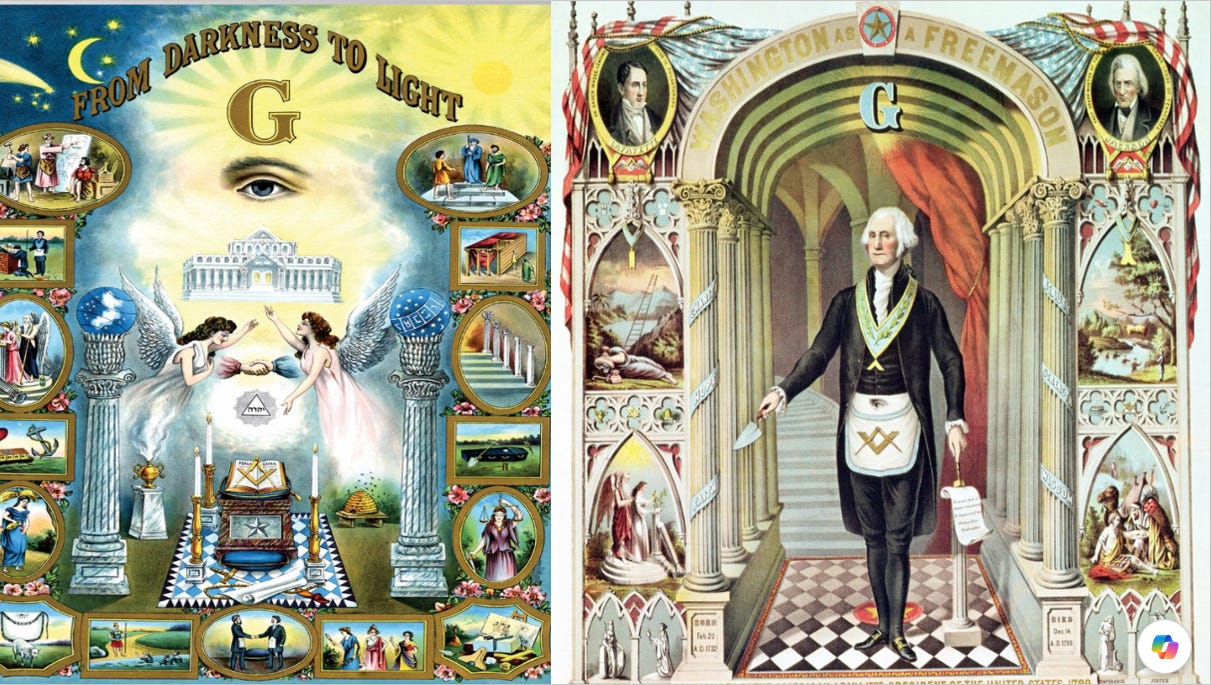
There’s an even better one of George Washington with an illuminated “G” that points to the initial’s prominence in Masonic rite (source):
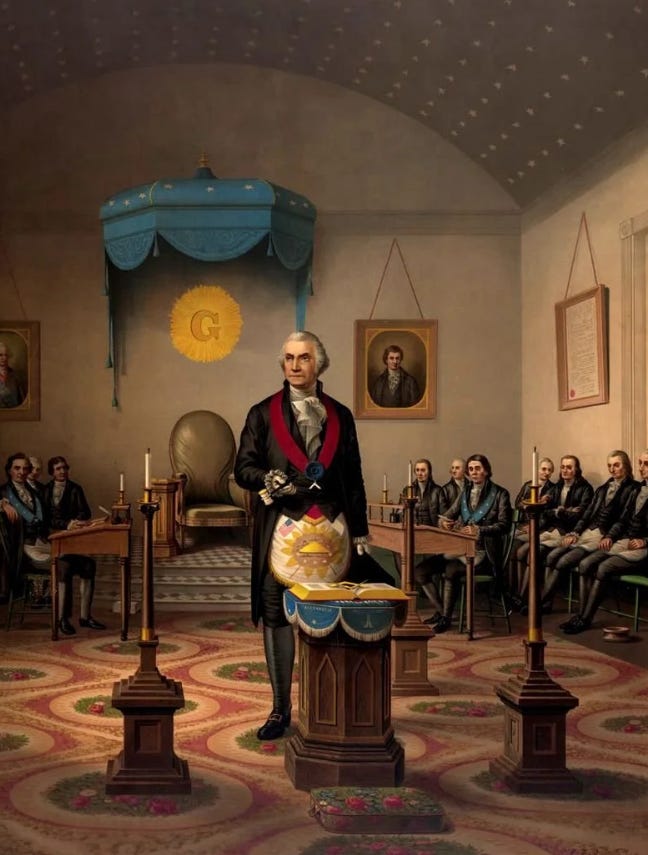
What is with the ‘G’ over the chair resting on a raised platform?
Masonic legend has the middle chamber of King Solomon’s Temple used as a meeting place of the craftsmen during the construction of the Temple. It is depicted with a blazing letter “G”suspended over the Worshipful Master, symbolizing geometry and God…
All American lodge rooms have a large “G” over the Master’s station in the east of the lodge. It is illuminated only when the Worshipful Master declares the lodge opened, and is turned off as soon as he declares it closed.
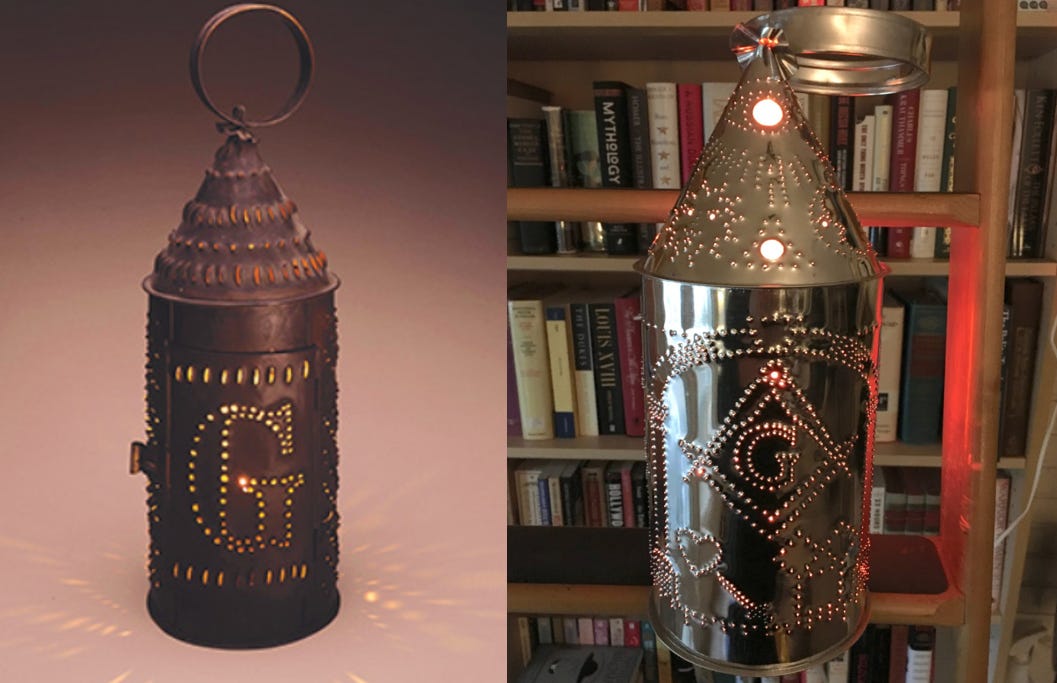
An early American lodge used this tin lantern with a “G” either suspended over the Worshipful Master’s station as the illuminated “G” or hung outside of the lodge hall to indicate a meeting was being held that evening [italic emphasis in original. Image on left below of historic lantern; the image on the right is a contemporary Masonic Lantern also in printed tin as a retro artisan product]. The Complete Idiot’s Guide to Freemasonry, pp 228-229
The best explanation of its meaning I found on my bookshelf was in David Hackett’s history of Masonic influence in the United States, That Religion in Which All Agree: Freemasonry in American Culture. Freemasonry was an exclusive craft guild of the Middle Ages that morphed into an English Enlightenment era Hall of Virtue for men:
Although nearly all early modern trades asserted high standing and great antiquity, the fact that masons created the vast stone cathedrals, arguably the most awe-inspiring human works in the Middle Ages, distinguished their claims from those of other medieval craftsmen. Unlike workers whose tools and products tied them to a local market, the masons involved in such large-scale projects were drawn from a relatively wide region. Assembling this regional labor force on a local work site necessitated the drawing up of detailed rules that would help to create shared values and standards of behavior both on and off the job. Among other things, these codes of conduct stipulated how masons should treat one another. For example, their requirements included not taking work from others or underpaying fellow masons, choosing only suitable persons to be apprentices, and respecting confidences and trade secrets.
In the available manuscript constitutions, these charges follow an elaborate legendary history of the guild that traces the origin of masonry to geometry – the source of all knowledge. In the fourteenth and fifteenth centuries, this mythical prehistory was intended to be read out or recited at meetings, especially when entrants were admitted to the craft. The manuscripts open with brief invocations or prayers addressed to God the Father, the Son, and the Holy Ghost. The narrator then characteristically launches into the subject by presenting the “worthy Craft of Masonry” as rooted in “Geometrye,” which is the foundation of “the seven Liberall Sciences.” The origins of geometry are then traced to the children of Lamech, mentioned in Genesis. The founder of geometry was Jabel, Lamech’s son who, fearing God’s punishment, inscribed his discovery on stone pillars that could survive fire or flood. After the Great Flood, Hemarynes (Hermes), a great-grandson of Noah, discovered the pillars and from them retaught the sciences to humanity. Next, Abraham and his wife Sarah went to Egypt and taught the seven sciences to the Egyptians including Euclid. Euclid then instructed King David during the latter’s sojourn in Egypt. On his return to the Holy Land, David gave these charges to the masons who began building the Jerusalem Temple, whose construction continued under his son Solomon. Solomon sent for workers from other countries, whom he charged to spread the craft to France and England (later rites of initiation took place in an allegorical Solomon’s Temple). Eventually, it was said, the English king Edwin compiled both this prehistory and the guild’s codes of conduct, and his books became the constitutions themselves.
In the seventeenth century, Scottish masons working from these constitutions created catechisms for their rituals of identification and initiation, which collectively became known as the Mason Word. Although it was customary for craft gilds to maintain constitutions detailing their rules and legendary histories, masons not only had extensive codes of conduct and an elaborate legendary history but also, unlike other guilds, evolved an extensive ritual life. Again, this may have been due the prominence of the craft and the need to guard trade secrets among a regional labor force. The early Scottish catechisms dealt with the admission of candidates to the two grades of mason known as Entered Apprentice and Fellow Craft. These rites probably existed prior to that time and may have been created out of earlier practices of the craft. Though fragmentary and diverse in their contents, the surviving catechisms usually include questions and answers to ascertain the identity of another craftsman, culminating in the recognition of a secret or words, and rites of initiation that instructed the two grades of masons in the secrets of the Word.
Both rites of initiation were said to involve a “great many ceremonies,” which the surviving catechisms keep largely hidden from outsiders’ view. Emphasizing secrecy, the Entered Apprentice investiture involved the recitation of the craft’s legendary history, while the Fellow Craft rite explained the significance of the letter G – for both geometry and God – and its place in the Temple of Solomon. The ceremonies took place within the Mason’s lodge, which could be their guild, their workplace, or the setting for their ritual return to ancient Egypt. Though the scattered evidence of the catechisms does not give a clear picture of the early rites, the “work” to which the master put the masons in the lodge presumably symbolized the building of the temple. Among religious people of that time, ‘building the Temple” meant creating the kingdom of God. Post-Reformation influences also appear to be present, in the use of the singular form of word. Scotland’s new Calvinist churches emphasized the truth of the “Word of God” as revealed in scripture. Scripture itself was often referred to as “the Word.” Such phrases as “in the beginning was the Word” invoked powerful sentiments of mystery and ultimate truth. In the Wisdom of Solomon, a favorite among Masons, “God made all things by his Word, and his Word killed all unbelievers.” pp 24-25
Which explains the centrality of ‘G’ to Freemasons at least historically as standing simultaneously for ‘Geometry’ and ‘God.’ For the grander view, there is this explanation of that link:
In Masonic rituals and teachings, the letter “G” holds a place of profound importance. It is prominent in many lodge rooms, particularly in the United States, often placed near the roof or sky during the first and second degrees, symbolizing divine guidance and blessing. In the third degree, the letter “G” is hidden, representing the unwavering light of the divine even in the darkest of times. The Royal Arch degree unveils it once more, in a new form, underscoring its lasting significance.
This journey through the degrees reflects a Mason’s path toward enlightenment, seeking to unify the divine wisdom of the Great Architect with their own moral and spiritual growth. The letter “G” thus becomes a symbol of the eternal quest for understanding and alignment with our creator and that our actions are performed in the presence of The Grand Architect. This allusion to the letter G’s meaning is confirmed during The Tracing Board lecture of the Fellowcraft Degree:
After our ancient brethren had gained the summit of the winding staircase, they passed into the middle chamber of the temple where their attention was directed to certain Hebrew characters which are depicted in a Fellow Craft Lodge by the letter G, denoting God, the Grand Geometrician of the Universe to whom we must all submit and whom we ought to humbly adore….
The letter "G" in Freemasonry encapsulates the essence of Masonic teachings. Representing both Geometry and God, it bridges the gap between the material and the spiritual, the scientific and the divine. By understanding the significance of the letter "G," Masons are reminded of the profound connection between the physical universe and the higher moral and spiritual truths that guide their lives. As such, the letter "G" stands as a testament to the enduring legacy of Freemasonry, uniting its members in a shared pursuit of knowledge, moral excellence, and spiritual enlightenment. (see also here and here)
Problems with Reading the Letter ‘G’ Strictly as an Initial rather than as a Symbol
That’s well and good, I suppose, but there is something head-scratching about it. As one Freemason has noted, the letter ‘G,’ though it may stand for Geometry as that science’s first letter, is not geometrical as are so many of Masonry’s craft symbols (the set square, the compass,, etc.). Not to mention that, if the ‘G’ stands for God or Great Architect, it’s an English or German cipher, a letter and languages that betray a modern rather than the ancient origin that Mason’s claim for their fellowship and esoteric rites and beliefs.
Owing to a departure from tradition the letter G has become a puzzle both as to its shape and meaning. Though supposed to represent Geometry and occupying the place of honour in the Lodge, the outline of this letter stands pronounced as the most ungeometrical and therefore the most unmasonic of our emblems. The reason of this discrepancy is not far to seek when we call to mind the fact that the present form of the letter dates no further back than the middle of the third century B.C., and its intrusion among Masonic emblems can be regarded in no other light than as a comparatively modern innovation.
In the passage from That Religion In Which All Agree above, too, there is mention of a “catechism,'“ a question and answer ritual exchange between guide and the candidate for initiation about the letter ‘G.’ In one back and forth, the initiate wanna be has to say that the G’s meaning is its being “letters four” and “science five,” and answer that being a one letter abbreviation for God and Geometry doesn’t explain.
Which failing highlights that in being an initial ‘G’ is only a pointer to, an abbreviated spelling out of rather than an actual symbol of God and Geometry which has the quality of being somehow slapdash or arbitrary.
In Part Two of this two part post, I’ll share the thoughts of a Freemason, a Perennialist with great familiarity with Masonry, and ‘Crypto Curry’ about more challenging interpretations of the letter ‘G’ before concluding with three ‘So What?’ points: (1) about the success or failure of Rowling-Galbraith’s use of ‘G’ as coloration, (2) the likelihood that we’ll see Freemasonry again in Strikes 9 and 10, and (3) the bizarre possibility that the ‘G’ colored Hallmarked Man has an embedded symbol of the ten-book series.
Stay tuned!
If this ‘G’ is meant to signal more to the reader than, “I have done my research on freemasonry,” in terms of the overarching series and one of Strike’s core driving traumas, my mind leaps to Gillespie.
For a while now since we've given such attention to all the letter G's in HM, I keep remembering the "g"s in DH. In ch10 Kreacher's Tale, Harry finds part of a letter Lily wrote to Padfoot:
"He read the letter again, but could not take in any more meaning than he had done the first time, and was reduced to staring at the handwriting itself. She had made her "g"s the same way he did: He searched through the letter for every one of them, and each felt like a friendly little wave glimpsed from behind a veil. The letter was an incredible treasure, proof that Lily Potter had lived, really lived, that her warm hand had once moved across this parchment, tracing ink into these letters, these words, words about him, Harry, her son."
So much to unpack here: an alphabet letter within a letter of correspondence, a "friendly little wave glimpsed from behind a veil," the treasured aspect as proof of existence, "tracing ink" into the letters, "these words about... Harry, her son."
Harry's search through Sirius' room is rather like an archaeological dig and his discovery is on the order of the Dead Sea scrolls! Proof of scripture's historicity and accuracy, words about Him, Jesus, God's Son... an amazing treasure. Am I crazy for not being able to unsee this? And even if I am, I don't care because I love it. But also what is the deal with the letter G? In HM it's ominous, not friendly, just for starters. Still...