
Welcome back! This is the second part of a two part discussion of the symbolism of the letter ‘G’ in Rowling-Galbraith’s eighth Cormoran Strike novel, The Hallmarked Man. You’ll want to read the first part to be up to speed for this discussion, though I’ll briefly review it below.
In this concluding piece, there are five pieces: an introduction to subliminal coloration as Rowling’s narrative super-power, a review of the letter ‘G’s appearances in Hallmarked Man and what Freemasons claim it symbolizes, a deeper dive into its meaning per Masonic sages and one Perennialist, three answers to the ‘So What?’ question, and a concluding note about whether this symbolism had the desired effect on readers.
Coloration is Rowling-Galbraith’s Literary Signature and Super-Power
As I wrote in Part One of this two-part post, ‘Coloration’ is a term used to describe background information that lights or shades the foreground material in such a way that the reader’s experience of the narrative is moved in a particular direction subliminally. ‘Coloration’ is not exclusively about colors, though that can play a part as in alchemical sequence symbolism; it is at least as much about prevalent symbols and types that create contact, if you will, between the immaterial referents, the greater realities, which the symbols represent and the reader’s imagination. C. S. Lewis’ use of traditional astrological tokens for the seven planets in each of his Narniad novels as detailed in Michael Ward’s Planet Narnia is all about coloration, as is Charles Williams’ use of Tarot imagery in his archetypal thrillers and Rowling’s own use of Christian and alchemical symbolism in her Potter and Strellacott series.
In that author’s latest novel, The Hallmarked Man, there is a peculiar emphasis on, a much repeated reference to the letter ‘G.’ It is done in such a way that the reader who is struggling with the story’s multiple suspects, with a bevy of new characters with names that sound like other characters’ names, and with a bizarre and inexplicably complex (can you say ‘convoluted’?) murder does not have the focus or attention band-width sufficient to pick up consciously. Which means that it penetrates only the unconscious mind, the alocal locus of coloration’s effect.
C. S. Lewis famously observed in an essay on The Literary Impact of the Authorized Version that “An influence which cannot evade our consciousness will not go very deep,” i.e., will not have a lasting or profound effect. Whence Twain’s injunction to writers to instruct their readers not overtly, which instruction they will resist instinctively, but only covertly, implicitly rather in explicit heavy-handedness.
Here’s what separates Serious Readers of Rowling-Galbraith from the million member army of her global audience: they get that all of her Shed artistry, her intentional reworking via specific craft choices of her Lake inspiration into archetypal story and transformative imaginative experience, depends on subliminal coloration. I understand if “all of it” is repugnant to readers as somehow over-board as a critical claim, John-on-a-hyperbole-rant (again), but a brief look at Rowling’s signature Shed tools makes that claim close to indisputable.
Long-time readers here know that we talk about seven specific tools that Rowling deploys in almost everything she writes:
Literary alchemy,
Ring composition and parallelism,
Mythological templates,
Cratylic Names,
Psychomachian allegory,
Kathartic shock, and
Traditional symbolism
[I’d add “Ghosts” but it would destroy the magic of Seven, right? Let’s not go there.]
Every one of these tools work on a reader (1) by escaping his or her conscious mind’s detection and (2) the operative element’s penetration of his or her unconscious mind via the potency of the working symbolism or archetype and its repetition. No one grasps on a first reading Rowling-Galbraith’s stories’ alchemical sequences and symbols, the chiastic echoing and meanings-in-the-middle-centers, the backdrop mythology, the character markers hidden in the names, the soul transformation allegory, the otherworldly referents experienced in repeated symbolic notes, or the misdirection setting up the Big Twist finish. Few, if we’re being honest, understand it even after it’s pointed out (if you’re a subscriber here, you obviously are part of the exceptional crowd; take a bow).
All of them, in other words, require the reader to not detect her artistry at the surface level; all the Shed tools deliver content that need to enter the reader’s unconscious mind via repeated subliminal imaginative experience. This coloration artistry, of course, isn’t something Mrs Murray invented; again, see, the astrological ‘Donegality’ of C. S. Lewis, Nabokov’s potustoronnost spirituality, Dickensian cryptonyms, and the psychomachia of Shakespeare, Dostoevsky, and Tolkien for her models and predecessors.
Allowing that she isn’t a patent-holding inventor, however, in no way diminishes the centrality or importance of grasping the author’s coloration artistry and achievement. Her sui generis deployment and combination of these tools are the mechanics of the transformative quality of her writing and the engine powering her international success.
Of all Rowling-Galbraith’s Shed tools, the need for escaping conscious awareness is perhaps most critical in the use of traditional symbolism; subtlety is a must, repetition of muted images buried or delivered under cover of distracting story elements is the way to escape detection and enter the unconscious mind.
Perhaps the biggest delight I have when giving public talks is sharing the excitement of discovery in audience’s of Serious Readers when their unconscious experience of Rowling’s repeated symbols are forced to the surface either for the first time or with greater clarity than they’d had even after repeated readings. Three for-instances of The Presence’s subliminal traditional symbolism that fit this mold:
She inserts traditional symbols of Christ at Harry Potter’s sacrificial love death-and-resurrection scenes which occur at the end of every Hogwarts Saga installment;
In Deathly Hallows, the Harry Potter series finale, there are seven individual and pairs of eyeballs floating around that deliver her experience of Harry’s transformed vision in the epic climax; and, in the Strike series,
Troubled Blood has crosses embedded throughout its narrative line to include Talbot’s otherworldly True Book illustrations (the Celtic Cross Tarot Card spread, the Maltese Cross of St John, the St Piran tattoo on Polworth, the astrological charts, the embedded psychomachian allegory of Strike as the Red-Crosse knight, etc.).
In Hallmarked Man, the traditional symbol Rowling deploys is the letter ‘G,’ easily overlooked because it’s an initial not a symbol, right? Let’s review what was discussed in Part One of this two part series about the various forms ‘G’ takes in Strike 8 and what Freemasons say about its meaning.
The Letter ‘G’ in Hallmarked Man
To explore the possibility that Rowling-Galbraith’s subliminal didactic message to her readers in Hallmarked Man involves the letter ‘G,’ I was obliged to provide evidence of the frequency of this image and examples of how the Freemasons interpret this letter as provided within Strike 8 and from properly Masonic texts. You can read all that in The Symbolism of the Letter ‘G’ in ‘Hallmarked Man’ (Part One).
In brief, the letter ‘G’ makes repeated appearances in various guises and in unexpected associations.
Robin’s research into the death of ‘William Wright’ in the Ramsey Silver shop vault begins with an online observer saying out of the blue that a ‘G’ was carved into the victim’s back and that this was tied to the Secret Word of Freemasonry and the legend of Hiram Abiff’s martyrdom. Rowling-Galbraith has Robin mention this to Murphy at their first unofficial briefing on the case and Murphy all but explodes; he denies it was a ‘G’ and says he heard it was a “hallmark” instead.
The letter is associated with Freemasonry as their symbolic center (GAOTU) via a telephone message and in Strike’s meeting with ‘Hiram’ Hardacre.
We learn after Robin’s being attacked in Harrow's that she was ‘Witness G’ in her rapist’s trial, the letter being to her something like a secret identity.
Strike not long thereafter finds a blood Red Letter ‘G’ painted on the street level door to the Agency which he hopes is a Masonic terrorist marker rather than the pointed suggestion that the Angel of Death is coming for Witness G.
I’d add that the Gorilla mask and doll of the Green jacket man that haunt Robin have some of their subliminal effect on her and the reader because of the initial guttoral sound of ‘Gorilla’ and ‘Green.’
The letter ‘G’ haunts Hallmarked Man, then; what is the meaning of this symbolism?
In Part One, I shared what Freemasons say about it, namely, that it is a one letter acronym for both ‘God’ and ‘Geometry,’ a remnant of Medieval stone-working craft guild initiation rites and fraternity oaths mixed up with Templar esoterism. I closed that discussion by noting the problems with this letter as traditional symbolism: ‘G’ is not a symbol but an initial, there is nothing inherently ancient or esoteric about it, it’s not tied to anything to do with craft masonry, it doesn’t look right among other Masonic symbols (not angular or symmetrical), and it doesn’t explain the mysterious Masonic catechism explanation of the letter’s meaning.
Which brings us at last to the business of Part Two: what does the letter ‘G’ mean when read as a symbol, what effect is it meant to deliver subliminally to readers, and does it work?
The Symbolism of the Letter ‘G’
As Hallmarked Man is overshadowed by Freemasonry the way Freemason’s Hall does the Ramsey Silver Shop, let’s begin our exegesis of ‘G’ symbolism again with what Masons say about its meaning. From a 1927 review of the history and meaning of the letter ‘G’ among the Brotherhood, the catechism of an examiner and a candidate for initiation in which the wanna-be Mason is required to recite the accepted meaning:
Respondent. In the midst of Solomon’s Temple there stands a “G,” A letter for all to read and see; but few there be that understand what means the Letter “G.”
Examiner. My Friend, if you pretend to be of this Fraternity, you can forthwith and rightly tell, what means that Letter “G.”
Resp. By sciences are brought to light, bodies of various kinds. Which do appear to perfect sight; but none but males shall know my mind.
Exam. The Right shall.
Resp. If Worshipful.
Exam. Both Right and Worshipful I am, to hail you I have command, that you forthwith let me know, as I you may understand.
Resp. By letters four and science five, this “G” aright doth stand, in due Art and Proportion; you have your answer friend.”
While authorities differ as to just when the letter “G” came into the ritual, all are agreed that the date is not later than 1768; very probably it was earlier.
By letters four and science five, this “G” aright doth stand, in due Art and Proportion; you have your answer friend. The 1927 exegete offers the following explanation of “letters four and science five:”
“Letters four” properly refers to J H V H, the tetragrammaton or four-letter word, the Hebrew designation of deity, which we call Jehovah, for want of a more likely rendition of the vowels (omitted in early Hebrew writing).
“Science Five,” of course, is Geometry. [Geometry is fifth of the traditional seven liberal arts.]
The Pythagoreans reverenced numbers as sacred; geometry was to them the sacred science. It initial letter, Gamma, a square, was especially revered. The Gamma looks like a square used by builders; it was the symbol of the actual, four-sided, or geometrical square, the first whole number square, and therefore, the representative of deity, the four-letter word, the tetragrammaton.
Symbols are easily converted the one into the other and back again. If the Gamma, which appeared like a workman’s square, was a symbol of the geometrical square, which in turn was a symbol of Deity, then, by a simple reconversion looked like Gamma, which in one position looked like the square of the workman, soon came to symbolize the tetragrammaton or four-letter word.
The Greek Gamma was rounded into the Latin “C.” For a while it stood for both the sounds of “g” and “k.” Later (third century B.C.), a slight change was made in the Latin “c” which stood for the soft, or “j” sound - and behold, our modern Roman “G.” Hence, by a path straight to any but mind demanding documentary proof, we place the origin of our “G,” as representing both God and Geometry, as far back as the Pyrhogoreans (sixth century, B.C.).
Another interesting hypothesis - it is hardly more - calls attention to the fact that three geometrical forms appear in the Greek alphabet, as we have seen; Gamma (G) is a square standing on end, the horizontal arm extended to the right. Omicron (O) is a circle, Delta (D) is a triangle.
Writing one letter on top of another to form a monogram is very old. The three Greek letters, Gamma, Omicron and Delta may be combined in a monogram to form a very fair conventionalizing of our letter “G” inside a triangle which looks not unlike our modern square and compasses!
This is little more than sophistry, I fear, especially in the Greek letters for G-O-D giving us the Latin letter ‘G,’ but more importantly in attributing to the Pythagoreans some knowledge of the Hebrew Tetragrammaton, the unspoken Name of God (Adonai ‘the Lord’ or Jehovah serving as spoken place-holders).
Our playful decipherer does note, if dismissively, another Masonic interpretation that says the ‘G’ is the Hebrew letter yodh, the first of the Tetragrammaton:
Mackey, the great Masonic authority, regretted that the Roman “g” ever found its way into our symbolism, and read the “G” as a substitute for the Hebrew Yod, which in turn is a symbol of the tetragrammaton, or four-letter word. Unquestionably the “Lost Word,” the very heart of the Masonic system, is represented by the Yod, but it is a far cry to include also Geometry in that representation. The Greek Gamma, (of which our roman “G” is a substitute) however, did represent both the ineffable Name and the greatest of the sciences.
The problem of ‘G’ meaning “letters four” remains whether one substitutes the Greek gamma, the Hebrew yodh, or the Latin letter. In what sense is the one letter understood as a symbol of “letters four”? The Tetragrammatron is suggested, of course, but it is four different Hebrew letters, none of which are akin to ‘G’ unless one stands on his hands or head when looking at a yodh and squints mightily:

As Serious Striker Tamara (‘Tamspells’) shared last week, Albert Pike in his exhaustive Morals and Dogmas shares a relatively brief explanation of the meaning of ‘G’ that embraces the yodh — and rejects the letter ‘G:’
In the East of the Lodge, over the Master, inclosed in a triangle is the Hebrew letter YOD [picture above]. In English and American Lodges the Letter G is substituted for this, as the initial of the word GOD, with as little reason as if the letter D., initial of DIEU, were used in French Lodges instead of the proper letter. YOD is, in the Kabalah, the symbol of Unity, of the Supreme Deity, the first letter of the Holy Name; and also a symbol of the Great Kabalistic Triads. To understand its mystic meanings, you must open the pages of the Sohar and Siphra de Zeniutha, and other kabalistic books, and ponder deeply on their meaning. It must suffice to say, that it is the Creative Energy of the Deity, is represented as a point, and that point in the centre of the Circle of immensity. It is to us in this Degree, the symbol of the unmanifested Deity, the Absolute, who has no name.
Our French Brethren place this letter YOD in the centre of the Blazing Star. And in the old Lectures, our ancient English brethren said, “The Blazing Star or Glory in the centre refers us to that grand luminary, the Sun, which enlightens the earth, and by its genial influence dispenses blessings to mankind.” They called it in the same lectures, an emblem of PRUDENCE. The word Prudentia means, in its original and fullest signification, Foresight; and accordingly, the Blazing Star has been regarded as an emblem of Omniscience, or the All-Seeing Eye, which to the Egyptian Initiates was the emblem of Osiris, the Creator. With the YOD in the centre, it has the kabalistic meaning of the Divine Energy, manifested as Light, creating the Universe. (italics in original, pp 15-16)
Pike, though using “kabalistic” imagery and Egyptian allusion, seems to be referencing the Creative Principle of Christianity, the Logos, through Whom the transcendent Father brings all things visible and invisible into existence and Who is known as the “Light of the world” as well the light in every man (John 1:9).
But that’s for a yodh in a “Blaze of Glory,” not the letter ‘G.’
John Cockburn, as noted in Part One, a Mason from Adelaide, made a similar complaint in 1897, though he insists that the Greek capital Gamma (Γ) should be used instead of ‘G',’ not the yodh. He introduces the Gammadion Cross or Swastika in this context:
In its original form the letter G was held to be sacred by the Pythagoreans; it was the initial letter of the Earth Goddess Ge or Gaia in whose honour the Eleusiniau mysteries were celebrated; it also stood for geometry, a word derived from Ge and used by Pythagoras as synonymous with Tetractys or the Divinity.
When however our ancient brethren turned their eyes towards the sacred symbol they beheld, not the unmeaning form of the letter G, but the gimel or gamma Γ, the emblem in all ages the most revered by our Craft, the true Masonic square. The second tracing board tells us that the letter G denotes God and depicts certain Hebrew characters, these characters are the four letters which spell the holy name Jehovah, the awful Tetragrammaton.
In the opinion of the ancients the most fitting geometrical representation of the number four was by means of the square; Plutarch says that “The number four is a square” and according to Philo Judaeus “Four is the most ancient of all square numbers, it is found to exist in right angles as the figure of a square in geometry shows,” and “Four is the first number which is a square being equal on all sides, the measure of justice and equality.”
What then could be more appropriate than the representation of the Tetractys or the Tetragrammaton by the square letter gamma? And to what letter other than that bearing the form of the square could the attention of the Craftsman about to receive his wages be with equal propriety directed? The square is one of the working tools of a fellow-craft and is the emblem of that just relation between man and man which entitled the workman relying on the honesty of his work and on the integrity of his employer, to claim without scruple and without diffidence the due reward of his labour.
In short, the gamma or the square falls into its place in the mosaic of masonry as readily as the modern G refuses to be assimilated, and this harmony goes far to establish the antiquity of our ritual; for, if the text is obscure with the letter G but becomes luminous with the gamma, there is proof that the ritual must have been settled before the disappearance of the ancient and the introduction of the modern letter.
The fifth science was geometry which explains the G or Γ in its operative aspect, and the letters four, or tetragrammaton, would elucidate its other, or symbolic, meaning. Is it not just possible that the form in which the letter G formerly appeared in the Lodge may have been that of the Swastica, one of the most frequent and sacred of figures in both Eastern and Western Symbolism, whose absence from modern Craft Masonry is a matter of surprise? The Swastica is composed of four gammas combined and was known among old time craftsmen as the tetragammaton [Note that ‘tetraGAMMAton’ is not ‘TetraGRAMMAton.’]
It is impossible to avoid a feeling of regret that the beautiful symbolism of the square has been marred by the usurpation of the letter G in the place of the gamma, and it appears to be a question worthy of consideration whether it would not be well to show our respect for the ancient landmarks by restoring to the sacred symbol its original form.
Cockburn, writing in 1897, had no qualms about introducing the Swastika as an explanation of the catechism’s “four letters” explanation of the letter ‘G’s meaning because the German fascists had not usurped it for their Aryan symbolism (check out the swastika’s ubiquity before the Nazis made it infamous as the Hakenkreuze). That doesn’t help us much with respect to ‘G’ because of his insistence on the Γ but we’re getting somewhere.
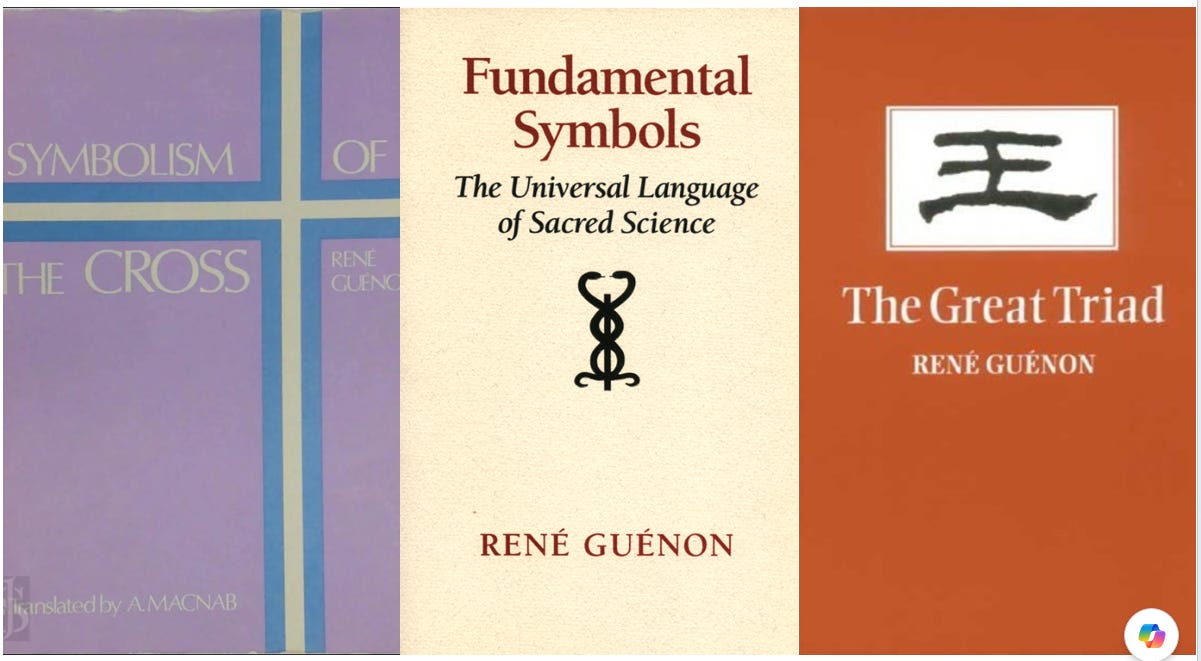
I confess that I didn’t make anything of the letter ‘G’s repeated appearances in Hallmarked Man until I saw that Rene Guenon, the most famous and profoundly metaphysical of the first 20th Century Perennialists, had written a brief essay in his youth, ‘The Letter G and the Swastika.’ I made that discovery inadvertently when looking for something else in Fundamental Symbols, a posthumous collection of his writing (downloadable as pdf here). Guenon was raised as a Roman Catholic in France but had his first introduction to esoteric thought via Freemasonry, in the symbolism and rituals of which he maintained a life-long interest though dismissing it ultimately as a pseudo-religion.
Guenon goes all in on both the yodh and the gamma capital being the backdrop of the Masonic ‘G:’
The letter G could not in itself be considered a true symbol inasmuch as it belongs to modern languages that have nothing sacred or traditional about them; but it ‘stands for God’ according to the English Masonic rituals, and is in fact the initial letter of the word God itself. Moreover its comparison with I is justified by the fact that, in certain cases at least, it has been considered as a substitute for the Hebrew yodh, symbol of the principle or of unity, in virtue of a phonetic assimilation between God and yodh…
… in a very old catechism of the Companion grade,[4] the question: ‘What does that G denote?’, is answered, ‘Geometry, or the fifth Science’ (that is, the science that ranks fifth in the traditional enumeration of the ‘seven liberal arts’, the esoteric transposition of which in medieval initiations we have pointed out on other occasions). This interpretation in no way contradicts the affirmation that the same letter ‘stands for God’, God being specially designated in that grade as ‘The Great Geometer of the Universe’; and on the other hand, what gives it all its importance is that in the oldest manuscripts of operative Masonry, ‘Geometry’ is constantly identified with masonry itself. There is thus something here which cannot be considered negligible. Besides, as we shall now see, it appears that the letter G, as the first letter of the word Geometry, has assumed the place of gamma (Γ), its Greek equivalent, which the very origin of the word ‘Geometry’ sufficiently justifies (and here, at least, a modern language is no longer involved).
Furthermore, the letter [gamma] has in itself a certain interest from the point of view of masonic symbolism, by reason of its form which is that of the set-square - obviously not the case with the Latin G. Now, before going further, it might be asked if this does not contradict what was said about G being a substitute for the Hebrew yodh… It becomes then a question of the superimposition of two different meanings that by no means exclude one another, something that is in no way exceptional in symbolism.
He discusses the “four letters” mystery of the Masonic catechism:
In the same catechism that was cited above, the following kind of enigma is also to be found; ‘By letters four and science five, this G aright doth stand in due art and proportion’.[7] ‘Science five’ here obviously designates the ‘fifth science’, that is, Geometry. As to the significance of ‘letters four’, at first sight and by symmetry we might be tempted to suppose that there is a mistake and that ‘letter’ must be read in the singular, so that it would be a question of the ‘fourth letter’, that is, in the Greek alphabet, the letter delta, which in fact is interesting symbolically by its triangular form; but since that explanation would have the great defect of showing no intelligible relationship with the letter G, it is much more likely that it is really a question of ‘four letters’ and that the irregular expression science five, instead of fifth science, has been placed there intentionally to make the statement yet more enigmatic.
Now the point that might seem to be the most obscure is this: why are four letters spoken of, or if it is really still a question of the initial letter of the word Geometry, why must it be quadrupled to stand aright in due art and proportion? The answer, which must be related to the ‘central’ or ‘polar’ position of the letter G, cannot be given except by means of the symbolism of operative masonry; and, moreover, it is here that it becomes necessary to take this letter in its Greek from, as indicated above.
In fact, four gammas joined together at right angles form the swastika, ‘symbol, as is also the letter G, of the Pole Star which is itself the symbol, and for the operative Mason, the actual throne of the hidden central Sun of the Universe, Yah, which obviously calls to mind very closely the Tai-I of the Far Eastern tradition.
[If you are confused about how ‘four gammas’ become a swastika, note that
the word “swastika” derives from the Sanskrit svastika “lucky or auspicious object”. The older term “gammadion cross” derives mainly from its appearance, which is identical to four Greek capital gamma letters (Γ) affixed to each other.]
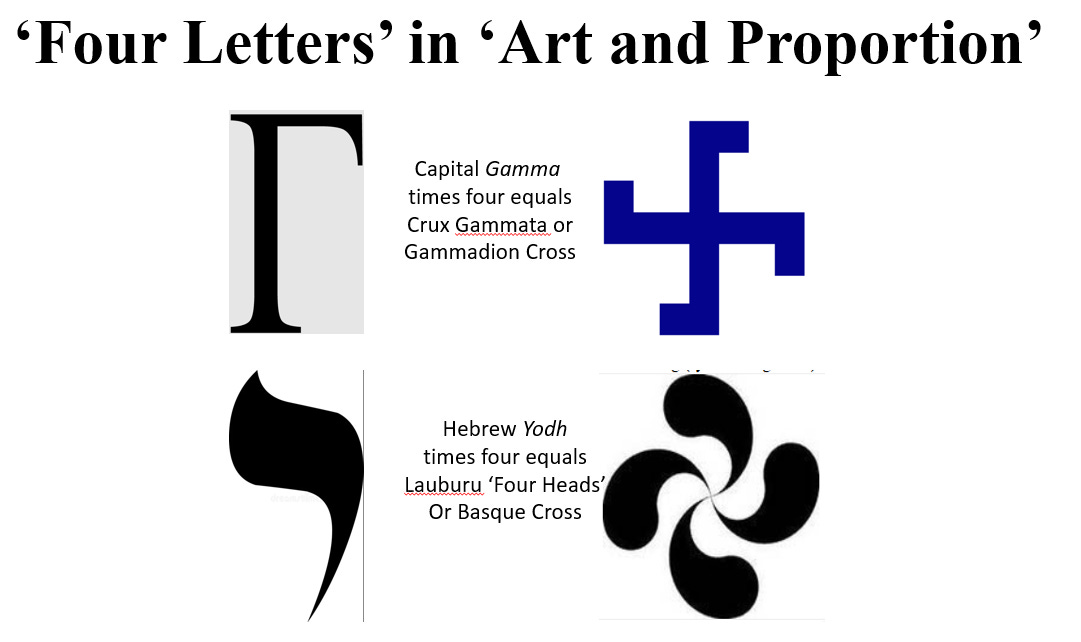
[See Rex Curry for more on yohd and gammadion swastikas.]

Guenon explores the equation of the swastika and the cross in his The Symbolism of the Cross, chapter X, ‘The Swastika’ (p 55):
[T]he swastika is essentially “the sign of the Pole. If it is compared with the figure of the cross inscribed in the circumference of a circle, it will be seen that these are really equivalent symbols in certain respects; but in the swastika the rotation around the fixed centre, instead of being represented by the circumference, is merely indicated by short lines adjusted to the ends of the arms of the cross and forming right angles with them; these lines are tangents to the circumference which mark the direction of movement at the corresponding points. As the circumference represents the manifested world, the fact that it is, as it were “suggested” (or “understood) indicates quite clearly that the swastika is not a symbol of the world, but rather of the Principle’s action upon the world.
That Principle in Christian cosmology is the Logos, of which Christ is the Incarnation. The ‘G’ of Masonic symbolism, through its “four lettered” meaning is linked to both yodh and gamma, is tied to the swastika and through it, as with Robin’s first conversation with RFM about the William Wright murder, to the cross and to Christ.
After discussing the “four lettered” answer to a catechism question in his ‘Symbolism of the Letter ‘G,’ Guenon then introduces a second question about the Masonic letter ‘G,’ “Who doth the ‘G’ denote?,” and explains cryptically the ‘G’s relationship again with faith in Christ:
Incidentally, we must not forget to mention that in response to the question ‘Who doth the G denote?’ (who and not what, as previously, when it was a question of Geometry), this catechism further contains the following phrase: ‘The Grand Architect and Contriver of the Universe, or he that was taken up to the pinnacle of the Holy Temple’. It will be noted that the ‘Grand Architect of the Universe’ is identified here with Christ (and thus with the Logos), himself placed in relationship with the ‘cornerstone’ understood according to the sense that we have explained. The ‘pinnacle of the Temple’(note the curious resemblance of this word with the Hebrew pinnah which signifies ‘angle’) is naturally the summit or the most elevated point and as such it is the equivalent of that which is the ‘key of the arch’ (Keystone) in Arch masonry….
It may be interesting to note further than in the Kabbala, the yodh is thought of as formed by the union of three points representing the three supreme middoth arranged as a set-square, turned in the direction contrary to that of the Greek letter [gamma], which would correspond to the two opposite directions of rotation of the swastika.
Having established the effective equivalence of the yodh and gamma capital with respect to ‘G’ and how Freemasonry’s insistence that they be understood as “four letters” making them complementary swastikas, he pivots to the ‘G’ denoting “he that was taken up to the pinnacle of the holy temple.” He notes that this answer is a more less direct equation of the GAOTU and Christ because the Christ is “the ‘cornerstone’ understood according to the sense that we have explained.”
For Guenon’s previous explanation, see first his brief essay on why the “cornerstone” of Christian scripture, a frequent epithet for Christ, is better understood as “keystone,” the defining point or principle in a building, ‘The Cornerstone’ in Fundamental Symbols, pp 187-197, and then Coomaraswamy’s ‘Eckstein’ in What is Civilization?, pp 168-177 (Guenon credited AKC with the insight).[For the short course, see ‘Capstone in the Bible’ and Ancient Symbols: Keystone.’]
This seeming departure from the symbolism of the letter ‘G’ is important because Freemasonry is consumed by the significance of the architectural arch of which the keystone is the principle (some orders of Freemasonry are dedicated to the arch, e.g., the Holy Royal Arch). It also is at the heart of why bridges are so important in Freemasonry and play such a role in Hallmarked Man; see William Stoddart’s explanation of the Logos as the metaphysical bridge between the Transcendent and Created Realms in his ‘Aspects of Islamic Esoterism.’
[For those who want to understand the Pythagorean symbolism implicit in the Compass and the Square frame of the letter ‘G’ that Freemasons represent as simple ‘speculative’ lessons in morality, see Guenon’s ‘The Tetraktys and the Square of Four’ in Fundamental Symbols (pp 74-77) and then Maximos Constas’ ‘Revelation as Concealment: The Theology of the Icon Screen.’]
So, following the various essays by Guenon, Cockburn, Coomaraswamy, and Stoddart,
the letter ‘G’ in Masonic lore is tied to yohd and Γ,
then in their “four lettered” “proportioned” form to four yohd/Γ swastikas (the Lauburu and Gammadion crosses), which takes us in turn to Cross,
then to the Salem Cross in Freemason Hall and another legible in the mutilated flesh of Tyler Powell’s back,
which brings us at last to the letter ‘G’ as a symbol of Christ crucified.
That’s a lot of travel, I admit, over some deep esoteric waters to get from the ‘G’ of Freemasonry to the second Person of the Trinity, God’s Logos, and Its incarnation as Christ. It seems the best explanation for the ‘G’ working in Hallmarked Man as a token standing for GAOTU, Robin’s heroic testimony against the rapist who tried to kill her, a calligraphic terrorist attack straight of Exodus, and the Gorilla toy grasping Green-coated man. It is the pervasive coloration of this confusing and seemingly chaotic novel, one awash in albedo imagery of purification alongside nigredo angst and dissolution, the color of supernatural mystery, transcendent meaning just out of sight but threatening radical change, even death, in Strike and Ellacott as their transformations as soul-meeting-Spirit come to their climax in the series last novels.
Three ‘So What’s?’
I wrote in the comments of Part One in this series about the symbolism of the letter ‘G’ that Part Two was going to be much more challenging than a review of all the ‘G’s in Strike 8 and the explanation that Freemasons offer about what it means (‘God’ and ‘Geometry’). I think I’ve delivered on that pledge — and I really hope that the Serious Readers here will follow some of the links above to the hard-to-find Perennialist essays most often in ridiculously expensive books as free pdfs.
Let me wrap up this long piece with three reasons that Rowling Readers should pay attention to the letter ‘G’ in Hallmarked Man in light of the symbolism discussed above, just in case you’re asking me under your breath, ‘So What, John? Why do I care?’
The symbolism of the letter ‘G’ with its heavy spiritual coloration is Rowling’s Nabokovian potustoronnost that creates the atmosphere of another world, which as noted acts as a compelling backdrop for both Robin and Strike’s subliminal transformation within their vocations as selfless avengers as well as their psychomachian soul-to-Spirit relationship with the other;
Will we see more Masonic symbolism in Sleep Tight Evangeline and finale? Maybe! She certainly has made us long for a big pay-off with respect to ‘G;’ see Sarah Keeler’s idea that it may be a pointer to Gillespie reappearing in Strike 9. I love that possibility and it certainly is in keeping with the HogwartsProfessor working thesis that Hallmarked Man is what it is to set up the next two books. If we’re going to see characters and themes bleed between the first book of the last three and its successors, why not its symbolism?probably not; and
If I had to bet money on it, though, I think we probably won’t see more Freemasonry or Big ‘G’ payoffs. It kills me to say that given the investment I’ve made in books about the Masons (they’re on a shelf beneath the dust-collecting little library on Mormon history and scriptures I collected while writing about Stephenie Meyers’ Twilight books). I just cannot see her weaving the Mason characters from Hallmarked Man into story lines that give us resolution with respect to Charlotte’s and Leda’s supposed suicides twenty some years apart, Shanker’s family history, and the mysteries around Strike’s time with the military police, especially the IED that nearly killed him.
Of course, if I could see the weave of Rowling-Galbraith stories this far out, I’d be writing stories like she does, right?
Having said that, let me go way out there and suggest a crazy possibility about why we should care about the letter ‘G,’ the way it colors Hallmarked Man, and its Masonic and Pythagorean symbolism. How about this? The letter ‘G’ as linked to the three barred Salem Cross could be the embedded shape of the ten book Strike series.
We have three decent contenders for series shape already:
Louise Freeman’s encyclopedic correspondence-and-pattern defined Double Wedding Band model, far and away the most thoroughly researched and closely argued shape;
Evan Willis’ Tetraktys Theory, which certainly got a big bump up in the letter ‘G’ discussion above via Guenon (again, see that Perennialist’s ‘The Tetraktys and the Square of Four’ in Fundamental Symbols, pp 74-77) is Salem Cross, more recognizable as Deathly Hallows triangulated and bisected circle; and
Nick’s and my not-really-a-shape idea that the first seven books constituted a ring a la the Harry Potter septology, in playful parallel with which they were written, and that the last three books will be an organic whole of some kind. (Please discount anything I’ve written in jest about the search for a shape before the series is done.)
Here’s a Parthian parting-thought shot: if I’m right in thinking that the point of the letter ‘G’ symbolism was to subliminally move readers to think about the Salem Cross Murdoch hallmark on Tyler Powell’s mutilated body, could that shape be the picto-gram for the series?
Here’s how that would work:
You start with the first seven books as a ring composition circle, one represented pictorially as a Salem Cross;
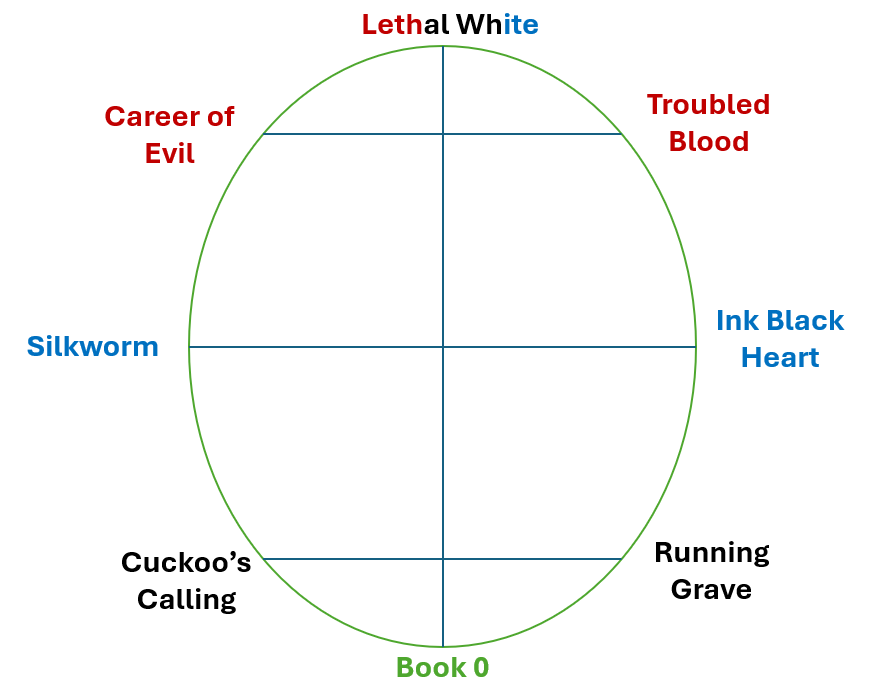
To get the three bars of the cross to be turtle-back lines, the latch of Books 1 and 7 have to be separated with Book 0 at the foot of the cross.
As Nick and I have discussed on several podcasts, Hallmarked Man represented a unique challenge in contrast with previous Strike titles. The first seven entries in the series had pretty neat parallels both with their Harry Potter numeric equivalent and one, sometimes two, of the other Strike novels (that Bird’s Eye View post Running Grave). Strike 8? Not so much. Honestly, Serious Strikers found parallels with every one of the first seven Strike-Ellacott mysteries in Hallmarked Man and a lot of the Potter novels. It was like Rowling-Galbraith was having a laugh at those of us who think every parallel is potentially meaningful…
That said, there was not not one but two Strike books that Hallmarked Man seemed to make repeated and undeniable references-in-echoing to: Career of Evil with its multiple suspects and itinerant narrative and Troubled Blood with its cross symbolism and Templars descendant coloration (St John’s Hospitallers and the Freemasons both trace their lineage to the Templars). Those are the obvious ones; Reddit user u/Random-Occurance365 compiled an absolutely mind-blowing list of Strike 3-5-8 parallels that Louise Freeman received permission to repost.
But how to represent those undeniable 3-5-8 echoes? It’s simple with the Salem Cross, right? Just drop it on the 3-5 turtle-back line:
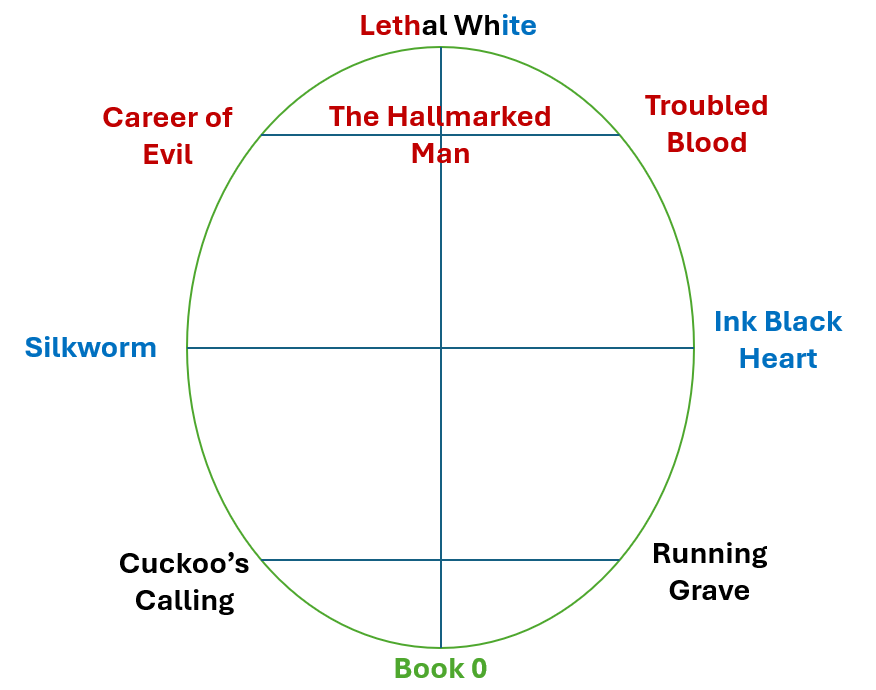
u/Random-Occurance365’s astonishing list of 3-5-8 parallels makes this an easy bar for the Salem Cross model which suggests that the next two books will take their places on the other turtle-back lines of the original seven book ring:
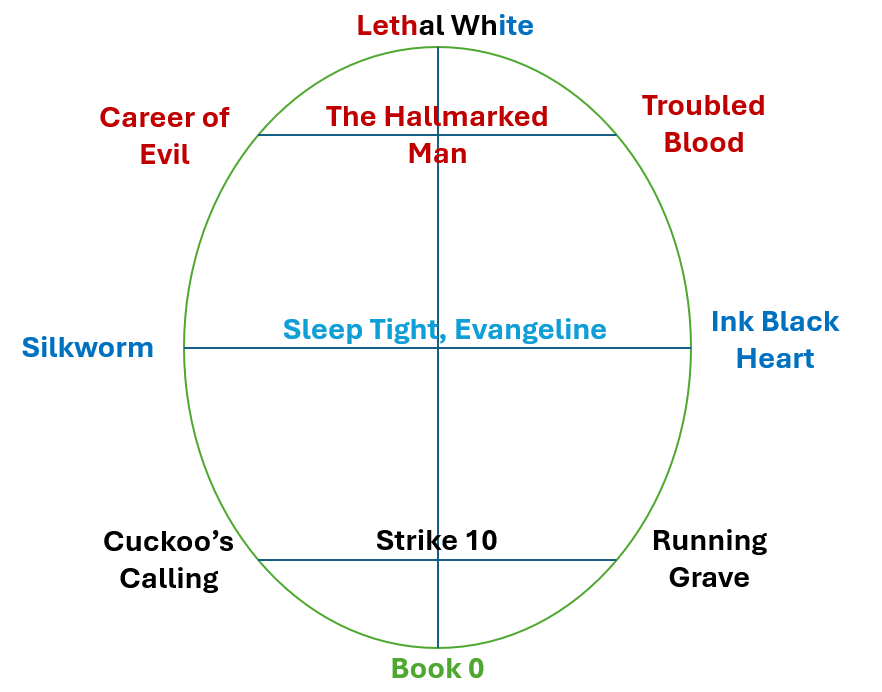
If Sleep Tight, Evangeline is as heavy in its echoing of Strikes 2 and 4 as Hallmarked Man was of 3 and 5, the Salem Cross embedded in the first of the last three books may be the series model (and a great guide for how the finale will play out?).
I think I enjoy this model, though, because it required splitting the latch of the Strike seven book ring to make the bottom bar of the Salem Cross. Cuckoo’s Calling and Running Grave, though, still have a host of parallels with Lethal White. When those connections are represented on the picture, a fun inversion of a beloved symbol turns up:
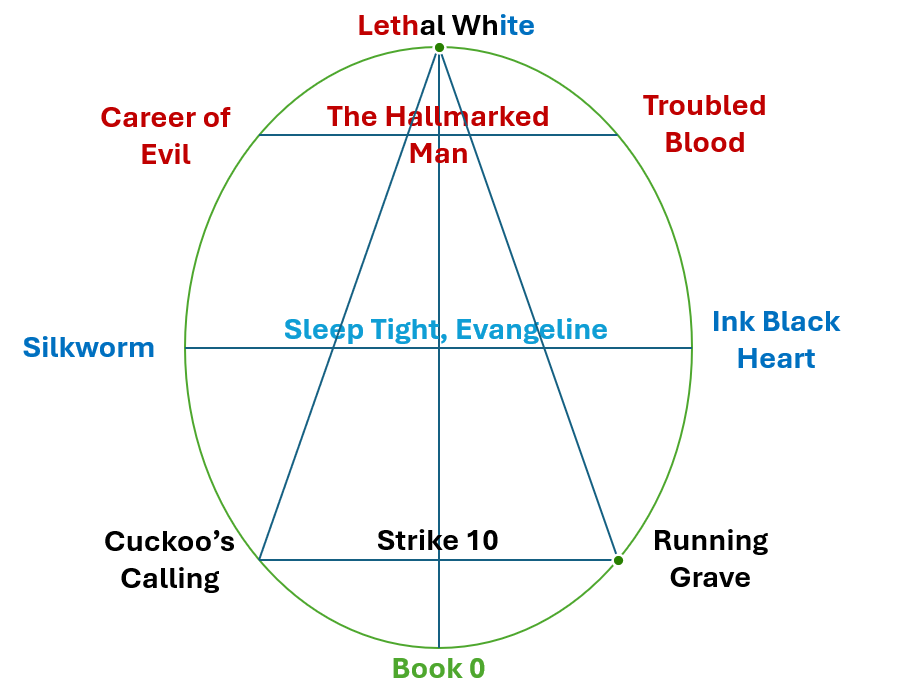
The Deathly Hallows symbol, you’ll recall, is a triangulated and bisected circle:
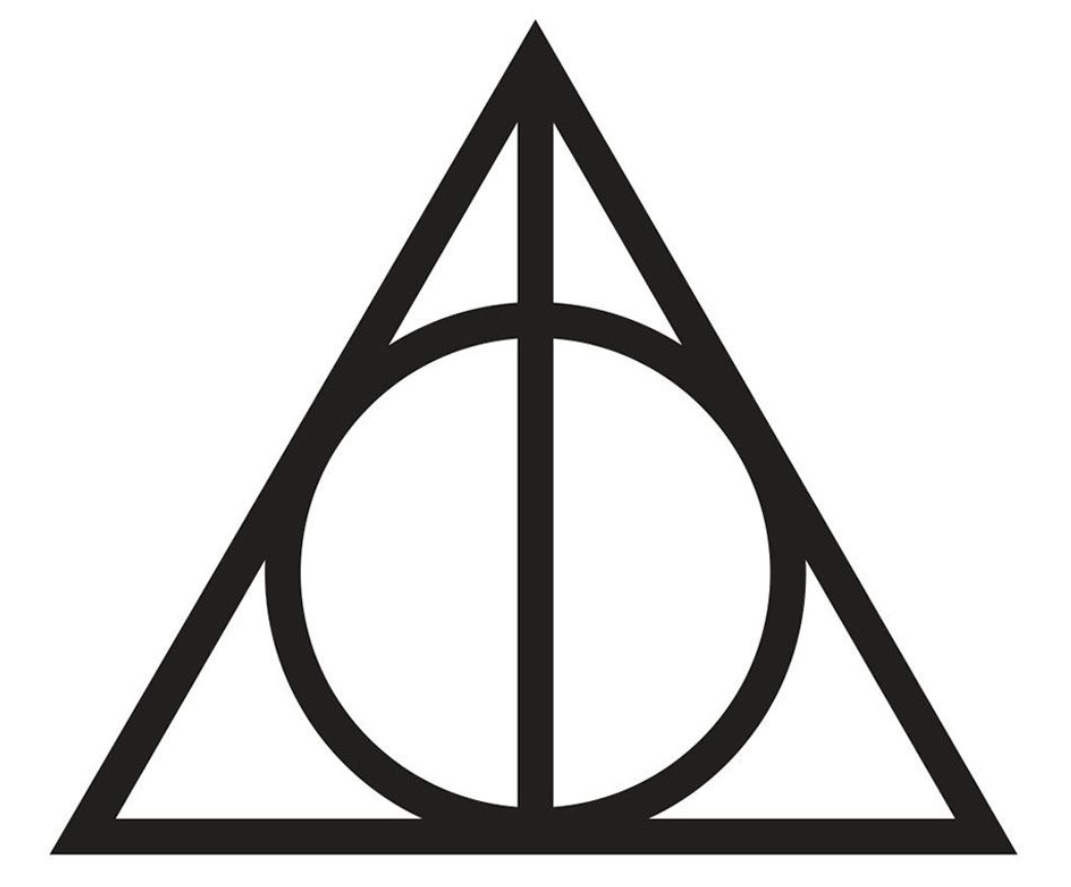
The Salem Cross series-shape model is a circumscribed and bisected triangle, an inversion or Fun House Mirror reflection of the Potter books’ most important single symbol.
So perhaps we will be seeing a lot more masonry (and crosses!) in the last two books? If so, we’ll be able to thank the letter ‘G',’ our Sesame Street sponsor and guide in this post, for pointing us to that titular hallmark on Tyler Powell’s back.
Conclusion
Our Paid Subscribers who read Ray Livingston’s The Traditional Theory of Literature know that there are, per A. K. Coomaraswamy, only two valid means of judging the value of a story: there is the Cultural Guardians ‘Gatekeeper’ position a la Socrates’ proscription of poetry in his ideal Republic on moral grounds and there is the gauging of the ratio of auctorial intention realized in the result, his or her written work.
I’ll be writing about the differences in these approaches in the coming months; the Children and Grandchildren of the OG Harry Haters have returned, now with AI tools and Social Media platforms to superpower their message delivery. I am obliged to share my thoughts about what they get right as well as where they go horribly wrong and descend into literary iconoclasm.
For today, though, I want to close with the relatively simple question: if Rowling’s intention in highlighting the letter ‘G’ in Hallmarked Man as she has was as I have argued to color the text with a particularly challenging patina of crucifixion and transformation in Christ, did it work? If the relatively esoteric symbolism of the Masonic ‘G’ and its several variants in Strike 8 was meant to communicate that potusturronost experience, is that what we got as readers?
It certainly doesn’t mean it didn’t work if readers didn’t understand that experience; the effect would have necessarily been subliminal or unconscious.
I think it did work.
Readers hated Hallmarked Man, said begrudgingly that it was a good book after repeated readings, but they that it was the worst of the series, no doubt about it.
I think it was the intention of the writer-artist to create the experience of death to self in love for another and to one’s vocation. That’s a painful crisis of soul, psychological catharsis and spiritual transformation, a confusing chrysalis. We get that via the letter ‘G’ coloration and its links to the Salem Cross carved into Tyler Powell, an experience Strike’s heroics mirrored in Ironbridge.
If you didn’t like it, that’s actually a measure of the book’s success. If you welcomed the purifying pain of empathy with fictional character in anagogical agony, you probably gave it much higher marks — without necessarily wanting to repeat the experience again right away. A close reading of its intricate structures, the rings within rings, however, certainly should have dispelled any idea that the novel was thoughtlessly put together.
Your mileage may vary, I understand. I look forward to reading your thoughts in the comment thread below and I’ll be posting my conversation with Nick about the letter ‘G’ later today. Thank you for subscribing and for your patience with our posting this last month; big things are in the works…
You know I think Albert Pike reconciles the tetractys and 7+3 model nicely
“TEN includes all the other numbers. It is especially seven and
three; and is called the number of perfection. Pythagoras represented
it by the TETRACTYS”
Much to think about and a lot of “light reading” with all the links…
Yes! The Salem Cross is certainly a symbolic reflection of the series structure. The juxtaposition of that symbol on Tyler's body with the alleged G mutilation is also I think a revealing one.
I think there's a case for a slight tweak to the augmented ring structure. If you look at the Salem Cross as composed of 10 lines, with each line representing one of the books. The first 7 books stay in more or less the same place, and then books 8 & 9 are on the spans of the vertical that sit between the cross-spars. The argument being that THM does have plenty of connections to Silkworm and Ink Black Heart, as well as COE and TB. On that hypothesis, STE will have correlations to TS and IBH, but also CC and TRG.
"Geometry" literally means "Earth measuring", which has some symbolic weight. It also has echoes of "geology" - which perhaps we see in the mining aspects of THM, which are very much a counterpart to the Masonic elements. "Geology" means the study of the Earth, but if we take the deeper roots of "ge" and "logos", it also means "the word of God".