
John Granger and family are well, and enjoying the Orthodox nativity and planning the herculean task of organising their life in a new state. In the meantime in the wake of the ‘Lake’ revelation that J. K. Rowling has a genetic blood condition, here is an overview of blood as a Golden Thread.
J. K. Rowling’s Harry Potter series is rich with Golden Threads, and few are as pervasive as blood. Blood operates on both literal and metaphorical levels, symbolising life, death, heritage, prejudice, sacrifice, and redemption. Primarily explored through the wizarding world’s obsession with blood status, it serves as a powerful allegory for real-world discrimination, while literal uses of blood underscore themes of morality and the consequences of defiling purity. Rowling weaves this theme throughout the seven novels, using it to critique bigotry and explore the essence of humanity.
This is not the first time that The Hogwarts Professor has explored this Golden Thread. In April 2020 as we waited for the release of Troubled Blood, John Granger and Elizabeth Baird Hardy was joined by Beatrice Groves on an episode of Reading Writing Rowling to discuss Troubled Blood and The Faerie Queene:
All right, folks, we’re going to get right to it. We have a title for the fifth Cormoran Strike book, Troubled Blood. But although the publisher promised we’d soon have a teaser about the book, we don’t have anything yet but the title. But as I said, that’s not going to stop us because we already have some theories. All right, so what are your first thoughts? I know, John, you’ve been thinking about this.
John: Okay, blood is a big deal in Harry Potter. Rowling uses the word 452 times in the series. And 315 times in the last three books. Love... In contrast, only merits 321 mentions across the entire thing. So if you think love is the theme, no, blood is the theme. Oftentimes, of course, it’s a reference to what flows in human veins, what’s built in conflict. But more interestingly, Rowling uses the word to highlight social position, so-called blood status or purity in blood. She uses it to describe our abilities and Think of Slughorn’s insistence that Harry’s potion skills must be in the blood. And to a degree, even our choices. Harry is fated to be the chosen one, not by the prophecy, we know, but by the choices, I put that in quotes there, choices he feels he has to make in light of his mother’s blood sacrifice. Blood, in other words, is a metaphor Rowling deploys to speak about human caste and polity, skills and achievement, and fate and free will. It’s her default conceit for almost everything she wants to talk about. It’s not much of a surprise, consequently, that a novel in the Corman Strike series has the title Troubled Blood because both the present series parallels Rowling’s first and because it’s very much a Rowling concern. Corman’s relationship with Charlotte largely founders on his low blood status in addition to her inbred volatility and dishonesty. His friend notes that he is popular with the thoroughbreds that love him just because they long for an infusion of his cart horse blood. My first thought then on learning that Strike Five was called Troubled Blood was that it must mean Charlotte is going to take center stage in the fifth book with her cartoonishly aristocratic husband, Jago Ross. But I’m looking forward to hearing what the others here think of the blood idea in J.K. Rowling.
John, what a start. That was so much more sophisticated than there’s always a murder in these books.
Well, what I want you to picture me as is going through each one of the books,
counting up the blood references. I have a friend who gave me a tool that I can do that now very easily. But it was fun to be able to say 452 blood references.
Beatrice: The magical blood isn’t there in both, and she’s come back to that with a blood pact. So that’s a new aspect of the importance of blood. I think in Harry Potter, she doesn’t play, the fact that Harry survives because Voldemort’s taken his blood is obviously present, but she doesn’t do that much with it. It stays as quite a sort of sotto voce explanation for his survival at the end. And she’s bringing blood more to the fore in Crimes of Grindelwald’s Blood Pact, I think. So it’s clearly something she’s carried on. This idea of magical power in the blood is something she hasn’t finished with yet. Obviously, it won’t be magical in Troubled Blood, but I just think it’s interesting that her post-potter work, she’s following blood up in these different ways.
Elizabeth: Yeah, I’m really interested in the idea that blood is connected with status, too, because, of course, that’s just a constant theme of the Cormoran Strike books, as you mentioned, too, there, John. So having that be articulated across the two series is interesting.
Beatrice: I’ve also, I’ve just been reading Dracula. What a great book for our time. I know, it seems like a slight, I started it before this began. And then obviously I’m now getting to grips with my to-do reading list rather more than I have been for a while. So I’m finishing it. And I was really struck in that, that the way it’s the, the way Dracula forces Mina to drink his blood. And when he does that, she then can see into his mind. So she has a scar on her forehead, very much like Harry’s scar, and it pains her. Similarly, when she sees it and when she sees into what Dracula is doing, she gets pain in that. So the way in which Harry can see into Voldemort’s mind is done via blood in Dracula. I thought that was very interesting.
Unlike Rowling’s Harry Potter series, where blood functions as a metaphorical and literal motif tied to heritage and prejudice, blood in Robert Galbraith’s works appears primarily in a literal, visceral sense, emblematic of the crime genre’s focus on violence, bodily harm, and mortality. It underscores themes of trauma, vulnerability, and the human cost of evil, while occasionally representing familial ties or heritage.
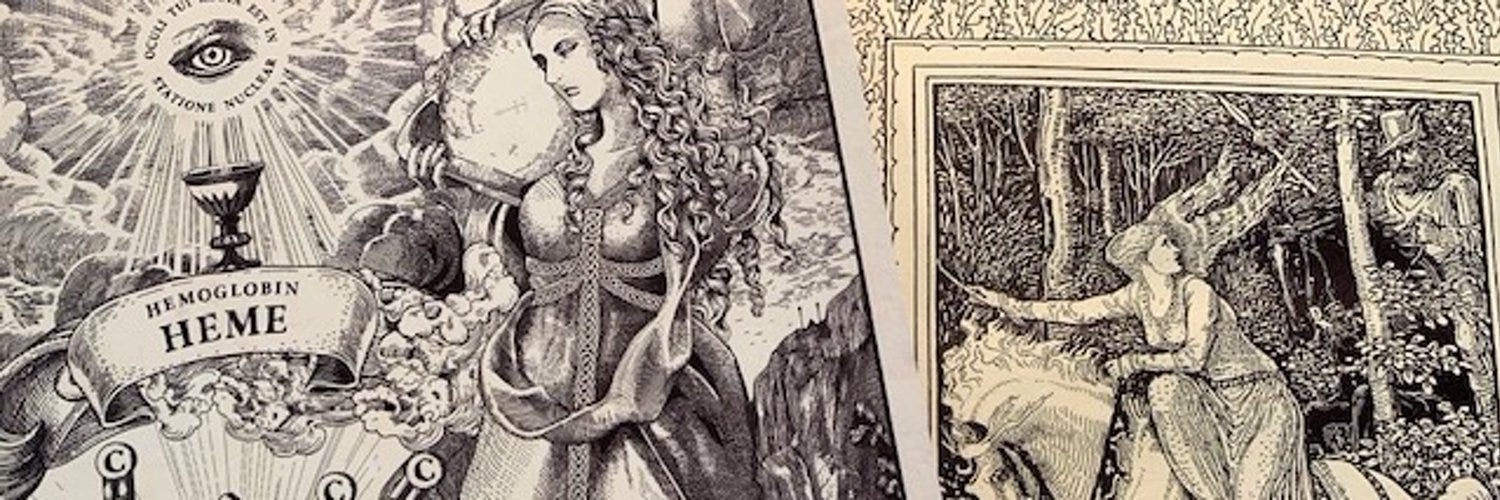
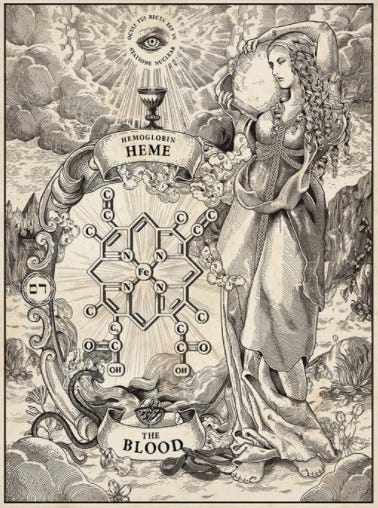
It is no small wonder that alongside the illustration from The Faerie Queen, Rowling chose to tease us with a stylised depiction of blood when she updated her Twitter Header.
Blood as Heritage and Prejudice: The Metaphorical Core
The most prominent use of blood in Potter is metaphorical, representing lineage and social hierarchy in the wizarding world. Wizards categorise themselves by blood purity: pure-bloods (no known Muggle ancestors), half-bloods (mixed magical and Muggle heritage), and Muggle-borns (born to non-magical parents). This system fuels deep-seated prejudice, embodied by antagonists like the Malfoys and Lord Voldemort, who champion pure-blood supremacy.
Pure-blood supremacists view Muggle-borns as inferior, using the slur “Mudblood” to imply “dirty blood.” Draco Malfoy’s use of this term against Hermione Granger in Harry Potter and the Chamber of Secrets highlights the casual racism embedded in wizarding society. Voldemort’s ideology drives the series’ central conflict: he seeks to eradicate Muggle-borns and enforce purity, mirroring historical prejudices like Nazi Aryan supremacy (Rowling has explicitly drawn this parallel, noting similarities to Nazi blood charts).
‘It’s about the most insulting thing he could think of,’ gasped Ron, coming back up. ‘Mudblood’s a really foul name for someone who was Muggle-born – you know, non-magic parents. There are some wizards – like Malfoy’s family – who think they’re better than everyone else because they’re what people call pure-blood.’
Chamber of Secrets Ch. 7
Ironically, many advocates of purity are not truly pure. Voldemort himself is a half-blood (son of a witch and a Muggle). Harry Potter is also a half-blood, with a pure-blood father and Muggle-born mother. This irony underscores Rowling’s message: blood purity is a fabricated construct. As Sirius Black notes, nearly all wizarding families have Muggle ancestry if traced far enough, rendering the obsession absurd and harmful.
Across the Cormoran Strike series, blood occasionally denotes lineage, though without the ideological weight of “blood purity.” Strike’s parentage—son of a famous musician and a tragic groupie—defines his outsider status, with “bad blood” implied in his dysfunctional family. In Lethal White, political scandals involve illegitimate children and blackmail, where blood relations expose hypocrisy. These instances portray blood ties as sources of conflict rather than supremacy, aligning with crime fiction’s interest in hidden family secrets fuelling murder.
Precisely what it was about him that attracted the type, Strike had never taken the time to consider, although Polworth, a man of many pithy theories, took the view that such women (‘nervy, overbred’) were subconsciously looking for what he called ‘carthorse blood’.
The Silkworm Ch. 13
Roy Phipps in Troubled Blood has an inherited blood disorder- von Wildebrads Disease. This is a genetic bleeding disorder that impairs the blood’s ability to clot properly. Roy’s health issues contribute to the novel’s themes of “troubled blood”—literal (his bleeding disorder and cancer) and metaphorical (family strife, inherited burdens, and emotional “bleeding” from loss).
Literal Blood: Life, Death, and Moral Consequences
Rowling complements the metaphorical with literal depictions of blood, often tied to sacrifice and immorality. Unicorn blood, introduced in Harry Potter and the Philosopher’s Stone, is silvery and life-sustaining but cursed: drinking it after slaying the pure creature grants “a half-life, a cursed life.” Voldemort, weakened after his failed attack on baby Harry, forces Quirrell to kill unicorns and drink their blood to survive. This act foreshadows Voldemort’s desperation and moral decay—prolonging life at the cost of purity leads to ruin.
The blood of a unicorn will keep you alive, even if you are an inch from death, but at a terrible price. You have slain something pure and defenceless to save yourself and you will have but a half life, a cursed life, from the moment the blood touches your lips.’
Philosopher’s Stone Ch. 15
Blood also features in rituals and protection. In Harry Potter and the Goblet of Fire, Peter Pettigrew uses Harry’s blood in a potion to resurrect Voldemort, inadvertently incorporating Lily Potter’s sacrificial protection: “blood of the enemy... forcibly taken” ties Voldemort to Harry’s life force, preventing him from fully harming Harry later. Lily’s willing sacrifice—her blood shed for love—creates ancient magic that shields Harry, contrasting Voldemort’s selfish use of blood.
Other instances reinforce blood’s duality: Snape’s invented spell Sectumsempra causes severe bleeding, symbolising his inner turmoil as the Half-Blood Prince; blood oaths (like Dumbledore and Grindelwald’s blood pact in the Fantastic Beasts films) bind magically through shared blood.
The Cormoran Strike novels are steeped in graphic depictions of violence, and blood serves as a recurring marker of physical brutality and death. In Career of Evil, a severed woman’s leg arrives at the agency in a package, drenched in blood and accompanied by a threatening note. This macabre delivery, sent by a killer from Strike’s past, sets off a chain of events involving dismemberment and murder. The bloodied limb symbolises not only the killer’s sadism but also Strike’s haunted history, as he recognises the sender’s fixation on amputation—a nod to his own prosthetic leg, lost in war.
Similar gore permeates other books. In The Silkworm, the victim Owen Quine is found eviscerated and posed in a grotesque tableau, his body hollowed out with acid burns and copious blood loss, evoking horror literature like Bombyx Mori, the fictional novel-within-the-novel. Blood here represents the literal spilling of secrets: Quine’s manuscript viciously satirises his acquaintances, and his murder is a vengeful act that leaves his life force drained.
These literal uses of blood ground the series in realism, contrasting the fantastical elements of Rowling’s earlier work. Blood is not magical but mundane and horrifying: it stains crime scenes, soaks clothing, and reminds characters (and readers) of the body’s fragility. Strike himself often bleeds—scrapes, wounds from fights—highlighting his battered physique and the toll of his profession.
Interconnections and Broader Implications
Rowling intertwines literal and metaphorical blood to deepen her themes. Voldemort’s use of unicorn blood mirrors his half-blood hypocrisy—he defiles purity while preaching it. Harry’s blood, infused with love’s sacrifice, becomes his greatest weapon, proving that true power lies in compassion, not lineage.
Perhaps the closest link to the Lake inspiration, beyond that of Roy Phipps’ von Willebrand Disease, occurs in Harry Potter and the Cursed Child. Astoria Greengrass, the wife of Draco Malfoy has an inherited blood curse, that ultimately caused her death.
DRACO We were capable of having children, but Astoria was frail. A blood malediction, a serious one. An ancestor was cursed . . . it showed up in her. You know how these things can resurface after generations . . .
In conclusion, blood in Rowling’s writings is a profound motif linking prejudice to moral corruption. Metaphorically, it exposes the folly of judging worth by heritage; literally, it illustrates the perils of violating innocence for personal gain. Through blood, Rowling delivers a timeless message: purity is not in ancestry, but in actions and heart. The series’ enduring appeal lies partly in this layered exploration, reminding readers that divisions based on “blood” ultimately weaken those who enforce them.
I've missed getting posts from you and John. Hope all is going well for both of you and your families. I love these exigetical posts!
In the wake of the revelation from Rowling, it's Sectumsempra that has been on my mind. With the twist that the wounds don't heal being a telling product from the pen of a writer with a bleeding disease.
Sectumsempra itself, and especially its appearance in HBP with Harry unwittingly inflicting far more trauma on Draco than he intended, is one of the most shocking things in the Hogwarts saga. It's a moment of real horror and darkness.